How to be a digital nomad in the US: a complete guide for Americans
Being a digital nomad in the US is legal, but your tax obligations, domicile state, and US address don't sort themselves out while you travel. Here's the complete setup: domicile, driver's license, banking, mail forwarding, health insurance, and taxes, in the right order.

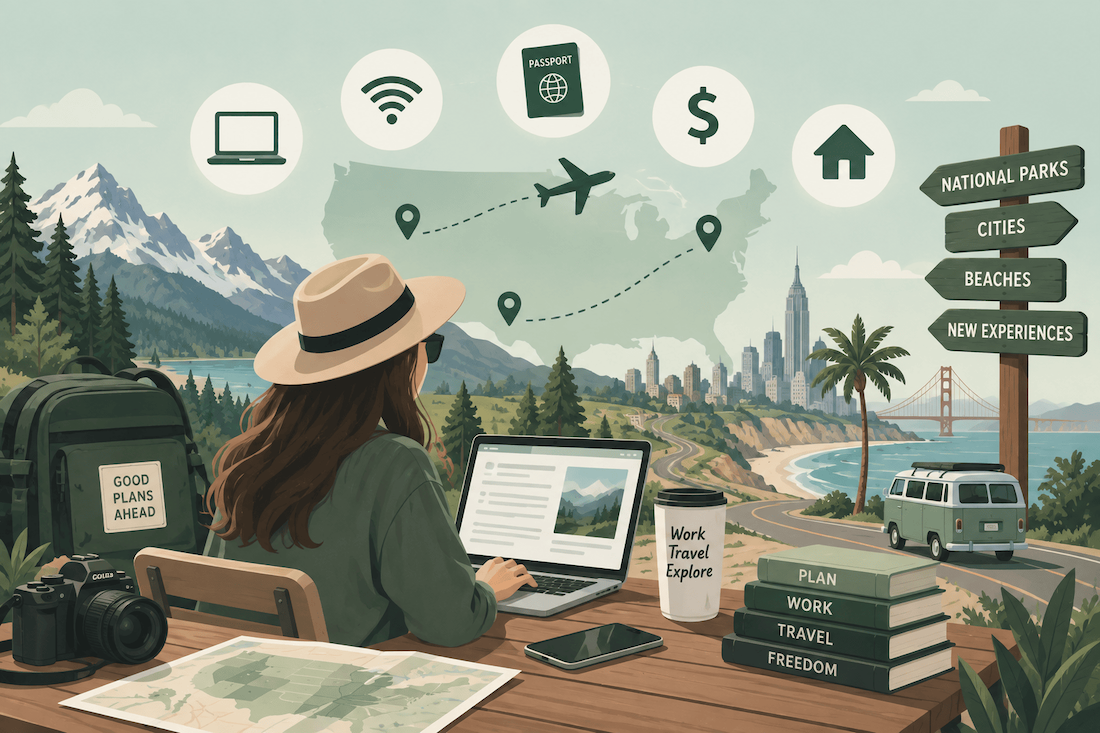
The digital nomad lifestyle is genuinely accessible for Americans. But it comes with US obligations that don't disappear just because you left. You still file US taxes. Your state of domicile can still tax your income. Your driver's license still needs to be current. Your bank still needs a US address on file.
Most nomad guides cover the fun parts: where to go, how to find WiFi, which coworking spaces to use. This guide covers what they skip: the US administrative infrastructure that makes the lifestyle sustainable long term, the tax obligations that don't go away, and the sequence experienced nomads actually follow before hitting the road.
Being a digital nomad in the US means working remotely while traveling, either within the US or internationally, without a fixed permanent address. For Americans, the lifestyle is legal. The complications are administrative, not legal. Every American has a domicile state that determines state tax obligations. That state can continue taxing worldwide income indefinitely unless you formally change your domicile. The right move before going nomadic: establish domicile in a no-income-tax state (Florida or Texas are the most accessible) and set up a US address, driver's license, bank account, and mail forwarding in that state. Federal taxes still apply regardless of where you live. US citizens file a federal return annually on worldwide income. For those spending 330 or more days abroad in a 12-month period, the Foreign Earned Income Exclusion ($132,900 for 2026) eliminates most or all federal income tax on earned income. Self-employment tax of 15.3% applies on top and is not covered by the FEIE.
What it actually means to be a digital nomad in the US
A digital nomad works remotely (typically online) while traveling rather than living in one fixed location. The work is location-independent. The location changes. That is the whole definition.
Two distinct groups of Americans live this way, with meaningfully different administrative challenges.
US-based nomads: full-time RVers, van lifers, and domestic travelers move continuously within the United States. No foreign visa is required. No FEIE eligibility. No FBAR. The main challenges are domicile state, US address, mail, and banking. The lifestyle is logistically complex but administratively simpler than international nomadism.
International nomads and expats: Americans who live and work primarily outside the US, face everything the US-based nomad faces, plus: foreign visa compliance in each country they enter, potential FEIE eligibility if they spend 330 or more days abroad, FBAR and FATCA reporting for foreign accounts, and foreign tax obligations depending on where they live. The tax picture is more complex; the tools available to manage it are also more powerful.
The core challenge for both groups is the same: the US administrative infrastructure does not maintain itself while you travel. A current driver's licence, a real US address on banking records, an active mail forwarding service, and a clearly established domicile state do not happen automatically. Building and maintaining them deliberately is what separates sustainable nomadism from a logistical mess two years in.
For a thorough treatment of the legal side, is being a digital nomad legal guide covers visa rules, tax obligations, and compliance risks in full.
Is being a digital nomad in the US legal?
Yes. US citizens can travel and work remotely within the United States indefinitely without any special permits or licences beyond what any employed or self-employed person needs. The lifestyle is legal.
The complications arise for international nomads. Working in a foreign country on a tourist visa, without a proper work visa or remote work visa, may violate that country's immigration rules. This is an immigration question for the destination country, not a US law question. Some countries have introduced digital nomad or remote work visas that explicitly authorize this; most countries technically prohibit working on a tourist entry. In practice, enforcement varies widely.
For US tax purposes, being nomadic does not reduce your obligations. It changes the tools available, specifically the FEIE for those abroad 330 or more days, but does not eliminate the requirement to file.
The remote work visa tax implications article covers what the visa situation means for your taxes in each country.
Your US home base: the 5 things every American nomad needs
This is the section most nomads underinvest in before leaving. Getting these five elements in place, in the right order, in the right state, is the difference between a sustainable nomadic lifestyle and a recurring administrative headache.
| Element | What It Requires | Why It Matters | Recommended Resource |
|---|---|---|---|
| Domicile State | Formal domicile change to a no-income-tax state before going nomadic | Determines state income tax obligation; old state can tax worldwide income indefinitely without a clean change | Florida or Texas domicile service |
| U.S. Address | Real street address in domicile state; non-CMRA for banking and DMV | Required by banks, IRS, DMV, and government agencies; CMRA-flagged addresses rejected for CIP and driver's licence | Virtual mailbox or domicile service in domicile state |
| Driver's Licence | Current licence issued by domicile state | Anchor document of domicile; required for banking, government agencies, and residency documentation | Florida DHSMV or Texas DPS in person |
| U.S. Bank Account | Active account with U.S. address on file | Income receipt, tax refunds, U.S. bills, international ATM access | Charles Schwab or Fidelity |
| Mail Forwarding | Service in domicile state that scans and forwards mail digitally | IRS notices, bank statements, and DMV renewals don't stop while you travel | Mail forwarding service in domicile state |
1. A domicile state
Every American legally has a domicile state, the state that considers them a resident for tax purposes. If you became nomadic without formally changing your domicile, your old state may still be taxing your worldwide income. California's Franchise Tax Board will pursue this. New York will pursue it. Oregon will pursue it. Moving does not end the claim; only a documented domicile change does.
The right move: establish domicile in a no-income-tax state before going nomadic. Florida and Texas are the two most accessible and most popular. Florida offers a formal Declaration of Domicile filed with the county clerk, a single notarised, publicly recorded document that anchors the domicile claim to a specific date. Texas files a Declaration of Domicile with the Aransas County Clerk and establishes domicile through the totality of facts: driver's license, voter registration, address records.
Best and worst domicile states for American nomads and expats guide covers the full comparison.
How to select the state of domicile blog post walks through the decision framework.
Florida residency requirements for tax purposes guide and Texas Residency: Benefits and Requirements guide cover the two most popular options in detail.
2. A US address
A US address is required for banking, IRS correspondence, driver's licence applications, voter registration, and financial institution compliance. Every institution needs an address on file. "I'm a nomad" is not a field in any bank's onboarding form.
For nomads, a virtual mailbox or domicile service provides a real street address in the chosen domicile state. The critical detail: the address must not be CMRA-flagged in the USPS database. Banks running Customer Identification Program checks and state DMVs reject CMRA-flagged addresses regardless of whether they look like real street addresses. Choosing a domicile service with a non-CMRA address avoids the most common banking and driver's licence friction.
Best mail forwarding services for American digital nomads guide covers the top providers.
How to maintain a US address while living abroad article explains the mechanics.
Physical address verification for US banks blog post explains what banks actually check for.
3. A current driver's licence
The driver's licence is the anchor document of domicile. It establishes which state considers you a resident, serves as the primary government-issued ID, and is required by banks, financial institutions, and government agencies. It must be current and issued by the domicile state.
A Florida or Texas licence is the standard for nomads who have established domicile in those states. Keeping an expired licence from a former state, or a licence from a state you no longer claim as domicile, undermines the domicile change and creates an immediate red flag in any residency audit.
Can a digital nomad get a US driver's licence article covers the process across all major nomad-friendly states.
4. A US bank account
Maintaining at least one active US bank account is essential for receiving income, paying US bills, accessing ATMs internationally, and maintaining financial infrastructure. Most US employers and clients pay to US accounts. The IRS issues refunds to US accounts. Social Security pays to US accounts.
Charles Schwab High Yield Investor Checking is the most widely recommended for nomads: it reimburses all ATM fees worldwide, charges no foreign transaction fees, and accepts a separate foreign mailing address for correspondence while keeping a US physical address for compliance. Fidelity offers similar benefits. Both are significantly more nomad-friendly than traditional brick-and-mortar banks, which are more likely to flag foreign activity and request updated address documentation.
For international nomads who open bank accounts in foreign countries: FBAR filing (FinCEN 114) is required if aggregate foreign account balances exceed $10,000 at any point during the year. This is separate from the tax return, filed with FinCEN, and carries significant penalties for non-compliance.
Best US banks for American expats guide covers the full banking comparison.
5. Mail forwarding
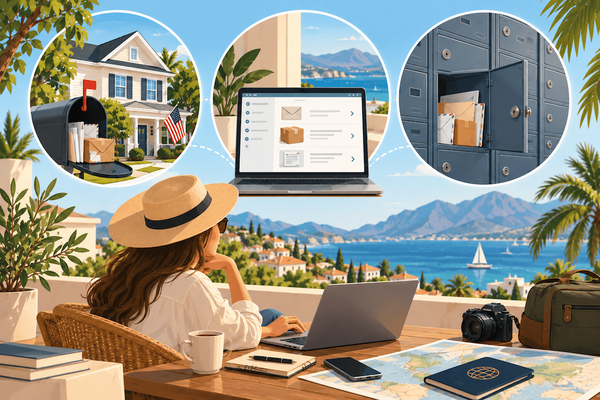
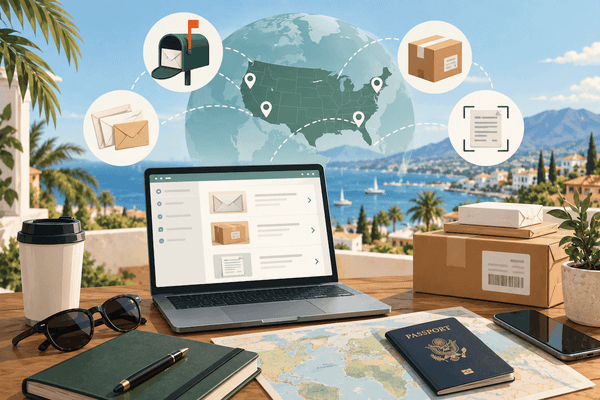
Physical mail still arrives at a US address: IRS notices, bank statements, DMV renewal reminders, Social Security documents, and anything else that government agencies and financial institutions send by post. A mail forwarding service receives this mail at the domicile-state address, scans it digitally, and delivers it to an app wherever you are. International forwarding sends physical items when needed.
The provider's address must be in the domicile state, using a Florida forwarding address while claiming Texas domicile creates an inconsistency that undermines the domicile claim across all records.
Taxes as an American digital nomad
Federal taxes: the filing obligation never goes away
US citizens and Green Card holders file federal taxes on worldwide income annually regardless of where they live. The obligation kicks in once income exceeds the standard filing threshold ($15,750 for single filers in 2025). The April 15 deadline applies; Americans abroad get an automatic extension to June 15, and a further extension to October 15 is available via Form 4868.
How to file taxes as a US citizen living abroad guide is the complete how-to guide for this annual obligation.
The FEIE — the biggest tax tool for international nomads
International nomads who spend 330 or more full days outside the US in any 12-month period qualify for the Physical Presence Test and can claim the Foreign Earned Income Exclusion. The FEIE excludes up to $132,900 of foreign earned income from US federal income tax for 2026. For nomads earning below this threshold, federal income tax owed is often $0.
The FEIE applies only to active earned income such as wages, self-employment income, and freelance income. It does not cover investment income, dividends, rental income, or capital gains. Those income types require the Foreign Tax Credit for double-taxation relief.
Foreign Earned Income Exclusion: the complete guide covers eligibility and mechanics. FEIE vs Foreign Tax Credit: which one to use article helps you choose the right tool for your income mix.
The self-employment tax trap
Self-employment tax runs at 15.3% on net SE earnings. The FEIE eliminates federal income tax on excluded income, it does not eliminate SE tax. A freelance nomad earning $80,000 abroad who claims the full FEIE pays $0 in federal income tax and approximately $11,304 in SE tax. Most freelancers who go nomadic discover this gap at tax time, not in advance.
Quarterly estimated tax payments using Form 1040-ES are required to cover SE tax obligations and avoid underpayment penalties. Remote work visa tax implications guide covers how the SE tax plays out across different country situations.
State taxes: domicile is what matters
State income tax obligations follow domicile, not physical presence. A nomad who is still legally domiciled in California owes California income tax at rates up to 13.3% on worldwide income regardless of where they live. New York applies similarly. Oregon runs at 9.9%. Moving abroad without formally changing domicile leaves the old state's claim fully intact.
The fix is the same as establishing the home base above: formally change domicile to a no-income-tax state before going nomadic. The driver's licence, voter registration, updated financial records, and consistent documentation all pointing to the new state end the former state's claim.
Do digital nomads pay state taxes article covers this in full. Stickiest states for US citizens guide ranks which states are hardest to leave. How to break state residency blog post is the step-by-step guide.
Banking and money as a nomad
Keep at least one US bank account active at all times. Income receipt, tax refunds, US bill payment, and most financial infrastructure run through a US account. A bank may close an account inactive for years or flag it as dormant; keep it active.
Charles Schwab and Fidelity are the two most nomad-friendly large US banks. Both reimburse ATM fees internationally, charge no foreign transaction fees, and accommodate the expat address situation more flexibly than traditional banks.
For currency conversion and international money transfers, Wise is the standard tool — significantly cheaper than bank wires for moving money between currencies. For international nomads who need local currency regularly, a local bank account or a multi-currency account through Wise or Revolut reduces conversion costs.
For international nomads with foreign bank accounts: FBAR is required if aggregate foreign account balances exceed $10,000 at any point during the year. FATCA Form 8938 applies if foreign financial assets exceed $200,000 at year-end or $300,000 at any point for expats living abroad. Both are information reporting requirements separate from the tax return, with significant penalties for non-compliance.
Health insurance for American nomads
The right health insurance depends on where you spend most of your time.
US-based nomads travelling primarily within the United States can use an ACA marketplace plan from the domicile state. Open enrollment runs each November for the following year. A Florida or Texas ACA plan covers care across the US network, useful for nomads who move between states frequently.
International nomads spending most of their time abroad need international health insurance. Most US domestic plans, ACA and employer plans alike, do not cover treatment outside the US except in emergencies. International health insurance (SafetyWing, Cigna Global, IMG Global) covers medical treatment in foreign countries and typically includes some level of emergency US coverage. SafetyWing starts at approximately $50/month and is the most popular budget option for nomads; Cigna Global provides more comprehensive coverage at higher price points.
The employer plan caveat: if your employer provides health coverage, verify explicitly whether it covers international treatment before assuming it works while nomadic. Most US employer plans do not.
Digital nomad health insurance: the 5 best options for Americans guide covers every option in detail.
The practical basics: accommodation, work, and connectivity
The administrative infrastructure matters most for sustainability. But the practical day-to-day setup matters too.
- Accommodation: Airbnb and Booking.com handle short stays. Furnished Finder connects nomads with mid-term furnished apartments (one to three months) at significantly lower rates than short-term platforms. Coliving spaces, Outsite, Selina, Remote Year, combine accommodation, coworking, and community. Housesitting platforms like TrustedHousesitters provide free accommodation in exchange for pet care.
- Coworking: WeWork and Regus operate globally. Local independent coworking spaces are usually cheaper and often better for regular use; Coworker.com aggregates them by city.
- Internet: local SIM cards are the most reliable solution in most countries — a local data plan is faster and cheaper than roaming. Airalo provides eSIMs for 190-plus countries, purchasable before arrival. Starlink covers remote locations where mobile coverage is unavailable.
- Time zone management: working with US clients from abroad requires intentional scheduling. Eastern time clients are most accessible from Europe; Southeast Asia creates the hardest overlap. World Time Buddy and Calendly with time zone detection handle the logistics.
Frequently asked questions
Do digital nomads pay US taxes?
Yes. US citizens and Green Card holders file federal taxes on worldwide income annually regardless of where they live. International nomads spending 330 or more days abroad may qualify for the FEIE ($132,900 for 2026), which eliminates most federal income tax on earned income. Self-employment tax (15.3%) applies on top and is not eliminated by the FEIE. How to file taxes as a US citizen living abroad
Can I be a digital nomad in the US as an American?
Yes. US citizens can travel and work remotely within the United States indefinitely without special permits. For international travel, the destination country's immigration rules apply. Working without a proper visa or work authorization in a foreign country may violate local law. Is being a digital nomad legal?
What state should I use as my domicile?
Florida and Texas are the two most popular choices — both have no state income tax, no estate tax, and established infrastructure for nomads. Florida's Declaration of Domicile creates the strongest documented paper trail. Texas works particularly well for people with existing Texas employer or family connections. How to select the state of domicile
What is the best bank for American nomads?
Charles Schwab High Yield Investor Checking is the most widely recommended, worldwide ATM fee reimbursement, no foreign transaction fees, and the most flexible address policies. Fidelity offers similar benefits.
Do I need health insurance as a nomad?
Yes, the right type depends on where you spend most of your time. US-based nomads can use an ACA marketplace plan. International nomads need international health insurance since most US plans do not cover treatment abroad.
How do I receive mail as a digital nomad?
A virtual mailbox or domicile service in your domicile state provides a real street address. The service receives mail, scans it digitally, and delivers it to an app. You can forward physical items internationally when needed. The address must be in the domicile state and not CMRA-flagged for banking and DMV purposes.
Conclusion
Being an American digital nomad is legal, increasingly well-supported, and financially viable, especially with the right domicile state eliminating state income tax and the FEIE eliminating most federal income tax for those abroad. The lifestyle rewards deliberate setup and punishes assumptions.
The sequence that works: establish no-income-tax domicile before going nomadic, get the driver's licence in that state, set up the address and mail forwarding, open the right bank accounts, get health insurance sorted. Then travel.
SavvyNomad handles the domicile setup for Florida and Texas, the residential address, the Declaration of Domicile, the driver's licence support, and the ongoing mail forwarding that keeps the US home base functioning while you live anywhere.