5 Best US banks for American expats living abroad


Living abroad opens up exciting opportunities but can also come with unexpected challenges—especially when it comes to managing your finances. For American expats, finding a bank that meets your unique needs while staying compliant with U.S. regulations is key to maintaining a US bank account. Maintaining US financial accounts is also crucial to ensure compliance with regulations and proper management of assets while living abroad.
Often, expats face roadblocks like high ATM fees, account freezes, and limited access to international branches. Another big issue? Meeting the residential address requirements needed for banking and legal purposes.
In this article, we’ll explore the best bank options for American expats and provide tips on maintaining a U.S. residential address abroad.
Key considerations for choosing expat-friendly banks
When you’re abroad, the right bank can make all the difference in keeping your finances simple and accessible. Here are a few things to look for:
ATM accessibility and foreign transaction fees
Some banks offer free ATM access worldwide, while others charge each time you withdraw, especially for foreign ATM withdrawals. Look for banks that either have low international fees or reimburse ATM fees, so you’re not losing money with every withdrawal.
Multi-currency support and multi-currency accounts
Multi-currency accounts can be a lifesaver, especially if you’re earning in one currency but spending in another. Banks that support multiple currencies or provide competitive exchange rates can help you avoid expensive conversion fees.
Global reach, online banking, and customer support
Global banking often means needing assistance at odd hours. Some banks specialize in international service with 24/7 support, making it easier to solve issues without waiting days for a response.
Patriot Act compliance
The Patriot Act led to Customer Identification Program (CIP) rules that require banks to verify each customer’s identity, including a physical address, as part of their anti-money-laundering programs.
Many banks will not accept CMRA (Commercial Mail Receiving Agency) addresses—such as typical mail-forwarding services—to satisfy their CIP “residential address” requirement. Instead, they usually require a verifiable residential street address (or a permitted alternative such as a U.S. military or APO/FPO address), so it’s essential to have a realistic plan for meeting this requirement.

5 best banks for American expats
HSBC Expat
HSBC's global presence across more than 60 countries makes it a convenient option for expats who move frequently or need in-person banking across Asia, Europe, and the Middle East. Their Global View and Global Transfer services make moving money between HSBC accounts in different countries straightforward, and the account supports multiple currencies, including USD, EUR, and GBP.
However, HSBC Expat comes with strict eligibility requirements that many expats won't meet. To qualify, you need to save or invest at least £75,000 with HSBC Expat within three months of opening, have an annual salary of at least £120,000 paid into the account, or already be an HSBC Premier customer in another country. If you don't meet these thresholds, you may not be eligible at all.
It's also worth noting that the HSBC Expat account is held in Jersey, Channel Islands—an offshore jurisdiction—rather than being a traditional U.S.-based bank account. While accounts are available in USD, the structure differs from that of a domestic U.S. bank, and U.S. ACH capabilities are limited. HSBC Expat is best suited to high-income expats or those with significant savings who prioritize global reach and in-person branch access.
Citibank
With one of the most extensive international networks among U.S. banks, Citibank operates in over 40 countries and is well-equipped for expats who want a traditional banking relationship with global reach. Its Citi International Personal Bank product offers multi-currency account options and free transfers between Citibank accounts worldwide through Citibank Global Transfers, which can be a real plus if you have family or business ties back home.
However, the most valuable international perks—including ATM fee rebates and foreign transaction fee waivers—are generally tied to the CitiGold tier, which requires a minimum combined balance of $200,000. Standard accounts come with monthly fees and fewer international benefits. Citibank has also been reducing its physical presence in some countries in recent years, so it's worth confirming branch and ATM availability in your specific location before opening an account.
Citibank is best suited to high-net-worth expats who need in-person banking access across multiple countries and frequently transfer funds cross-border.

Charles Schwab Bank
Charles Schwab is widely regarded as one of the most practical options for American expatriates, digital nomads, and frequent international travelers. Schwab accounts have no monthly maintenance fees, no foreign transaction fees, and offer unlimited worldwide ATM fee rebates—allowing you to withdraw cash almost anywhere without worrying about extra charges.
One important update for 2026: Schwab dropped its $25,000 minimum deposit requirement for international accounts in 2025, making them more accessible than before.
That said, important differences apply depending on whether you use a domestic U.S. or international (non-U.S.) residential address. When a client updates their address to an international residence, Schwab typically converts the account to international status through Schwab International. This transition keeps core benefits in place but introduces some limitations:
- Account access and eligibility: Americans abroad must apply through Schwab International, providing additional documentation such as a passport and proof of foreign residence (e.g., a utility bill). Schwab does not support all countries due to regulatory restrictions; clients in unsupported countries may face account restrictions or lose access entirely.
- Investment restrictions: Once marked as an international client, purchasing new U.S. mutual funds or CDs becomes restricted. You can typically retain existing investments but cannot add to mutual funds or CDs. Stocks and ETFs remain accessible, though EU and UK residents face additional limitations under MiFID II regulations, which block certain U.S.-based ETFs and funds.
- Bank accounts vs. brokerage accounts: International users may have Schwab Bank checking and savings accounts closed when they relocate abroad. Cash management typically shifts to the Schwab One International Brokerage Account, which provides similar functionality (debit card, check-writing) but is protected by SIPC rather than FDIC.
- International wire transfers: Schwab Bank does not directly offer international wire transfers, but Schwab's international customer support can facilitate wires through the brokerage account—typically at competitive rates, with a standard $25 fee per wire (waived once per month for clients with over $100,000 in assets).
- Support services: Schwab offers online and phone support for expats through a dedicated international team available 24/5. There are no physical international branches, so all interactions happen digitally or by phone.
Overall, Schwab remains one of the strongest choices for expatriates and digital nomads due to its low-fee structure, international ATM rebates, and solid support tailored to Americans abroad. The main limitations relate to regulatory constraints on investments, possible bank account closures upon moving abroad, and the absence of overseas branches.
Wise (formerly TransferWise)
Wise is known for its low-cost international transfers and multi-currency accounts, built specifically for people with cross-border financial needs. Their app is user-friendly, with transparent exchange rates close to the mid-market rate—avoiding the hidden markups often embedded in traditional bank transfers.
It's important to understand that Wise is not a traditional bank. It doesn't offer loans or full-service checking, so it works best as a complementary account alongside a primary U.S. bank. In the U.S., Wise operates as a money services business rather than an FDIC-insured bank, although certain balances may carry pass-through FDIC protection depending on the features you opt into. Check Wise's current terms for the specifics of deposit protection.
Revolut
Revolut is a digital-first financial platform offering multi-currency accounts, real-time exchange rates, and budgeting tools—useful for expats who want flexible, app-based banking across currencies. The platform is intuitive, with strong tools for managing spending in multiple currencies simultaneously.
Important 2026 update: Revolut filed an application with the U.S. Office of the Comptroller of the Currency (OCC) and the FDIC in March 2026 to establish "Revolut Bank US, N.A."—a full national bank charter. If approved, this would allow Revolut to offer directly FDIC-insured deposit accounts, gain access to U.S. payment networks like ACH and Fedwire, and launch new products including checking accounts, high-yield savings, and credit products. The approval process typically takes 12–18 months, so the full banking product is not yet available.
For now, Revolut continues to operate in the U.S. through a partnership with Lead Bank, with customer deposits receiving pass-through FDIC insurance up to standard limits through that partner arrangement. Revolut also does not currently have physical branches in the U.S., and customer support availability has been an inconsistent point for some users.
Revolut is best suited as a supplementary account for expats who need flexible multi-currency tools and low-cost transfers, rather than a primary banking relationship.
Checking accounts: features to look for
When selecting a checking account as an expat, there are several features to look for:
- Online banking: Look for banks that offer online banking services that allow you to manage your account, pay bills, and transfer funds from anywhere in the world.
- Mobile banking: A mobile banking app can be a convenient way to manage your account on the go.
- Low fees: Look for banks that offer low or no fees for services such as ATM withdrawals, foreign transactions, and account maintenance.
- Multi-currency accounts: If you need to manage multiple currencies, look for banks that offer multi-currency accounts that allow you to hold and manage funds in different currencies.
- US address: Many banks require a U.S. residential street address to open an account. Some may let you list a separate mailing address (including a mail-forwarding service) for correspondence, but they still rely on a verifiable residential address for CIP/KYC purposes. Always check a bank’s specific address rules and don’t assume a virtual mailbox or CMRA address alone will be acceptable.
By considering these features and challenges, expats can choose a US bank that meets their needs and provides the services they require to manage their finances effectively.
Maintaining a U.S. residential address for banking needs while abroad
For expats, choosing the right bank is only part of the equation; having a verifiable U.S. residential address is often essential for meeting financial institutions’ CIP and KYC requirements. However, many expats face obstacles, as traditional mail-forwarding addresses (often flagged as CMRA) are frequently not accepted by banks for legal and financial purposes.
Here are the best ways to maintain a compliant U.S. address:
Domicile services and maintaining a US address
Companies like SavvyNomad offer a bona fide residential U.S. street address in a tax-friendly state (e.g., Florida) and help you organize documentation, form filing, and proof-of-address packets that many financial institutions look for. The address is provided for documentary and correspondence purposes; actual acceptance always depends on each bank or broker’s own CIP/KYC policies and can change over time.
Using a residential-address or domicile service in a state with no personal income tax, such as Florida, can create administrative advantages—like having a consistent address for legal records, banking, and ID documents—but it doesn’t by itself create tax savings or guarantee that any particular institution, agency, or court will treat you as a resident.
This option can work very well for expats who need reliable, long-term address solutions to support banking and legal documentation. Eligibility for voting, state tax treatment and other residency-based benefits still depends on meeting the underlying legal rules of that state, not just on having an address.

Friend or family member’s address
While this option may seem easy and affordable, it often lacks the necessary documentation to serve as valid proof of residence for banks or legal needs. Relying on friends or family also involves inconveniences for both parties, as they may need to manage your mail, forward items, or verify your address details upon request.
Virtual mailbox services
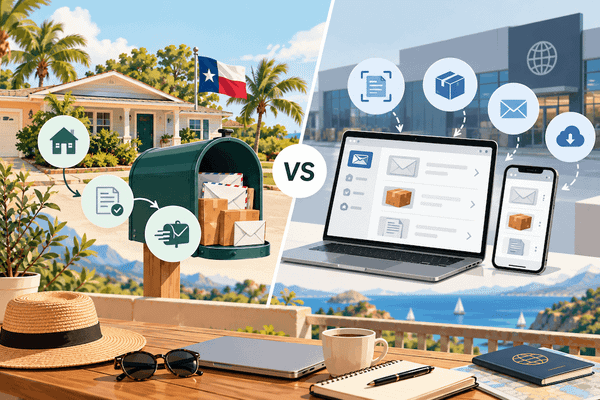
Virtual mailbox services allow expats to manage mail online through scanning and forwarding. However, most virtual addresses are flagged as CMRA addresses and, therefore, unsuitable for banking, legal, or financial purposes. While convenient for basic mail, this option cannot provide the official documentation required by banks.
 Jameson Rader