Florida residency requirements for tax purposes: 2026 checklist
Florida has no 183-day requirement, so that test belongs to the state you're leaving. Establishing Florida residency for tax purposes means satisfying Florida's checklist and convincing your former state the move was real. Here's exactly what both require in 2026.

Most people preparing to establish Florida residency for tax purposes spend their time counting Florida days. That's the wrong number to track.
Florida does not require you to spend any minimum number of days in-state. The 183-day rule belongs to your former state: it is their test for whether you ever truly left, not Florida's test for whether you arrived. Florida has no state income tax to enforce and no audit division scrutinizing residency claims. The hard part isn't satisfying Florida. The hard part is convincing the state you left that the move was real.
This is the complete 2026 checklist for establishing Florida residency for tax purposes, what Florida actually requires, what your former state will look for if it challenges your move, and the mistakes that leave an otherwise clean residency legally vulnerable.
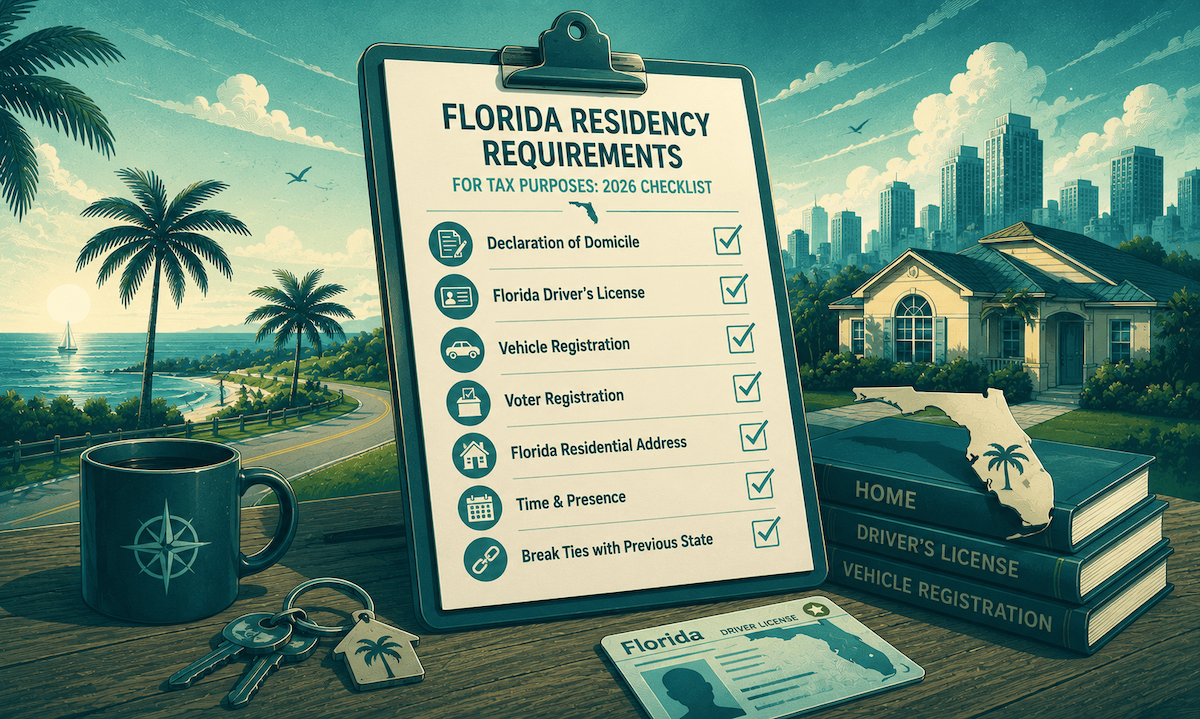
Florida has no minimum day-count and no waiting period, domicile begins the moment you genuinely make Florida your permanent home and can prove it. The 183-day rule is a former-state concept: New York, California, New Jersey, and similar states use it to determine whether a departing resident still owes them tax, not Florida's threshold for anything. The Florida-side checklist has four core items: Declaration of Domicile, Florida driver's license (required within 30 days of establishing residency), vehicle registration, and a Florida mailing address: all of which are updated consistently across all financial and government records. The former-state checklist is equally important: eliminating access to former-state housing, severing financial ties, and filing a final part-year return. The first two to three years are the highest-risk audit window. Track your days in the former state. Not your days in Florida.
What Florida residency for tax purposes actually means
Florida domicile is your one permanent home. Florida residency is program-specific and attaches to particular benefits. A person can be domiciled in Florida and still count as a resident somewhere else for a narrow purpose, the overlap that produces dual-taxation disputes.
Three Florida residency timelines create most of the confusion:
- For tax purposes: no waiting period, no day count. Florida domicile begins when you make Florida your permanent home with the intent to stay and take the actions that prove it. The legal standard is intent plus substantive ties, codified in Florida Statute §222.17 (Declaration of Domicile) and §322.031 (driver's license).
- For driver's license purposes: Florida Statute §322.031 requires a Florida driver's license within 30 days of establishing residency. This is a hard legal deadline, not a suggestion.
- For in-state tuition, 12 consecutive months of Florida domicile before classes begin. Not relevant to most SavvyNomad readers, but worth knowing to avoid confusion when researching Florida residency rules online.
The most important distinction to carry through everything that follows: the six-month concept comes from tax law used by departure states, not from Florida residency rules. Florida imposes no state income tax, but states like New York, New Jersey, California, and Illinois actively audit former residents who claim to have relocated. Florida has no interest in verifying your residency. Your former state does.
The Florida-side checklist 2026
Every item below exists to create dated, consistent, cross-referenceable evidence that Florida is your genuine permanent home. Florida residency is proved by facts, and the facts are records.
File a Declaration of Domicile
The Declaration of Domicile, filed under Florida Statute §222.17 with the county clerk in your Florida county, is a formal, notarized statement that you have abandoned any prior domicile and intend to make Florida your permanent home. It typically costs $10–$15 in filing fees and creates a dated public record of when you declared Florida your domicile. This is Exhibit A in any residency dispute with a former state.
One critical point: a recorded Declaration of Domicile states the intention, but a Declaration unsupported by actually living in Florida does not establish domicile on its own. Domicile requires both the intention to make Florida home and the overt act of residence behind it. The Declaration is necessary but not sufficient. It must be accompanied by the other checklist items.
For expats and nomads who haven't yet made their Florida trip: under Florida Statute §117.295, the Declaration can be notarised remotely via Florida's Remote Online Notarisation (RON) process. This means you can establish the dated record before arriving, reducing what needs to be completed in person.
Declaration of Domicile in Florida
Obtain a Florida driver's licence
Florida Statute §322.031 requires a Florida driver's licence within 30 days of establishing residency. This is the deadline most people either don't know about or treat as flexible. A long delay between the declared move date and the actual licence issuance gives a prior-state auditor a documentary gap to ask about, and it is the easiest mistake to avoid.
Book your DMV appointment as early as possible, ideally before your Florida trip begins. Wait times vary significantly by county and time of year. For expats and people without a permanent Florida street address, Florida accommodates non-standard address situations, a registered mail forwarding address can satisfy the address requirement at the DMV.
Florida driver's licence without a permanent address
Register your vehicle in Florida
If you own a US vehicle, register it in Florida and obtain a Florida licence plate. A car still registered in your former state is a direct signal to auditors that the old state remains your primary home. Vehicle registration is one of the first records that departure-state auditors request.
For expats who don't own a vehicle: this item doesn't apply, but if you ever do own one, register it in Florida.
Florida vehicle registration while living abroad
Voter registration in Florida (if eligible)
If you are eligible, you may register to vote in Florida. Voter registration can be one supporting indicator of domicile, but it is not determinative on its own. SavvyNomad does not determine voter eligibility or whether a given address qualifies as your legal residence for voting. Confirm your eligibility and the correct residence address with the applicable Supervisor of Elections before registering. If you already have a voter registration in another state, confirm with the applicable election authorities whether and how that record should be updated or cancelled.
Establish a Florida mailing address
A real Florida street address (not a PO box) that receives your government mail, IRS correspondence, financial statements, and official documents. This address must be consistent across every institution simultaneously. Inconsistency is what auditors look for: one account still pointing to a New York address two years after your claimed move date is the kind of detail that triggers follow-up questions.
For expats: a Florida mail forwarding service with a real street address (not a virtual PO box) satisfies the DMV and government document requirements and handles international forwarding. This is the address that should appear on every document going forward.
Best mail forwarding services in Florida
How to maintain a US address while living abroad
Update financial and legal records
File IRS Form 8822 to update your address with the IRS: this is separate from your tax return and must be done explicitly. Then update systematically: banks, investment accounts, brokerage accounts, credit cards, insurance policies, payroll, employer records, and any professional licences.
Estate planning documents deserve specific attention. Florida law requires the personal representative of an estate to be a Florida resident unless bonded, a will drafted before your move may name an executor who no longer qualifies under Florida law. Have a Florida attorney review your will, trusts, and power of attorney.
How to inform the IRS about a new domicile
Update healthcare providers
Move your primary doctors, dentists, and other regular healthcare providers to Florida-based practices where practical. Healthcare provider location is an explicit audit factor in New York's BINTS residency framework (Business, Income, Near and dear items, Time, Stuff) and in California's closest-contacts analysis. It's not the first thing auditors look at, but in a close case it matters.
Not always immediately possible, document the transition plan if you can't change providers in the first months.
Establish Florida community ties
Join Florida-based organizations, transfer club or religious memberships to Florida chapters, open a Florida bank account or branch relationship. State you are a Florida resident in business transactions, charitable activities, and when registering at hotels or events. These are the softer factors auditors examine last, but they can tip a close case, and they cost nothing to address.
The former-state checklist: the half most people skip
Most of the residency confusion comes from one mismatch: Florida sets no day count to satisfy, but the state you left still applies its own. People who move to Florida tend to chase a Florida threshold that does not exist, while ignoring the New York or California test that still applies to them as departing residents.
Stay under 183 days in your former state
For New York and New Jersey: maintaining a permanent place of abode and spending more than 183 days in-state triggers statutory residency regardless of your Florida domicile, you can owe full state income tax in both states for the same year. For California: exceeding 183 days eliminates the safe harbour presumption and opens a totality-of-contacts review.
The day-counting rules are strict: partial days count as full days; travel days count; any presence in the state can count depending on the state's rules. Track this contemporaneously, a calendar reconciled against credit card records, phone location data, and toll records. Reconstructing day counts after an audit notice is far harder than maintaining them in real time.
The practical target: spend the majority of your days in Florida or outside the US, and stay clearly under 183 days in any former state. For expats living abroad, this is usually straightforward, the challenge is the former-state ties, not the day count.
Eliminate or relinquish housing in the former state
The home comparison carries particular weight in New York audits: if the New York residence is larger, more valuable, and better furnished than the Florida home, auditors treat that as strong evidence that New York remains the primary home regardless of stated intentions.
Selling the former-state property is the cleanest solution. Renting it to an unrelated party at market rate is the next best option. Retaining personal access to it, even informally, is the highest-risk position in any residency dispute. If you keep former-state property: declare it a secondary or vacation property on insurance policies, document that your Florida home is your primary residence by size and furnishings, and consider placing it in a trust or LLC.
Update all former-state records
Surrender or let lapse your former-state driver's licence. Update or transfer professional licences. Stop using a former-state address on any official, banking, or government correspondence, permanently and completely. If you are eligible, confirm with the applicable election authorities whether and how an existing registration should be updated or cancelled.
File a final or part-year return in the former state
File a final resident return, or a part-year return for the year of departure, in your former state. The return should clearly reflect the departure date. An abrupt change from resident to non-resident filing without a clearly documented transition year raises questions most departure states will want answered.
Stickiest states for US citizens ranked
What a tax auditor actually looks for
The first two to three years are the highest-risk audit window for residency challenges. This is when departure states are most likely to initiate review, and when the gap between your declared move date and your actual behaviour is most visible.
New York's Department of Taxation and Finance uses the BINTS framework: Business, Income, Near and dear items, Time, and Stuff, to evaluate whether a taxpayer truly abandoned New York domicile. No single factor is automatically decisive, but auditors focus on whichever most strongly supports continued New York domicile.
California's Franchise Tax Board applies a closest-connections test: a former resident can spend zero days in California and still be treated as a California domiciliary. If their closest connections like home, family, business, professional services, banking, vehicle registration, voter registration point to California.
The evidence of departure actually includes: credit card statements showing the locations of purchases, cell phone location data, EZ-Pass and toll records, airline records, social media check-ins, calendar entries, and utility usage patterns. None of this is speculative, these are the documented tools of residency audit practice.
The asymmetry worth repeating: Florida will never audit your residency. Only your former state will. Every item on both checklists above exists to answer one question convincingly: did you genuinely make Florida your permanent home?
One SavvyNomad client, an IT Chief who had been managing US state requirements from overseas, described what it felt like before getting the full setup right:
"Managing state requirements from thousands of miles away can feel like trying to solve a puzzle without all the pieces. There was always a lingering uncertainty in the background. After transitioning with SavvyNomad, that stress disappeared."
What to expect in a residency audit
Common mistakes that leave Florida residency legally vulnerable
- Waiting months to get the Florida driver's licence. Florida Statute §322.031 requires it within 30 days. A gap between your declared move date and your licence date is an audit-ready inconsistency. Fix: book the DMV appointment before you arrive in Florida.
- Keeping a home available for personal use in the former state. This is the single most common reason a residency claim fails. Fix: sell, rent to an unrelated party, or formally convert to investment property. Do not retain personal access.
- Tracking Florida days instead of former-state days. Florida has no day-count threshold. Your former state does. Fix: keep a contemporaneous travel log reconciled to credit card and phone records.
- Voting absentee in former-state elections. Voter rolls are public records that auditors use routinely. Fix: confirm with the applicable election authorities whether and how an existing registration should be updated or cancelled.
- Filing a Declaration of Domicile without the other supporting steps. A Declaration unsupported by actually living in Florida does not establish domicile. Fix: the Declaration should be one item in a package completed within the same short window, not a standalone step taken months before or after everything else.
- Leaving financial accounts pointing to the former state. If bank statements, investment accounts, and insurance policies all still show a New York or California address a year after your claimed move date, auditors will notice. Fix: update everything systematically in the same period as the driver's licence.
- Not filing a final or part-year return in the former state. An abrupt jump to non-resident filing without a clear transition-year return raises questions. Fix: file the part-year resident return for the year of departure with the departure date clearly reflected.
Florida residency requirements for specific situations
Expats and people living abroad
Because expats are living primarily outside the US, they're less likely to trigger residency elsewhere under typical 183-day tests in high-tax states. That makes Florida a very attractive domicile option.
The main practical challenge is completing the in-person requirements: the Florida driver's licence requires a DMV visit, and the county clerk requires physical presence for some Declaration filings (though RON handles this remotely). The solution is a focused Florida trip — Declaration, DMV, banking, and any other in-person items compressed into one visit.
One client who had lived in Croatia for over four years described what working through the process looked like:
"I haven't been in the US for over four years and Jameson got on the call with me and answered every question I had. He was there answering all my emails along the way over the months until I was ready to actually make it to Florida and get my new residency. Once I got there, everything was set up so that it was as smooth as possible."
How to become a Florida resident without living there
Digital nomads without a fixed address
Florida accommodates non-standard address situations better than most states. A registered mail forwarding service with a real street address — not a virtual PO box — satisfies the DMV and government document requirements. The key is using that one Florida address consistently across every institution from day one.
Florida driver's licence without a permanent address
Virtual mailbox vs mail forwarding
People who retain property in a former state
Retaining former-state property is the highest audit-risk factor in a residency challenge. If you keep it: rent it to an unrelated third party at market rate, declare it a secondary or vacation property on insurance, and document clearly that your Florida home is your primary residence by size, furnishings, and time spent. If the former-state property is larger and better-appointed than your Florida home, that comparison will work against you.
Selling US real estate as an expat
Frequently asked questions
Do I need to spend 183 days in Florida to establish residency?
No. Florida has no minimum day-count requirement for domicile. The 183-day rule belongs to your former state. 183-day rule Florida
Is a Florida mailing address alone enough to establish Florida residency for tax purposes?
No. An address is one element of domicile. You also need the Declaration of Domicile, driver's licence, and consistent records across all financial and government institutions.
How long does it take to establish Florida residency for tax purposes?
There is no waiting period. Florida domicile begins when you genuinely make Florida your permanent home with the documentation to support it. The driver's licence is legally required within 30 days of establishing residency.
What if my former state audits my Florida residency claim?
The two checklists above, the Florida-side items and the former-state severance items — are your evidence base. Contemporaneous records (travel log, dated documents, consistent address history) are what determine the outcome. What to expect in a residency audit
Can I establish Florida residency without visiting Florida?
The Declaration of Domicile can be completed via Remote Online Notarisation before you arrive. The driver's licence requires an in-person DMV visit. Plan one focused Florida trip to complete all in-person requirements simultaneously. How to become a Florida resident without living there
Does Florida verify or audit residency claims?
No. Florida has no state income tax to enforce and no residency audit division. The verification, if it happens, comes from your former state.
Do I need a Florida property or lease?
No. A registered mail forwarding address with a real Florida street address is accepted for DMV and government document purposes. You do not need to own or rent a physical property in Florida to establish domicile.
Conclusion
Florida residency for tax purposes is not primarily about what Florida requires. Florida's requirements are relatively straightforward: a Declaration of Domicile, a driver's licence within 30 days, vehicle registration, and a consistent Florida address across all records. That's the easy half.
The harder half is making the move hold up against scrutiny from the state you're leaving, by eliminating housing access there, updating every record that points back to it, staying under its day-count threshold, and maintaining a contemporaneous paper trail from day one.
Every item on both checklists above exists to answer one question convincingly: did you genuinely make Florida your permanent home? Get both halves right, and the answer is clear.
SavvyNomad handles the full Florida residency setup: Declaration of Domicile, driver's licence logistics, Florida address, and ongoing compliance monitoring so that answer stays defensible over time.