FEIE vs foreign tax credit: which one should you actually choose?
FEIE or foreign tax credit? Learn the key differences, when to use each, and how to choose the right option as a U.S. expat.

A lot of Americans abroad have heard something like, “You won’t pay U.S. taxes if you live overseas.”
But that’s not exactly true.
If you’re a U.S. citizen, you usually have to file a federal tax return no matter where you live. What can change is how you lower or avoid being taxed twice.
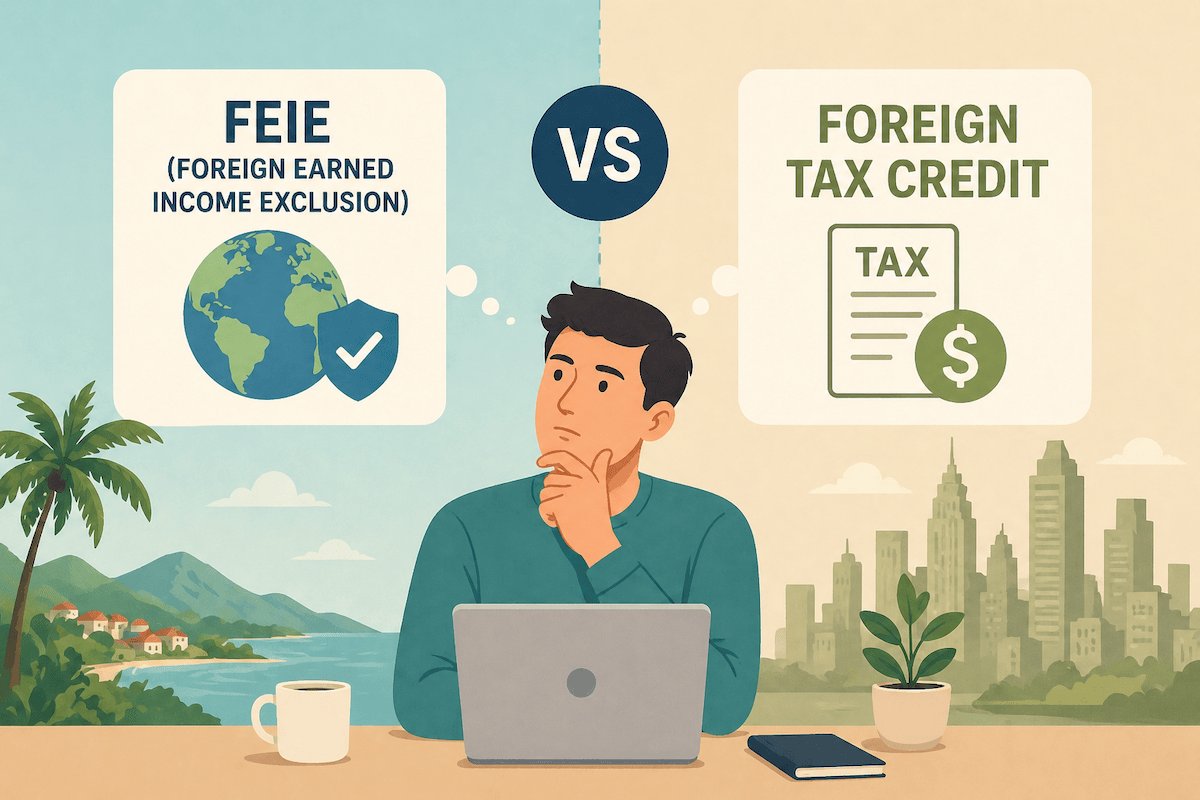
That’s where two main options come in: the Foreign Earned Income Exclusion (FEIE) and the Foreign Tax Credit (FTC).
Both can help lower your U.S. tax bill, but they work in different ways. Picking the wrong one could cost you money or limit your options down the road.
This guide breaks down how each option works, when one might be better than the other, and how to think about your choice in the bigger picture. The goal is to help you understand the pros and cons so you can make an informed decision.
The FEIE lets you exclude part of your foreign earned income from U.S. taxes. The FTC gives you a credit for foreign taxes you’ve already paid, dollar for dollar.
If you live in a country with low taxes, the FEIE can be appealing because it reduces your U.S. tax liability on some of your income. If you’re in a high-tax country, the FTC might work better since your foreign taxes can offset what you owe the U.S.
There’s no one-size-fits-all answer. The best choice depends on your income, local tax rates, and your future plans.
What is the foreign earned income exclusion (FEIE)?
The FEIE lets you exclude up to a specified amount of foreign-earned income from U.S. federal taxes. This limit changes each year.
“Earned income” generally means wages, salaries, or self-employment income. It does not include passive income, such as dividends, interest, or capital gains.
To qualify, you need to meet one of two tests:
- Physical Presence Test: You spend at least 330 full days outside the U.S. during a 12-month period.
- Bona Fide Residence Test: You establish residency in a foreign country for an uninterrupted tax year.
If you qualify, you can exclude income up to the limit. In some cases, you can also claim a housing exclusion for certain expenses.
Where FEIE helps most
FEIE is especially helpful if your income is below or close to the exclusion limit and you live in a country with low income taxes. It can also make your U.S. tax return simpler since you’re reducing the amount of income that gets taxed.
Limitations to keep in mind
FEIE doesn’t cover passive income. It also doesn’t exempt you from self-employment tax, and it might affect your eligibility for some income-based U.S. tax credits. Also, once you choose FEIE, there are rules about changing your mind in future years.
What is the foreign tax credit (FTC)?
The FTC works differently.
Instead of excluding income, the FTC lets you claim a credit for foreign taxes you’ve already paid. This credit reduces your U.S. tax on that same income.
Put simply, if you pay taxes to another country, you can often lower your U.S. tax by the same amount.
Unlike FEIE, the FTC can be used for a wider range of income, including some passive income. You can also carry credits forward or back to other tax years if you don’t use them all at once, under certain rules.
Where FEIE helps most
The FTC usually works best if you live in a country with higher taxes. If your foreign tax rate is close to or higher than U.S. rates, the credit can often cover most or all of your U.S. tax.
Limitations to keep in mind
The FTC can be trickier to figure out, especially if you have different types of income or income from several countries. There are also rules and limits that affect how much credit you can actually use.
FEIE vs FTC: key differences explained
In short, FEIE removes income from your U.S. taxes, while FTC reduces the tax you owe by giving you credit for foreign taxes paid.
But there’s more to it in practice.
- FEIE lowers your taxable income, which might put you in a lower tax bracket. FTC doesn’t change your income, but it cuts down the tax you owe on it.
- FEIE limits the amount of income you can exclude. FTC doesn’t have that same limit, but it depends on how much tax you pay to other countries.
- Flexibility is another key difference. FTC usually gives you more long-term options, especially if your income goes up or your situation changes. FEIE can be helpful at first, but it might not work as well if your income grows past the exclusion limit.
Check out the Reddit conversation about the key differences between FEIE and FTC:
Foreign Income Exclusion vs Foreign Tax Credit
by u/76since89 in tax
When FEIE usually makes more sense
FEIE is often a good fit if your income is modest or you live in a country with low or no income tax.
In these cases, excluding income can really lower your U.S. tax bill. It can also make filing easier if your income is simple.
Freelancers and remote workers early in their careers, or those who want things simple, often use FEIE.
But it’s important to consider how your situation could change. What works for you now might not be the best choice later.
When FTC is often the better option
FTC usually works better if you live in a country with higher tax rates.
If you already pay a lot of taxes abroad, the credit can reduce your U.S. tax bill, sometimes to zero.
The FTC is also helpful if you have different types of income, such as a salary and investments. Since it covers more income types, it can be a better overall solution in these situations.
For long-term expats, FTC is often considered the more flexible choice, especially as your income grows.
Can you use both FEIE and FTC?
Yes, but there are some restrictions.
You can use FEIE for a portion of your income and then apply FTC to the remaining taxable income. This can be useful in certain situations, such as when your income exceeds the FEIE limit.
But you can’t claim a credit on income you’ve already excluded. So, you need to be careful about how you use both together.
Using both FEIE and FTC can help, but it complicates things, and you need to understand how each one works.
Real-world scenarios
Take a freelancer living in a low-tax country. If their income is below the FEIE limit, using the exclusion is usually the easiest and best option.
Now think about an employee in a high-tax country. Here, the FTC can offset most of its U.S. tax, making it the better choice.
A third example is someone with both earned income and investments. In this case, using both FEIE and FTC might make sense, depending on how their income is set up.
These examples show why your choice depends on your situation: there’s no single rule that works for everyone.
How your domicile and state taxes affect the choice
Federal tax planning is just one piece of the puzzle.
Your state of residence (domicile) also affects your taxes. Some states keep taxing you even after you move abroad, depending on how you keep ties there.
This means your FEIE or FTC plan could still be affected by state tax rules.
Picking a state with no income tax as your domicile can make things easier, but you’ll need to plan and keep good records. Your address, paperwork, and being consistent all matter for your residency.
Common mistakes to avoid
Many expats have problems not because of the rules, but because of how they use them.
- Assuming one option is always best: The right choice depends on your situation, and what works this year might not be best next year.
- Focusing only on short-term savings: Choosing FEIE for simplicity now can limit your flexibility later as your income or circumstances change.
- Ignoring state taxes: Even if your federal tax is reduced, state obligations can still create unexpected liabilities.
- Switching between FEIE and FTC without understanding the rules: changing your approach without planning can lead to problems or missed opportunities.
Knowing about these common mistakes can help you make better choices and avoid problems down the line.
How to choose the right option for your situation
Your decision mainly depends on a few things: your income, the tax rates where you live, and your future plans.
If your income is on the lower side and you don’t pay much in foreign taxes, FEIE might be the simplest solution.
If you earn more or pay a lot in foreign taxes, FTC could yield better results and greater flexibility.
It’s a good idea to review your choice from time to time. As your income, location, or lifestyle changes, your best strategy might change too.
How SavvyNomad can help
Tax strategy isn’t something you do alone. Your address, where you call home, and your paperwork all play a part in how your setup works.
SavvyNomad helps you pull all these pieces together. Whether it’s setting up a U.S. address or keeping your records in order, the aim is to make your setup easier to handle.
Conclusion
FEIE and the Foreign Tax Credit are both useful, but they tackle the same problem in different ways.
FEIE takes income out of your U.S. taxes, while FTC gives you credit for taxes you’ve already paid. The best choice depends on your income, where you live, and your long-term plans.
There’s no single answer, and what works best can change as your situation changes. If you take a thoughtful approach and know the trade-offs, you can avoid extra costs and headaches.
With the right setup, you can reduce your tax burden while keeping your overall system consistent and manageable.
FAQs
Which is better: FEIE or FTC?
It depends on your income level, where you live, and how much tax you pay abroad.
Can I switch between FEIE and FTC?
Yes, but there are rules and limitations, so it’s important to plan carefully.
Do I still need to file U.S. taxes?
Yes, U.S. citizens generally need to file regardless of where they live.
What happens if I choose the wrong one?
You may pay more tax than necessary or limit your options in future years.
Does this affect state taxes?
It can. Your state residency status may still create obligations depending on your situation.