Does Florida tax retirement income? Social Security, 401(k), IRA and pensions
Florida has no state income tax, so it doesn’t tax Social Security, 401(k), IRA, pension or military retirement income. See what federal tax and your old state can still claim, and what Florida taxes instead.

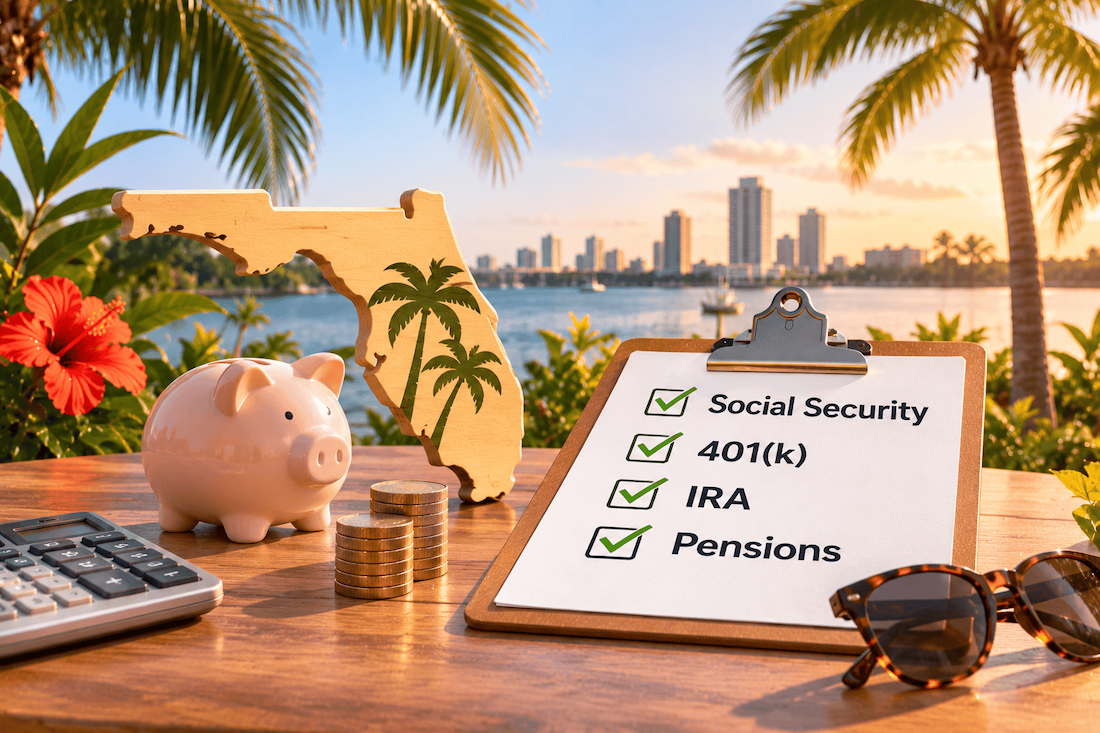
No. Florida has no personal income tax, so the state doesn't tax retirement income. That covers Social Security, 401(k) and IRA withdrawals, pensions and military retirement pay.
Three things limit that answer. Federal tax still applies. Your old state may still claim you if you haven't truly left it. And the rule only helps if Florida is your legal domicile. This guide covers each income type, what Florida does tax, and what to know if you're moving from another state or living abroad.
Does Florida tax retirement income?
Does Florida tax retirement income? No. Article VII, Section 5 of the Florida Constitution bars the state from taxing the income of natural persons, so Florida levies none on your Social Security, withdrawals, pensions or annuities. It also means you don't have to file a Florida income tax return.
Federal tax is separate. Florida's rule doesn't change what you owe the IRS.
| Income Type | Florida Tax | Federal Tax |
|---|---|---|
| Social Security Benefits | None | Up to 85% of benefits can be taxable, depending on your income |
| Traditional 401(k) and IRA Withdrawals | None | Taxed as ordinary income |
| Roth 401(k) and Roth IRA Withdrawals | None | Generally tax-free when the withdrawal is qualified |
| Pensions (Private and Government) | None | Generally taxed as ordinary income |
| Military Retirement Pay | None | Generally taxable |
| Annuity Payments | None | The taxable portion is taxed as ordinary income |
| Dividends, Interest and Capital Gains | None | Federal rates apply |
The same income can be taxed heavily in other states. For your information, states that don't tax retirement income article compares all 50.
Does Florida tax Social Security benefits?
Does Florida tax Social Security benefits? No. Florida doesn't tax Social Security income, and there's no threshold, phase-in or partial exclusion to track.
What the IRS does. Whether your benefits are federally taxable depends on your combined income: adjusted gross income, plus nontaxable interest, plus half your Social Security benefits. These are the thresholds from IRS Publication 915:
| Filing Status | Combined Income | Taxable Portion of Benefits |
|---|---|---|
| Single or Head of Household | Under $25,000 | None |
| Single or Head of Household | $25,000 to $34,000 | Up to 50% |
| Single or Head of Household | Over $34,000 | Up to 85% |
| Married Filing Jointly | Under $32,000 | None |
| Married Filing Jointly | $32,000 to $44,000 | Up to 50% |
| Married Filing Jointly | Over $44,000 | Up to 85% |
These thresholds aren't adjusted for inflation, so more retirees cross them each year. "Up to 85%" means up to 85% of your benefits can be included in taxable income. It isn't an 85% tax rate. If you're married, file separately and lived with your spouse at any point in the year, you generally have no protected base amount at all.
Other states. Because Florida doesn't tax Social Security, you can skip this variable. In 2026, eight states still tax at least some benefits: Colorado, Connecticut, Minnesota, Montana, New Mexico, Rhode Island, Utah and Vermont. Most only tax benefits above income thresholds. West Virginia is fully exempt from 2026.
Social Security for US expats guide covers collecting benefits abroad.
Does Florida tax 401(k) and IRA withdrawals?
Does Florida tax 401(k) withdrawals? No. Florida doesn't tax withdrawals from a 401(k), a traditional IRA, or a Roth account. Does Florida tax IRA distributions? Also no, including required minimum distributions and Roth conversions.
The federal side still applies. Traditional account withdrawals are generally ordinary income, and the federal rules on early withdrawals and required distributions apply wherever you live.
The state that matters is the one where you're domiciled when you take the withdrawal. A retiree who's still domiciled in a high-tax state when they withdraw owes that state's tax, even if they've moved. The section below on your old state explains why.
How to use a 401(k) and IRA as an American expat guide covers managing accounts from abroad.
Does Florida tax pensions and military retirement pay?
Does Florida tax pensions? No. Florida doesn't tax private pensions, government pensions or annuity payments. Does Florida tax military retirement? Also no. Military retirement pay is generally taxable federally.
Does Florida tax Social Security and pensions? Neither. Many income-tax states exempt only some pensions, such as government or military ones, or exempt them below a dollar cap. Florida needs no exemption schedule, because it has no income tax to exempt from.
What Florida does tax retirees
No income tax doesn't mean no taxes. Retirees mainly notice three things.
Sales tax
Florida charges a 6% state sales tax, and counties add local surtaxes on top. The rate you pay depends on the county.
Property tax and the homestead exemption
If you own a Florida home, property tax is your biggest tax. Rates vary by county, and the homestead exemption reduces the taxable value of your primary residence. To get it, you generally need to own the home and make it your permanent Florida residence. Can you keep your Florida homestead exemption while living abroad? article covers how living abroad affects that.
For 2026, the exemption is up to $51,411. That's $25,000 applied to all levies, including school taxes, plus $26,411 applied to non-school levies.
Amendment 3 changes this. Florida voters approved it on November 3, 2026, with about 62% of the vote in unofficial results. Starting January 1, 2027:
- The exemption for non-school levies rises to $150,000 in 2027 and $250,000 in 2028, with inflation adjustments after that.
- School taxes continue. Only the first $25,000 of assessed value stays exempt from them.
- The annual cap on assessment increases for non-homestead property drops from 10% to 5%.
- Save Our Homes stays in place: homestead assessments are still capped at 3% or inflation, whichever is less.
It doesn't change your 2026 bill. The first tax bills reflecting it arrive in November 2027, and implementing legislation may still add details.
If you're moving to Florida: the Property Appraisers' Association describes a different path for people who become Florida residents on or after January 1, 2027. They start with a smaller exemption of about $50,000, adjusted for inflation from 2028. After four years of homestead exemption, they become eligible for the larger exemption starting in the fifth year. Residents as of December 31, 2026 qualify for the larger amounts when they buy and apply for homestead. Confirm the final rules before you plan around them.
Amendment 3 only matters if you own a Florida homestead. If you rent, or don't own a home there, it doesn't change your tax picture.
Estate and inheritance tax
Florida has no estate or inheritance tax. Article VII, Section 5 limits any such tax to amounts credited against federal tax. Federal estate tax can still apply to large estates.
Florida vs Texas domicile guide shows that Texas has the same income-tax result.
Can your old state still tax your retirement income after you move?
Usually not on qualified retirement income, but only once you're no longer its resident or domiciliary. That's the effect of 4 U.S.C. § 114.
The rule. Under 4 U.S.C. § 114, no state may impose an income tax on the retirement income of someone who isn't a resident or domiciliary of that state, as determined under that state's own laws. Congress passed it in 1996, and it applies to amounts received after December 31, 1995.
What counts as retirement income. It covers income from qualified plans and arrangements including:
- 401(a) trusts, which include 401(k) plans
- IRAs and simplified employee pensions
- 403(a) annuity plans and 403(b) contracts
- 457 deferred compensation plans
- Governmental plans
- Military retired pay
Certain nonqualified plans are covered only if they meet conditions in the statute, such as payments in substantially equal installments for life or at least 10 years. A lump-sum payout from a nonqualified plan that doesn't meet them can still be taxed by the state it came from. Ask a CPA before you rely on this.
The catch is domicile. The rule asks whether your old state treats you as a nonresident under its own laws. A state that still considers you a resident can still tax you. Some are known for contesting departures. Stickiest states for US citizens guide covers which ones.
What proves a domicile change. Domicile means your permanent home. In practice, states look at where you actually have your life records:
- A Florida residential address
- A Florida driver's license
- Voter registration
- A Declaration of Domicile filed in Florida
- Updated financial and government records
Florida residency requirements for tax purposes guide covers each step.
The year you move. Part-year returns can apply. Do I have to file taxes in two states if I moved blog post explains how.
Income from your old state. Rental property or a business there can follow different rules, so ask a tax professional.
Can you get Florida's tax treatment while living abroad?
Florida's treatment follows your domicile, not where you spend your time. So yes, if Florida is genuinely your legal home. That takes a real Florida address, license and records, not just a mailbox. Is establishing a Florida domicile while living abroad legal guide covers the legal side.
What doesn't change when you live abroad:
- Federal tax. US citizens owe federal tax on worldwide income, wherever they live.
- The foreign earned income exclusion doesn't help here. The IRS excludes pensions, annuities and Social Security benefits from "foreign earned income," so it won't reduce tax on retirement income.
- Your country of residence. It may tax you too. Tax treaties can change how pensions and Social Security are treated, and most treaties have special rules for Social Security, so check the treaty with the country where you live.
Getting a Florida domicile from abroad. SavvyNomad provides the Florida residential address, the Letter to the Tax Collector for your driver's license appointment, and Declaration of Domicile support. The license appointment is the one step that requires you to be there in person. Plans start at $60 a month, billed annually. No plan guarantees a tax outcome or that an agency will accept a document. Cost to establish Florida residency guide itemizes the fees, and Florida Residency Guide 2026 article covers the steps.
One customer who switched their domicile to Florida wrote on Trustpilot: "The portal is clear, the steps were laid out in order, and the team answered my questions quickly when I had them."
Frequently asked questions
Is Social Security taxed in Florida?
No. Florida doesn't tax Social Security benefits. Federal tax can apply to up to 85% of them, depending on your income.
Do retirees pay property tax in Florida?
Yes, if they own property. A homestead exemption reduces the taxable value of your primary residence, and Amendment 3 raises it from 2027. School taxes continue.
If I move to Florida, can my old state still tax my pension?
Generally not on qualified retirement income once you're no longer its resident or domiciliary (4 U.S.C. § 114). Your old state decides under its own laws whether you've left, and exceptions exist, so document the move carefully.
Can I claim Florida residency for retirement if I live abroad?
Yes, if Florida is your real domicile, with a residential address, license and records to support it.
Does Florida tax military retirement pay?
No. Military retirement pay is generally taxable federally.
Does Florida have an estate tax?
No. Florida has no estate or inheritance tax. Federal estate tax can still apply to large estates.
Conclusion
Florida taxes none of your retirement income: not Social Security, 401(k) or IRA withdrawals, pensions or military retirement pay. Federal tax still applies, and the rule only helps if Florida is truly your domicile. If you own a Florida home, Amendment 3 lowers property taxes from 2027.