Physical address verification for US banks: a guide for expats & nomads
US banks require a physical US address under the PATRIOT Act, but not every US address qualifies. CMRA-flagged forwarding services are routinely rejected. Amazon packages don't count. Here's what actually satisfies residential address verification, and what to do when your bank asks.

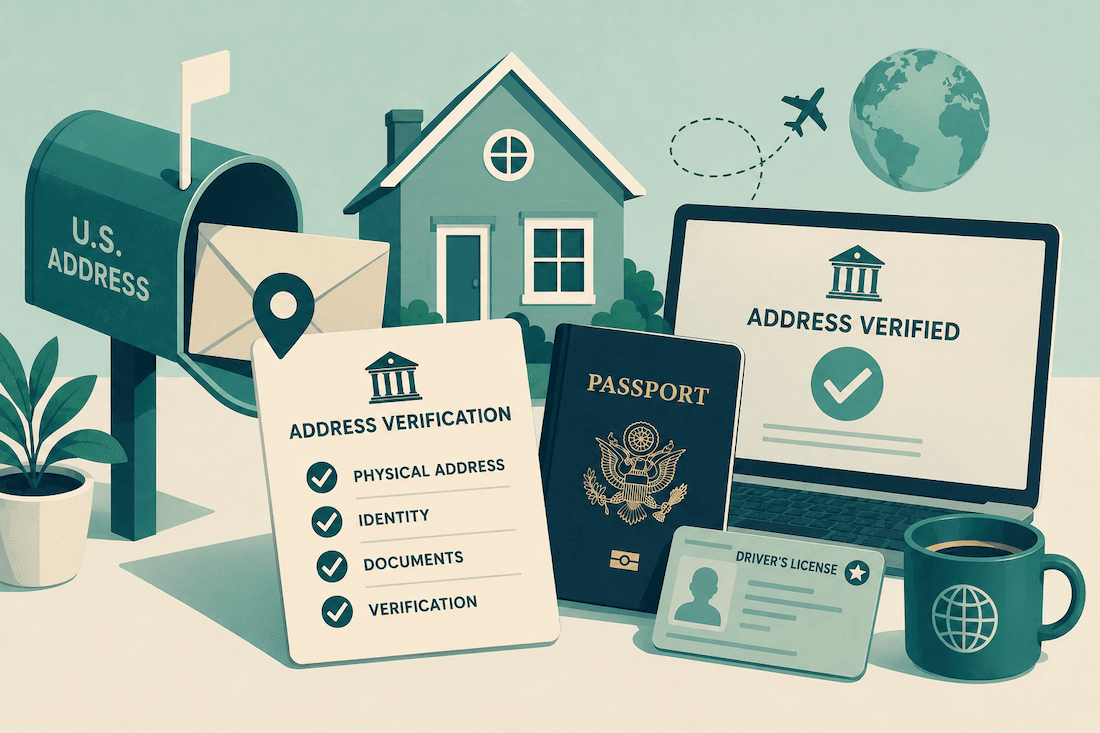
Receiving a letter from your US bank asking you to verify your address is one of the more stressful moments in expat financial life. Your account might be flagged. Your statements might have started bouncing. Or you're proactively trying to get your address situation sorted before it becomes a problem.
This is not a bank policy quirk. Physical address verification is a legal requirement. Under the USA PATRIOT Act, every US financial institution must run a Customer Identification Program on every account holder. That program requires a verifiable physical US address on file. A foreign address doesn't satisfy it. A PO box doesn't satisfy it. And not every real street address in the US satisfies it either.
This guide explains what banks are actually checking during residential address verification, which address types pass, what documents to prepare, and what to do when your bank is already asking.
US banks are required by the USA PATRIOT Act to collect and verify a physical US address for every account holder as part of their Customer Identification Program. A foreign address or a PO box does not satisfy this requirement. Not all US addresses qualify: addresses flagged in the USPS Commercial Mail Receiving Agency (CMRA) database are routinely rejected by bank compliance systems, even when they are real street addresses. A real street address that is not CMRA-flagged is what most banks are looking for. The strongest single document for residential address verification is a state-issued driver's license showing the US address. A Florida driver's license, a Declaration of Domicile, and voter registration create a document package that most banks accept without question. Expat-friendly banks like Charles Schwab and Fidelity allow a separate foreign mailing address for correspondence while maintaining a US physical address on file for CIP purposes. If your bank has already sent a physical address verification letter, you typically have 30 to 60 days to respond before the account is restricted.
Why US banks require physical address verification
Title III of the USA PATRIOT Act, enacted in 2001, created the Customer Identification Program requirement for all US banks. CIP requires banks to verify the identity of every account holder, including a physical address, as part of their anti-money-laundering and counter-terrorism financing obligations.
The legal standard is not "you must live at this address right now." The standard is that the bank must have a reasonable belief that it knows the customer's true identity, and that a verifiable physical location is part of that identity. Banks have flexibility in what they accept to satisfy this standard, which is why different banks have different policies, but none of them can waive the requirement entirely.
The physical address serves three distinct purposes in a bank's compliance system. First, CIP identity verification: the address is used to confirm the customer is a real person at a real location that can be verified against public records or credit databases.
Second, AML monitoring: unusual geographic patterns, an account consistently accessed from foreign IP addresses while a US address is on file, can trigger a compliance review.
Third, regulatory record-keeping: the address becomes part of the permanent compliance file the bank must maintain and produce for regulators on request.
This is why a foreign address cannot satisfy the requirement. Bank compliance systems are built to verify US addresses against US public records, US credit bureaus, and US government databases. Foreign addresses cannot be verified through those same systems.
PO boxes are rejected universally because they do not constitute a physical location where a person can be identified or contacted. They are forwarding points, not physical locations.
The key practical point: even if you have lived abroad for a decade, file your US taxes correctly every year, and have no intention of evading anything, your bank still needs a US physical address on file to satisfy its own regulators. This is a compliance obligation on the bank's side, not a judgment about your lifestyle.
Best US banks for American expats
How to maintain a US address while living abroad
What types of US addresses banks actually accept
Not all US addresses pass residential address verification equally. There is a practical spectrum from addresses that pass everywhere to those that are almost universally rejected.
Tier 1: Clean residential address
A genuine personal residence: your own property, a family member's home where you are a documented resident, or a rented apartment in your name. This passes all banks without question. It is the cleanest solution. Most expats don't have this, which is why the rest of this section matters.
Tier 2: Real street address, not CMRA-flagged
A mail forwarding service that provides a real street address (not a PO box number) and has not been registered with the USPS as a Commercial Mail Receiving Agency. This passes most banks. The specific provider matters significantly.
Tier 3: Real street address, CMRA-flagged
A commercial mail forwarding service registered with the USPS CMRA database. The address appears to be a real street address, but bank compliance systems cross-reference the CMRA database and flag it. UPS Store locations, Mailboxes Etc., and many similar commercial services are CMRA-registered. The rejection rate at banks is high even though the address includes a street number.
Tier 4: PO box or foreign address
Rejected universally for primary address purposes.
| Address Type | Example | Passes CMRA Check | Accepted by Banks | Strength as Primary CIP Address |
|---|---|---|---|---|
| Genuine Personal Residence | Your own property or a family member's home where you are properly documented | N/A | ✅ Always | Strongest |
| Domicile Service Address (Non-CMRA) | SavvyNomad Florida residential address | ✅ Yes | ✅ Most banks | Strong |
| Virtual Mailbox with Real Street Address (Non-CMRA) | Independent provider using a residential-style street address | ✅ Yes | ✅ Often | Moderate |
| CMRA-Registered Commercial Service | UPS Store, Mail Boxes Etc., or other CMRA | ❌ Flagged | ❌ Often rejected | Weak |
| PO Box | USPS PO Box 1234 | N/A | ❌ Never | None |
| Foreign Address | Any non-U.S. residential address | N/A | ❌ Never | None |
The CMRA database and why it matters
The USPS maintains a Commercial Mail Receiving Agency database of businesses that receive mail on behalf of customers. Services that register with the USPS as CMRAs are identified in this database. Many bank compliance systems cross-reference incoming address updates against it.
An address that appears in the CMRA database is flagged automatically as a commercial mail receiving address rather than a residential address. An address that looks like "123 Main Street Suite 400" but is CMRA-registered will often be rejected even though it is a legitimate real street address. This is why the choice of mail forwarding provider matters, not just whether the address has a street number.
What "residential" means for banking purposes
Banks use the word residential to mean an address that reasonably represents where a real person can be found or contacted and that passes verification against public records. A residential-style address from a domicile service provider that is not CMRA-flagged, and is consistent with a driver's licence and other government records, satisfies this standard for most banks.
Is a virtual address legal in the US?
Virtual mailbox vs mail forwarding
Best mail forwarding services for US expats
What documents banks ask for (and what works without a utility bill)
The standard document list
When a bank sends a physical address verification letter or requests residential address verification documentation, they typically ask for one or more of these:
- State-issued driver's license or government ID showing the US address
- Recent utility bill (gas, electric, water) within 60 or 90 days showing the US address
- Bank statement from another institution at the same US address
- Lease or rental agreement
- Mortgage statement
- Government-issued correspondence: voter registration card, IRS notice, Social Security Administration letter, W-2
The utility bill problem
Most expats don't have US utility bills. They don't pay for electricity or gas at a US address. A utility bill appears first on most bank requirement forms because it is the standard document for domestic US customers — readily available, recently dated, and tied to a specific address. It is not the only accepted document.
When a bank asks for a utility bill and you don't have one, the solution is to present two or three alternative documents that together tell the same coherent story about the US address.
What works without a utility bill
- State-issued driver's license showing the US address is the single most effective document. It is a government-issued ID verified through the DMV. A Florida driver's license, for example, was issued after an in-person DMV visit and is tied to state government records. Most banks accept a driver's license as primary evidence without requiring anything else.
- Declaration of Domicile filed under Florida Statute §222.17 is a notarised, publicly recorded document that declares the address as your legal permanent home. It carries significant weight precisely because it is a legal declaration made under penalty of perjury and recorded in a county public record. Not every bank explicitly lists this, but it is accepted as strong supporting evidence when presented alongside a driver's license.
- Voter registration showing the US address confirms the same address appears in state government records.
- IRS correspondence to the US address, a Form W-2, tax refund notice, or IRS CP letter, confirms the IRS has the same address on file. This is particularly persuasive because it shows the address is consistent across both the bank and the IRS.
- Social Security Administration correspondence to the US address works the same way.
- A bank statement from another US bank at the same address confirms the address is consistent across financial institutions.
- Lease agreement, some domicile services provide an actual signed lease for the address. This is specifically what VirtualPostMail's TruResidence product is designed to produce. A signed lease is a strong document because it mirrors what domestic renters use.
Is an Amazon package proof of address?
No. A common question, and a common mistake. An Amazon delivery confirmation or packaging label is not a government-issued or financial document and is not accepted by banks for residential address verification.
The same applies to any commercial delivery, subscription service, or retail receipt. Banks require documents issued by government agencies, financial institutions, or official landlords. Amazon, FedEx, UPS delivery confirmations, and similar commercial shipping records do not satisfy the requirement regardless of how recently they were dated.
The two-document approach
A driver's license plus one government document voter registration, an IRS letter, or SSA correspondence is typically sufficient for most banks. A driver's license alone is often enough. A Declaration of Domicile adds significant weight for banks that request additional corroboration.
How to prove US residency without utility bills
Declaration of Domicile in Florida
How to inform the IRS about a new domicile
Which US banks are most flexible on address requirements
Expat-friendly banks
- Charles Schwab (High Yield Investor Checking) is widely considered the most expat-friendly US bank on address and account maintenance. Schwab accepts a separate foreign mailing address for correspondence while maintaining a US physical address for CIP purposes. It reimburses all ATM fees worldwide, charges no foreign transaction fees, and has a long track record of retaining accounts for Americans living abroad. For most expats, Schwab is the first recommendation.
- Fidelity offers similar flexibility. No foreign transaction fees, accommodates foreign correspondence addresses separately from the physical address on file, and works well for both checking and investment accounts.
- USAA is only available to military personnel and their families, but is extremely flexible for members living or stationed abroad. Maintains accounts without requiring traditional US address documentation in the same way civilian banks do.
Less flexible banks
Traditional brick-and-mortar banks: Chase, Bank of America, Wells Fargo — tend to be stricter. Their compliance systems are more likely to flag foreign addresses, send physical address verification letters, and close accounts if the situation is not resolved. Existing accounts at these banks are generally safer to maintain than trying to open new ones. If you have an existing account at a traditional bank and your address situation is solid, don't change it unnecessarily.
The separate mailing address approach
Many expat-friendly banks have two separate address fields: a US physical address (for CIP) and a separate mailing or correspondence address (where statements actually go). The mailing address can be a foreign address or a US forwarding address. The physical address must be the US address that satisfies CIP.
When updating your address with a bank, ask specifically whether they have separate fields for physical address and mailing address. Many expats mistakenly update only one field and create a compliance gap.
Best checking accounts for US travelers
What to do if your bank has sent a physical address verification letter
Understanding the request
Banks send address verification requests for several reasons. A recent address update may have flagged a foreign address. A routine CIP compliance review may have identified a gap. FATCA-related reporting may have triggered a review. Or an automatic system flag fired because the account was consistently accessed from foreign IP addresses while a US address was on file.
The request is almost always a compliance update process, not an accusation. Treat it as administrative and respond promptly.
Typical timeline: 30 to 60 days to respond before the account is restricted. Account closure usually follows a restriction period, not the initial request. Banks are required to give reasonable notice before closing accounts.
What to do immediately
Read the letter carefully. Identify exactly what the bank is requesting: updated address documentation, address change confirmation, or identity verification.
Do not update your address to a foreign address in response to the request. That typically accelerates the problem rather than resolves it.
Gather your documents. A driver's license showing the US address is the starting point. Add at least one supporting document: voter registration, an IRS letter, or a Declaration of Domicile.
If you do not currently have a driver's license with a US address, this is the point at which establishing proper domicile, including a Florida driver's license, becomes genuinely urgent.
Submit documents through the bank's secure document portal or by certified mail. Keep copies of everything submitted and note the submission date.
If the bank closes the account anyway
Some banks will close accounts regardless of documentation once they determine the account holder lives primarily abroad. This is within the bank's legal rights.
The proactive step: open an account at Schwab or Fidelity before the current account is closed. Do not wait until you have no US banking access. It is significantly easier to open a new account while you still have an existing active US account than after yours is closed.
Best mail forwarding services for US expats
How proper domicile strengthens your banking position
An expat with properly established Florida domicile has a considerably stronger document package than one who only has a forwarding address.
The Florida domicile document package: a Florida driver's license (government-issued ID with the address), a Declaration of Domicile (notarised public record filed with the county clerk), voter registration (public record showing the same address), and consistent IRS and SSA records pointing to that same address. All four documents tell a completely coherent story: this person has a legal, declared, government-verified US address in Florida.
No utility bill is needed when these four documents are consistent and available. The package exceeds what most banks require for residential address verification.
Contrast this with a forwarding address alone: the address may or may not pass the CMRA check, and the supporting document package typically consists of whatever the mail forwarding service provides. That is a much thinner file.
The banking benefit is one of several reasons expats with formalized Florida domicile rarely face account problems. Their address is corroborated by multiple independent government records that point to the same location. When a bank runs its verification, every data point confirms the same address.
Florida residency requirements for tax purposes
Declaration of Domicile in Florida
Frequently asked questions
Can I use a family member's address for my US bank? Yes. A family member's address is a genuine residential US address and satisfies CIP requirements. The bank does not require you to own the property. Ensure your driver's license and other records reflect this address consistently; a mismatch between your ID and your bank address creates its own problem.
Will a mail forwarding address work for my bank? It depends on the provider. A real street address that is not registered in the USPS CMRA database can work for most banks. A CMRA-flagged address is often rejected by compliance systems regardless of how real the street address looks. Check whether your specific provider appears in the USPS CMRA database before relying on that address for banking purposes.
Is an Amazon package proof of address for my bank? No. Commercial delivery confirmations, subscription service labels, and retail receipts are not accepted for residential address verification. Banks require government-issued documents, financial institution statements, or official landlord documentation. Amazon packaging does not qualify regardless of how recently it was dated.
What happens if I update my bank address to my foreign address? Most bank compliance systems will flag a foreign address as incompatible with US CIP requirements and may trigger a document verification request or account restriction. Maintaining a US address on file is the safer approach.
Can I have a foreign mailing address and a US physical address at the same bank? Yes, at most expat-friendly banks. Schwab and Fidelity both accommodate this. The US address is used for CIP; the foreign or forwarding address is used for correspondence. Always ask whether the bank has separate fields for these two purposes when opening an account or updating records.
What is a CMRA and how do I know if my address is flagged? A Commercial Mail Receiving Agency is a business that receives mail on behalf of customers and is registered with the USPS. The USPS publishes this database. If you are using a commercial mail forwarding service, search the USPS CMRA database to confirm whether your provider is registered. Is a virtual address legal in the US?
Is a Declaration of Domicile enough on its own? Probably not as a single document, though some banks accept it as primary evidence. Combined with a Florida driver's licence showing the same address, it is a very strong two-document package. Voter registration adds a third corroborating source that leaves little room for a compliance officer to ask for more.
Conclusion
Physical address verification is a legal requirement that is not going away. The question is whether your US address situation is strong enough to satisfy it when your bank asks.
Two things matter most: whether your address passes the CMRA check, and whether your documents are consistent and government-issued. An Amazon package is not proof of address. A utility bill helps but is not the only option. A state-issued driver's license and one corroborating government document are sufficient for most banks.
For expats with a properly established Florida domicile, the document package such as driver's license, Declaration of Domicile, voter registration, consistent IRS records, almost always satisfies banking requirements without a utility bill or a traditional US residential lease.
SavvyNomad's Florida domicile service creates the address infrastructure that banks are looking for.