Best mail forwarding services for American digital nomads
Most mail services for travelers give you a CMRA address. It handles your mail but often fails a bank's address check. Here's how 7 services compare for American nomads, and when you need a residential address instead.


If you’re an American nomad, staying on top of important mail can be a challenge. Bank statements, tax documents, and official letters don’t stop just because you’re abroad.
Bank statements, IRS letters and new debit cards keep arriving while you travel. A nomad mail service receives them at a US address, scans them and ships them to you. The address type matters most, because many banks and DMVs won't accept the mailbox address most services provide.
If you only need a mail service for travelers that scans and forwards, iPostal1, Anytime Mailbox and Traveling Mailbox are the low-cost picks, starting around $10 to $15 a month. Stable, US Global Mail and LegalZoom Virtual Mail (formerly Earth Class Mail) start at $39 to $49 a month and suit business users. All six use mailbox addresses that banks often flag. If you also need an address for banking, a driver's license or state domicile, SavvyNomad gives you a residential address in Florida or Texas plus a Florida mailing address for forwarding, from $90 a month billed annually.
Mail services for travelers: quick comparison
| Service | Address Type | Works as a Bank or License Address? | Best For | Starting Price |
|---|---|---|---|---|
| SavvyNomad | Residential (FL or TX) + Florida mailing address | Yes, residential address is a place of abode | Banking, license and domicile |
$90/mo Billed annually with forwarding |
| Traveling Mailbox | CMRA | No | Simple app, cheap forwarding | $15/mo |
| iPostal1 | CMRA | No | Lowest price, many locations | $9.99/mo |
| Anytime Mailbox | CMRA | No | Widest choice of addresses |
~$9.99/mo Varies by location |
| Stable | Street address with unit (CMRA) | Some banks accept, some don't | Business mail |
$49/mo Billed annually |
| US Global Mail | CMRA | No | Automation, higher volume | $49/mo |
| LegalZoom Virtual Mail (Earth Class Mail) | CMRA business address | No | Digital-first business mail | $39/mo |
Residential address vs CMRA address
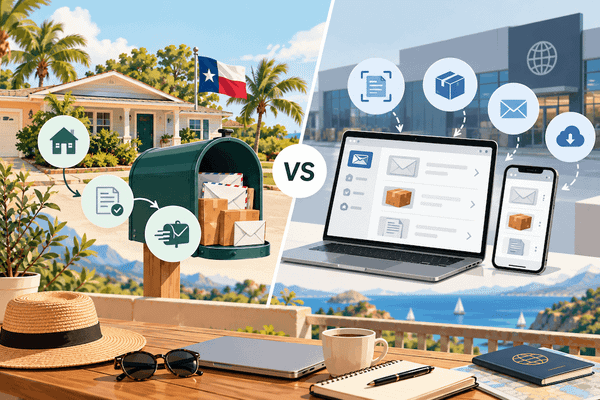
This is the biggest difference between services. A commercial mail receiving agency (CMRA) address is a mail drop. It works well for receiving, scanning and forwarding mail. But under their Customer Identification Program rules, banks generally expect a residential or business street address as your primary address, and CMRA-flagged addresses are routinely rejected. State driver license offices also need proof of a residential address.
A residential address is a place of abode. It can go on your bank's identity file and your driver's license. Most banks let you list a residential address and a separate mailing address, so many nomads use both. Read more about physical address verification for US banks. If you only need a mailbox, our hub on the best mail forwarding service and virtual mailbox options goes deeper.
What to look for in mail services for travelers
Beyond the address type, these features separate a good option from the best mail service for travelers who live abroad.
- Check deposit. If you still receive paper checks, look for a service that deposits them for you.
- International forwarding. The best international mail forwarding service for you depends on where you are. Check which carriers they use, what they charge per shipment and whether they ship to your country.
- Package consolidation. Combining several orders into one box cuts international shipping costs.
- Scanning. Most services scan the envelope. Content scans may be included or billed per page.
- Storage. Free storage windows range from about 7 to 30 days before fees start.

Top 7 mail forwarding services for American nomads
Here's an updated comparison of some top mail forwarding providers for American nomads, including pricing and feature highlights:
SavvyNomad

Who it's for: American nomads who need a US address that works for banking, a driver's license and state domicile, not just for mail.
How it works: You get a residential address in Florida or Texas. It's an RV park lot or, on the Domicile Premium plan, a Florida home address. It's a place of abode, not a CMRA, so you can use it with banks and on your driver's license. The residential address accepts essential mail only, such as cards and government letters, and no packages. On the SavvyNomad plan and up, you also get a mailing address in Brandon, Florida for everyday mail and packages. That's true even if your domicile is in Texas, because all mail runs through the Florida facility.
Key features:
- Residential address in Florida or Texas, plus domicile support such as filing your Declaration of Domicile
- Free scanning, worldwide forwarding, shredding and check deposit through an online portal
- Business mail at the mailing address on the SavvyNomad plan and up
Pricing:
- Basic Domicile: $60/mo billed annually ($75/mo quarterly). Residential address and domicile support only. No mail forwarding.
- SavvyNomad: $90/mo billed annually ($105/mo quarterly). Adds the Florida mailing address and mail forwarding.
- Domicile Premium (Florida only): $265/mo billed annually ($295/mo quarterly). Adds a home address and a monthly utility bill.
Forwarding costs postage plus a $5 handling fee. Check deposits cost $6 plus $9.99 postage. Packages are stored free for 7 days.
Drawbacks: It costs more than a basic virtual mailbox, and mail forwarding starts on the SavvyNomad plan. Residential addresses are only in Florida and Texas. The address alone doesn't establish residency or guarantee acceptance by any bank or agency.

Drawbacks: The residential address is Florida-based only, given its integration with the domicile service. The address is provided for documentary and correspondence purposes and does not, by itself, establish residency, qualify you for any particular tax benefit, or guarantee acceptance by any specific third party.
Comment
by u/bohdandr from discussion
in digitalnomad
Traveling Mailbox

Traveling Mailbox offers flexibility across multiple U.S. addresses and a wide range of mail management options, including a dedicated app for easy mobile access.
Who it's for: Nomads who want an easy mobile app and predictable forwarding fees.
Key features:
- Multiple US address locations, all CMRA
- Junk mail you flag doesn't count toward your plan
- Forwarding costs postage plus $2 per shipment, not per item
- Check deposit for $4.95 plus postage
Pricing: Basic $15/mo (40 envelopes), Extended $25/mo (100 envelopes), Small Business $55/mo (200 envelopes). Annual plans get two months free.
Drawbacks: CMRA address only. Envelopes and page scans over your plan limit cost extra.
Comment
by u/twilight-2k from discussion
in expats
US Global Mail

US Global Mail offers a simple, affordable solution with a Texas-based address, ideal for expats who need reliable mail forwarding and storage at a lower price.
Who it's for: Nomads with a business or high mail volume who want AI sorting and automation.
Key features:
- Permanent US street address, with price varying by location
- Mail opened and scanned, plus AI summaries
- Free check deposits and shredding on the Scale plan
- 30 days of free physical mail storage on Scale
Pricing: Scale from $49/mo (360 opens and scans a year), Teams from $99/mo, Enterprise on request. Exact price depends on the address you choose.
Drawbacks: US Global Mail has moved upmarket, so it's no longer a budget option. CMRA address only.
Earth Class Mail
(by LegalZoom)
A well-known, long-standing provider with a strong reputation, especially for business users.
Key features:
- Mail scanning and digital storage
- Check deposit services
- Integration with cloud storage (Google Drive, Dropbox)
- U.S.-based addresses (limited locations)
Pricing: Starts around $19/month, with higher tiers for businesses.
Drawbacks: More focused on virtual mailbox (digital-first) rather than physical forwarding. Pricing increases quickly with usage.
Best for: Nomads or businesses that want digital mail management + integrations.
Comment
by u/Ninsd331 from discussion
in digitalnomad
iPostal1:
lowest entry price
iPostal1 is one of the largest networks of addresses in the U.S. and globally, making it very flexible.
Who it's for: Budget-minded nomads who want to pick from many US addresses.
Key features:
- Thousands of mailbox locations
- App-based scanning and forwarding
- Package handling
Pricing: Green $9.99/mo (30 items), Blue $14.99/mo (60), Silver $24.99/mo (120), Gold $39.99/mo (240). Prices vary by location tier. Annual billing gives you two months free.
Drawbacks: Every iPostal1 address is a CMRA, so it won't work for banking or legal residency. Forwarding, extra scans and overages cost extra.
Comment
by u/bananadotorg from discussion
in llc
Anytime Mailbox: widest choice of addresses
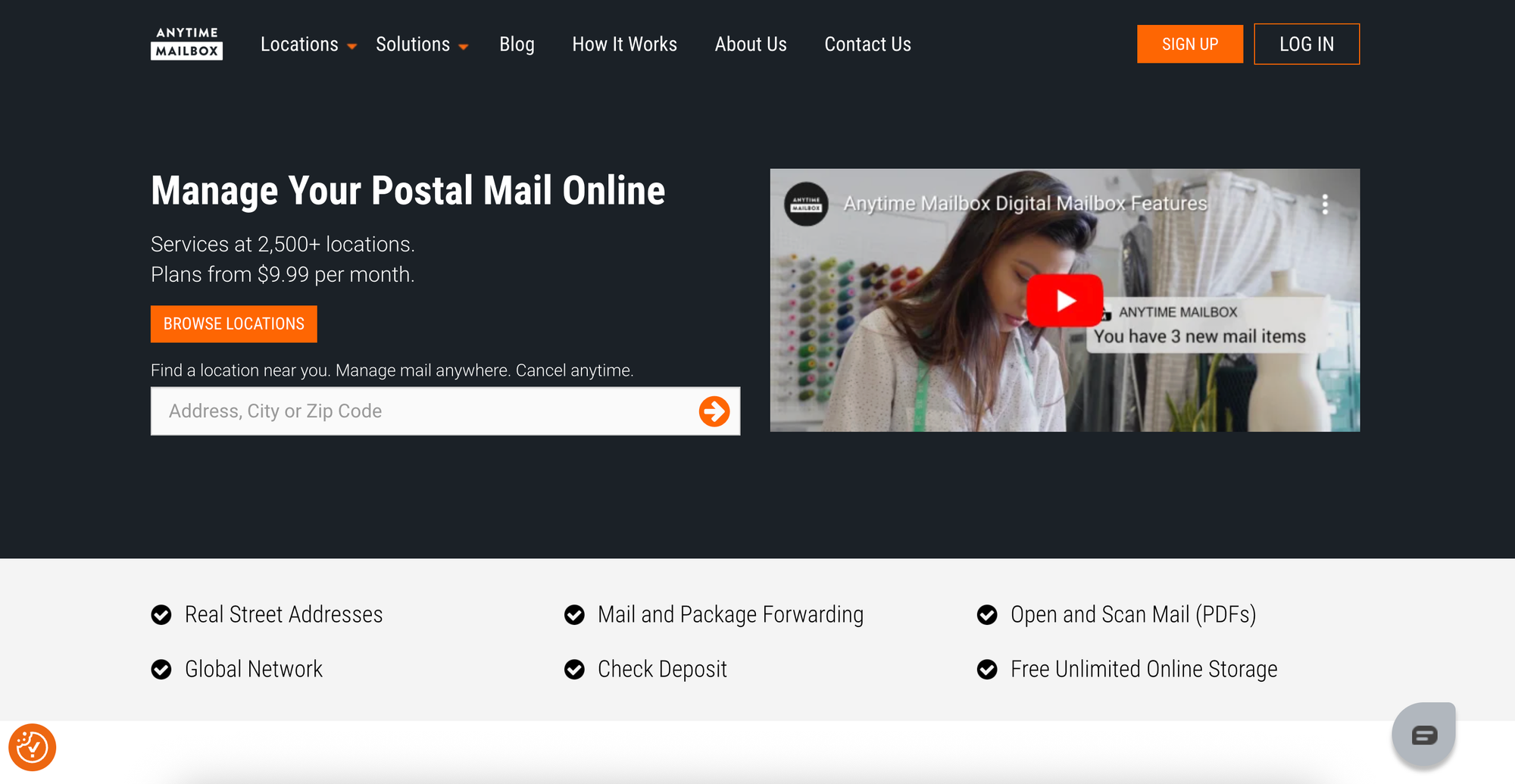
Who it's for: Nomads who want to choose a specific city or street from a large network.
Key features:
- More than 2,500 locations, run by independent mail centers
- Add-ons for open and scan, forwarding, check deposit and shredding
- Vanity addresses in some cities
Pricing: Plans from about $9.99/mo, with some locations lower. Each mail center sets its own prices and extra fees, and premium addresses cost more.
Drawbacks: Fees and service quality vary by location, so compare the exact address before you sign up. Most addresses are CMRA addresses.
Stable: business-leaning street address
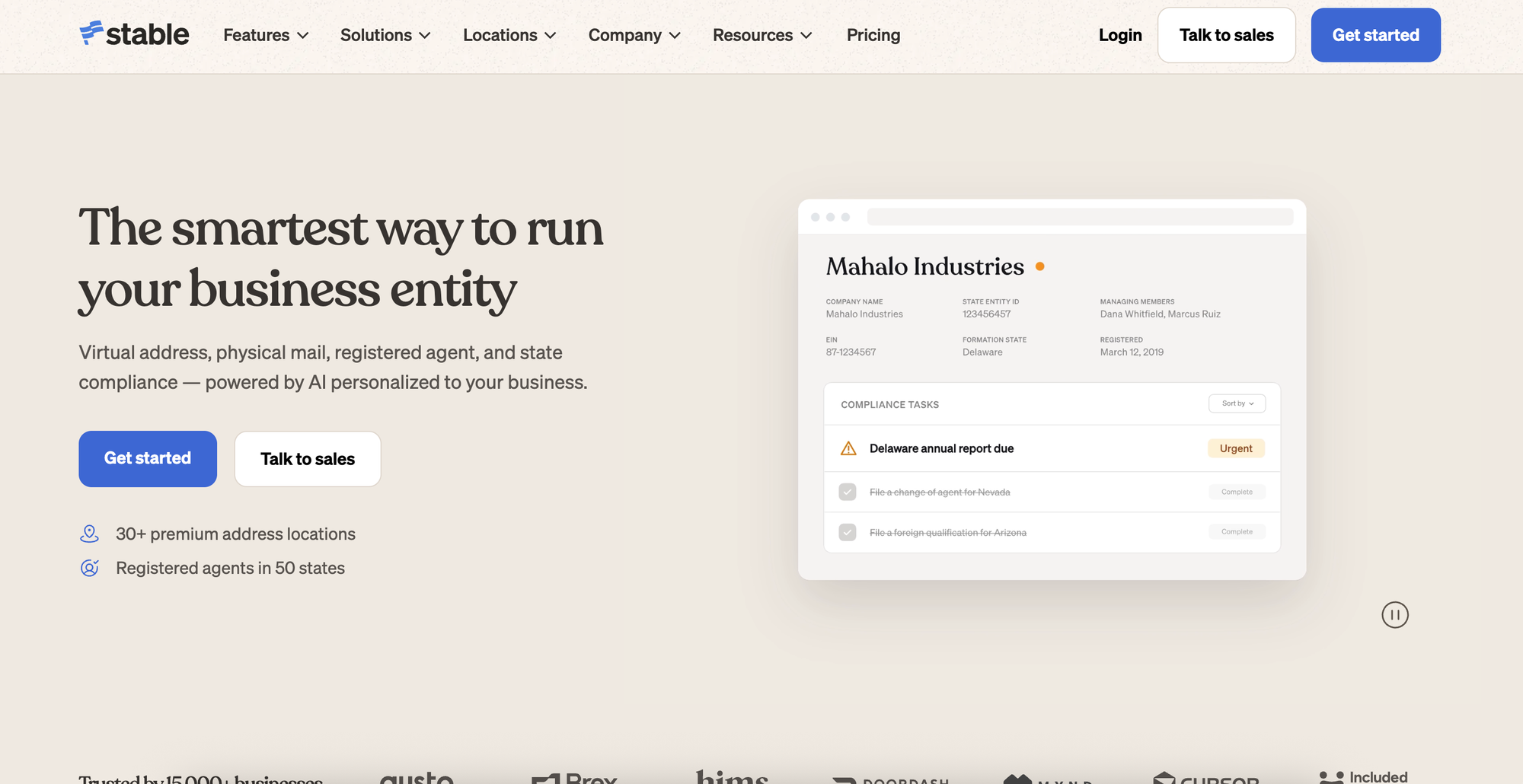
Who it's for: Nomads running a business or LLC who want a clean street address and fast scanning.
Key features:
- Street address with a unit number in 37 US cities, not a PO box
- Mail scanning and forwarding through an online dashboard
- Check deposits from about $3 each
- Optional registered agent service
Pricing: Grow $49/mo billed annually or $59 monthly (30 pieces of mail), Scale $83/mo billed annually or $99 monthly (50 pieces). Extra pieces cost $3 each.
Drawbacks: Pricier than personal mailboxes. You still sign USPS Form 1583, so banks may treat the address as a CMRA. Ask your bank before relying on it.
Fees and features compared
| Service | Check Deposit | Forwarding Fee | Free Storage | Mail Included |
|---|---|---|---|---|
| SavvyNomad | $6 + $9.99 postage | Postage + $5 | Packages: 7 days | Unlimited free scanning |
| Traveling Mailbox | $4.95 + postage | Postage + $2 per shipment | 30 days | 40 envelopes, 35 page scans (Basic) |
| iPostal1 | Extra fee | Postage + handling | Varies by plan | 30 items (Green) |
| Anytime Mailbox | Add-on, set by location | Set by location | Set by location | Varies by location |
| Stable | From about $3 per check | Extra fee | Not listed | 30 pieces/mo (Grow) |
| US Global Mail | Free on Scale | Extra fee | 30 days (Scale) | 360 opens/yr (Scale) |
| LegalZoom Virtual Mail | $10 per check or subscription | Extra fee |
Letters: 30 days Packages: 10 days |
5 scans/mo (Starter) |
*Prices are list prices at the time of writing. Check each provider's site before you sign up.
Choosing the right mail forwarding service
Factors to Consider
When choosing a mail forwarding service, there are several factors to consider, including:
- Reliability and Reputation: Look for a mail service provider with a strong reputation for reliability and customer support.
- Cost and Pricing Structure: Evaluate the service's cost, including any additional fees for features such as package forwarding or mail scanning.
- Speed and Efficiency of Delivery: Consider the speed and efficiency of delivery, including the availability of same-day shipping options.
- Security Measures and Privacy Protection: Ensure the provider has robust security measures to protect your email and personal information.
- International Coverage and Restrictions: If you need to forward mail internationally, consider providers that offer international shipping options and have experience with customs clearance.
- Customer Support and Service Quality: Evaluate the level of customer support and service quality, including the availability of online support and phone support.
By considering these factors, individuals and businesses can choose a mail forwarding service that meets their specific needs and provides a secure, efficient, and convenient way to manage their mail and packages.
Why a U.S. residential address matters for expats
For American expats, having a U.S. residential address (rather than a Commercial Mail Receiving Agency, or CMRA) address is often critical for certain official purposes. A true residential address can allow you to satisfy legal, banking, and tax-documentation requirements that CMRA addresses typically do not meet as a primary customer address. Here’s why it matters:
- Address for Government Agencies: For voter registration, DMV renewals, and Social Security, a residential address is often essential to maintain records and stay in good standing.
- Banking Access: Many banks require a residential or business street address to verify accounts, prevent closures, and maintain credit scores.
- Legal and Tax Documentation: Residential addresses are typically acceptable for IRS tax filings, certain state-tax records, and other official correspondence.
A residential-address service like SavvyNomad’s can help American expats maintain essential connections and meet many documentation requirements without the limitations of a CMRA-only address, while actual acceptance and treatment always depend on each agency’s or institution’s rules.
Options for maintaining a U.S. residential address while living abroad
Domicile service
Using a domicile service, like SavvyNomad’s, provides a verified U.S. residential street address that can support official documents, tax filings, and banking CIP/KYC requirements, though each institution decides what it will accept.
Additionally, a domicile address can be one important element in a broader plan to establish residency in a no-income-tax state like Florida and may enable state-level tax advantages if you also meet that state’s legal requirements; the address alone does not establish residency or guarantee any particular tax outcome.
Mail forwarding service
Residential mail forwarding services offer a verified, permanent mailing address, along with additional services such as mail scanning and international forwarding.
Family or friend's address
Using a friend or relative's address can work for informal mail, but if a bank or government agency requires proof of address, this option can be problematic because the required documents won't be available.
Frequently asked questions
What is the best mail forwarding service for nomads?
It depends on what you need the address for. For mail only, iPostal1, Anytime Mailbox and Traveling Mailbox are the cheapest options. If you also need an address for your bank or driver's license, SavvyNomad pairs a residential address with mail forwarding.
What is the best mail service for travelers on a budget?
iPostal1 starts at $9.99 a month, Anytime Mailbox at about $9.99 and Traveling Mailbox at $15. All three scan your mail and forward it worldwide. None of their addresses work for banking or a driver's license.
What is the best international mail forwarding service?
Look at per-shipment fees, carrier choice and package consolidation. Traveling Mailbox charges postage plus $2 per shipment, not per item. SavvyNomad charges postage plus $5 and forwards worldwide. Compare shipping quotes to your country before you sign up.
Is a nomad mail service the same as a residential address?
No. A nomad mail service usually gives you a CMRA mailbox address. A residential address is a place of abode that banks and DMVs accept. Many nomads use one of each.
Ways to keep a US residential address while abroad
- Domicile service. A service like SavvyNomad provides a residential street address you can use with banks and on your license. It can be one part of establishing residency in a no-income-tax state like Florida or Texas, but the address alone doesn't establish residency or guarantee a tax outcome.
- Family or friend's address. This works for informal mail. It gets harder if a bank or agency asks for proof of address in your name, and it can tie you to a state you meant to leave.
- Keeping your old home. If you still own or rent in your old state, that address works, but it may keep you a tax resident there.
Conclusion
If you only need to receive mail, a $10 to $25 virtual mailbox will do the job. If your bank, your driver's license or your state residency depend on the address, you need a residential address, not a CMRA. Many nomads pair the two: a residential address for official records and a mailing address for everything else.
Related reading: best virtual mailbox services, best mail forwarding services for expats and Florida mail forwarding services.