Residential Address vs Mailing Address: What's the Difference?
Your residential address is where you live; your mailing address is where mail goes. See which one the DMV, IRS, banks and voter registration ask for and what to use if you live abroad.

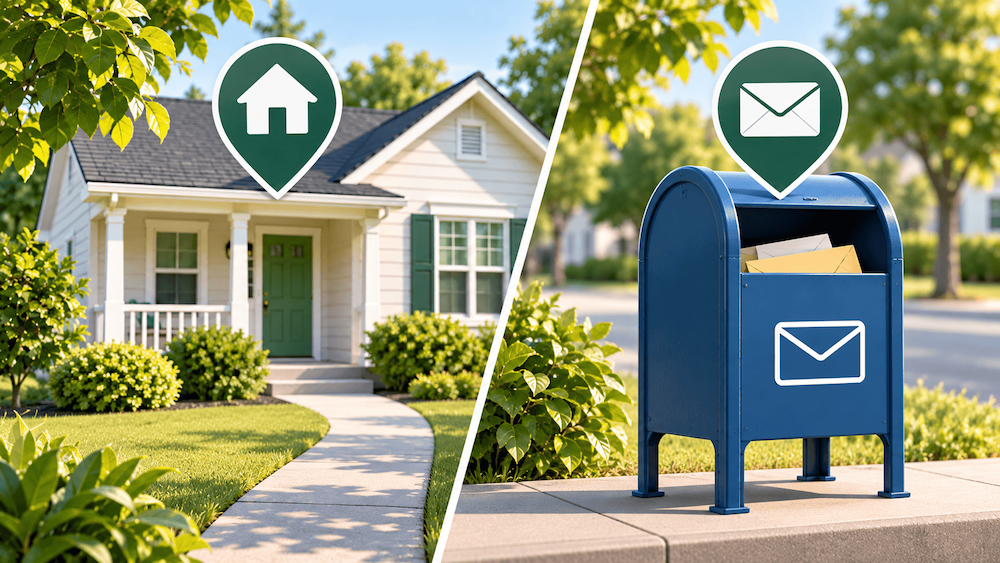
Your residential address is where you live. Your mailing address is where your mail is sent. They can be the same, and they often aren't.
The difference matters because different forms and institutions ask for one or the other, and if you provide the wrong one, your application could be rejected. This guide looks at what each of the DMV, the IRS, banks and election offices want and what you need to do if you're living overseas.
What is the difference between a residential and a mailing address?
The difference between a mailing address and a residential address is down to function, really. A residential address is where you live. A mailing address is where your mail is to be sent. Many people use the same address for both. Some will use two.
Institutions will of course treat them differently. They'll typically verify your residential address with documents that show your name at that address. Your mailing address is pretty much just where mail can be delivered.
| Feature | Residential Address | Mailing Address |
|---|---|---|
| Definition | The place where you live | The place where you receive mail |
| Examples | A house, apartment or condo | Your home, a PO box, a private mailbox (PMB) at a mail center, a relative's address, a forwarding service |
| Can It Be a PO Box? | No | Yes, with limits |
| Used For | Driver's license, voter registration, residency records, identity checks | Receiving IRS letters, statements and packages |
| Who Verifies It | The DMV, election offices and banks, using documents | Usually no one. It only has to be deliverable. |
Physical address vs mailing address
A physical address is a street address of a place that actually exists (as opposed to a PO box). For a person it's almost always going to be your residential address so physical address versus mailing address is pretty much the same as residential address versus mailing address.
One thing in the banking world is that a 'physical' address can be a business street address. The federal rule requires banks to collect 'a residential or business street address' for individuals. Physical address verification in the US banking context is about how the banks apply it.
What is a residential address? What counts, and what doesn't
What is a residential address? That's the address where you actually live and the institutions will check that against documentation that shows your name and that address. A lease or a deed, a utility bill, a bank statement etc. would all be examples of that. Each of the agencies will have their own list.
What is considered a residential address is narrower than people expect. These generally don't count:
- A PO box. Florida's voter registration form asks for the "address where you live" and explicitly states that a PO box is not acceptable. Texas DPS says that if a better address is available then a PO box is not acceptable. The tax collector's pages for the Florida driver's license state that documents cannot show a PO box or a service address.
- A virtual mailbox or CMRA address (which is a business address at a mail centre with a PMB number). Texas DPS states that a business address is not an acceptable residence address.
- A registered agent address (it's where the legal papers go, not where you live).
- A business office or a co-working address for the same reason.
A residential address in itself won't establish your legal domicile. Domicile v residence article will explain the difference.
What is a mailing address? PO box, virtual mailbox, forwarding service and more
What is a mailing address? It's any address at which you can reliably get mail. It doesn't have to be your address. The various types:
- Your home. That's the simplest case.
- A PO box. Rented from USPS and it takes USPS mail. PO box alternatives guide looks at it in comparison to the other options.
- A virtual mailbox (or private mailbox) at a CMRA. You get a street address and a PMB number. All CMRA customers complete USPS Form 1583 which authorises the business to receive mail on your behalf. Is a virtual address legal in the US guide looks at the legality.
- A family member's or friend's address (often written 'c/o').
- A mail forwarding service which takes the mail and sends it on to you wherever you are.
USPS standards require that mail for a CMRA mailbox has a PMB or "#" designator and number so that it can't be presented as a suite or an apartment.
Can your mailing address be different from your residential address?
Yes. Government forms are built for it. Florida's voter registration form asks for "address where you live (legal residence, no P.O. Box)" and separately for a "mailing address if different". Texas's driver's license form will accept a mailing address in addition to your residence address.
It's normal when:
- The post office don't deliver to your street. The IRS says in that case you're to use a PO box.
- You route mail to a workplace, a relative or a post office.
- You're a seasonal resident or a full time traveller.
- You live abroad.
A practical rule: if it asks where you live, enter your residential address. If it asks where to send the mail, enter your mailing address.
Which address do the DMV, IRS, banks and voter registration ask for?
| Institution | Needs | Notes |
|---|---|---|
| DMV (Florida) | Residential | A Florida residential address with two proofs from different sources. A current license, an envelope, a PO box or a service address doesn't count as proof. |
| DMV (Texas) | Residential, plus an optional separate mailing address | A Texas residence address. A business address isn't acceptable. Two printed proofs show your name and residential address. |
| IRS | Mailing | Form 8822 changes your home mailing address. A PO box only if USPS doesn't deliver to your street. "In care of" and foreign addresses are allowed. |
| Bank Identity Checks | A street address, residential or business | The federal rule asks for a residential or business street address. Many banks apply stricter policies, especially to PMB addresses, so ask yours. |
| Brokerage | A street address, residential or business | Broker-dealer rules use the same wording as the bank rule. |
| Voter Registration (Florida) | Residential, plus an optional mailing address | The form asks where you live (no PO box) and for a mailing address if different. |
| Jury Duty | The address on your license, ID and voter records | Florida state-court jury lists use qualifying driver license and ID records. Texas uses voter rolls and DPS records. |
| Car Insurance | Residential (where the car is kept) | Insurers typically ask for a garaging address, where the vehicle is primarily kept, plus a mailing address. |
Mailing address vs residential address at the DMV
For a driver's license, your mailing address versus your residential address at the DMV is straightforward. The DMV needs your residential address and evidence of that address. Your mailing address is simply where they send the card.
If you live with someone else and don't have documents in your own name, then Florida has a Certification of Address form (signed by the person you live with). A Florida driver's license without a permanent address guide will suffice in Florida, and Proof of residency in Texas article will cover Texas.
What if you live abroad or travel full time?
You still need to know which address goes where. Here's what the rules allow:
- Banks. The federal rule asks for a residential or business street address. It doesn't specify that the address has to be in the US. For an individual with no street address, it will accept an APO/FPO box number or the street address of a next of kin or another contact individual. Banks have their own policies on top of that, and many will require a US address for a US account, so you'll need to check with the bank in question.
- The IRS Form 8822 will take a foreign address or an 'in care of' address.
- Each institution will have its own criteria as to what it will accept. Always ask before you rely on an address.
What do you put as your residential address if you're living abroad? You put your actual residence. If a form is asking for a US residential address for a particular purpose (e.g. a US driver's license), then the options are your actual US home or a domicile service which will provide you with a residential address.
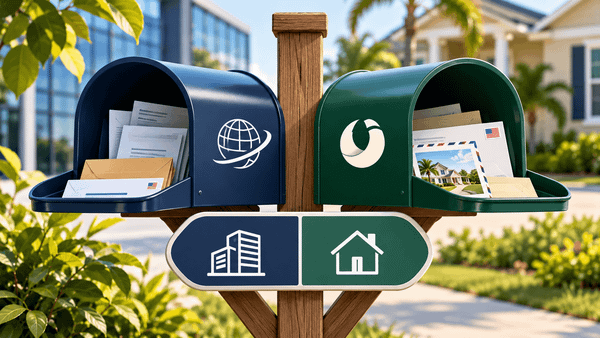
SavvyNomad's setup is another example of the two-address approach. Each customer is allocated a residential address (either in Florida (Sunshine Village) or Texas (Rockport)) and a separate mailing address (a PMB at our Florida facility in Brandon).
We handle all mail in Brandon. Mail sent to the Texas residential address will take up to 10 business days to appear in your account and you can't send packages to that address. Basic Domicile will only forward essential mail. A residential address on its own does not constitute domicile and no plan will guarantee that an agency or bank will accept that address.
One customer wrote on Trustpilot: "I'm absolutely delighted to have a residential address as well as a PMB."
How to maintain a US address while living abroad guide compares five options, and Florida Residency Guide 2026 article covers the Florida steps.
Frequently asked questions
Can I use a PO box as my residential address?
No. Florida's voter registration form, the Florida driver's license documents and the Texas DPS all exclude it. A PO box can be used as an address.
Is a virtual mailbox a residential address?
No, it's a business address with a PMB number and it will work as a mailing address.
What do I put as my residential address if I live abroad?
Your true residence (where a form asks where you live). Where a form requires a US residential address for a particular purpose see the section above.
What is a physical address?
A street address where a place actually exists. For a person that generally means a residential address.
Can my postal address be different from my residential address?
Yes, government forms ask for them separately.
Is a registered agent address a residential address?
No, it's where the legal papers are sent.
Which address does the IRS require?
A mailing address. You'll update it via Form 8822.
Conclusion
A residential address is where you live, and a mailing address is where your mail goes. Where a form asks where you live, use your residential address. Where it asks where to send the mail, use your mailing address. If you need both of those from overseas, you'll need to plan each one separately.