What is a CMRA address? Commercial mail receiving agencies explained
CMRA stands for Commercial Mail Receiving Agency, a private business that receives mail on your behalf at a real street address. It's not a PO box, but banks and DMVs treat it differently from a residential address. Here's exactly what the flag means and where it matters.

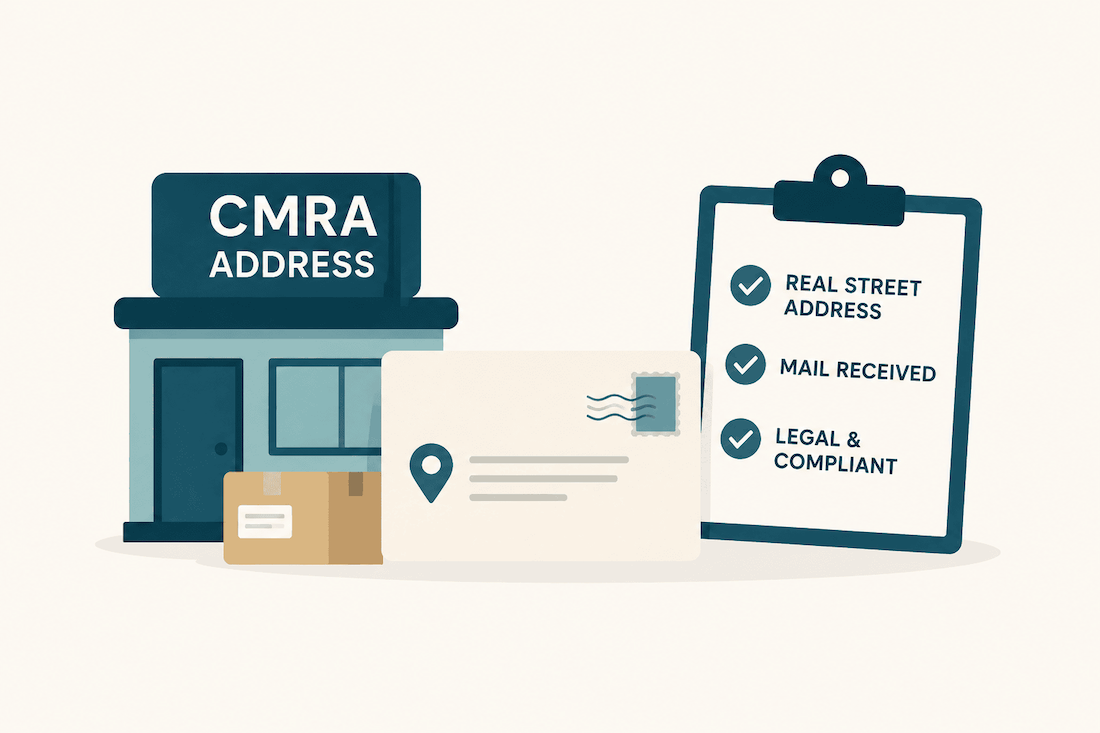
CMRA stands for Commercial Mail Receiving Agency. A CMRA address is the street address of a private, USPS-regulated business that accepts mail and packages on your behalf.
Most people encounter the term when a bank rejects an address, when a virtual mailbox provider mentions Form 1583, or when they are trying to understand why some US addresses work for banking and DMV purposes and others don't. The definition is straightforward. The implications for expats and nomads are more specific and worth understanding clearly.
A CMRA (Commercial Mail Receiving Agency) is a private, USPS-regulated business that receives mail and packages on behalf of customers at a real street address. It is not a PO box: it provides a real street address that accepts deliveries from all carriers, not just USPS. Common examples include UPS Store locations and Mailboxes Etc. USPS flags every CMRA address in its Delivery Point Validation (DPV) system, which banks and compliance systems can query. As a mailing address, a CMRA generally works fine; the IRS, brokerages, and most correspondence use it without issue. As a primary address for banking or DMV purposes, many institutions reject it because it is commercial rather than residential. Every CMRA customer must complete USPS Form 1583 with two forms of ID. The USPS Web Tools API that previously powered free CMRA lookups was retired in January 2026; third-party tools are now the primary way to check whether an address is flagged.
What CMRA stands for: the plain definition
CMRA stands for Commercial Mail Receiving Agency. A CMRA is a USPS-regulated business that receives mail on behalf of others. USPS defines it as a private business that accepts mail delivery on behalf of another person or entity as a business service.
In practice: instead of mail going to your home or office, it goes to the CMRA's physical location, where staff receives it on your behalf. The CMRA then holds it for pickup, scans it digitally, or forwards it to wherever you actually are.
Common examples of CMRAs: UPS Store locations, Mail Boxes Etc., and other business centers. If you have ever rented a mailbox at a shipping store and received packages there on your behalf, you used a CMRA.
The PMB designator
USPS regulations require CMRA customer addresses to include a private mailbox designator, written as PMB or #, so postal systems can identify the address as a CMRA. A properly formatted CMRA address looks like this:
Your Name, 1215 Main Street PMB 123, City, State, Zip
The PMB number is your individual mailbox number within the CMRA. This is one of the ways to spot a CMRA address: if it includes a PMB number or a pound sign followed by a number, it is almost certainly a CMRA address.
Any business wanting to operate as a CMRA must register with the USPS and comply with specific regulations. CMRAs must keep detailed records of all customers and their mail handling practices, and USPS postal inspectors conduct audits to ensure compliance. This registration and audit structure is what makes CMRA addresses accountable, and why they are treated as a distinct address category in USPS data.
USPS Form 1583: why every virtual mailbox requires it
CMRA vs PO box vs residential address: the key differences
Three address types that get conflated but work very differently:
CMRA address
A real street address that accepts all carriers: USPS, FedEx, UPS, DHL. Includes a PMB designator. Flagged as a commercial mail receiving address in USPS systems. Requires Form 1583 and identity verification to set up. A CMRA address is a mailing address, not a residential one, and many banks will reject it as a primary address.
PO Box
A box rented directly from USPS at a post office. A PO box only accepts USPS mail, private carriers like FedEx and UPS cannot deliver to a PO box. The address format announces itself immediately: PO Box 1234. Universally rejected as a primary address by banks and most government agencies. No Form 1583 required, standard USPS rental process.
Residential address
A genuine home or personal residence. Accepts all carriers. Not flagged as commercial or CMRA in USPS systems. Accepted by banks, DMVs, and government agencies as a primary address. No special registration or identity verification beyond normal residency.
The practical difference that matters most
A PO box announces itself in the address format. A CMRA address looks like a normal street address with a suite number, until a bank or compliance system queries the USPS flag. Both are rejected as residential addresses for banking purposes, but the mechanisms differ: PO boxes are obvious; CMRA addresses require a database check.
The table crystallizes the comparison the prose just made.
| Address Type | Real Street Address | All Carriers Accepted | USPS CMRA Flag | Accepted by Banks (CIP) | Accepted by DMV | Form 1583 Required |
|---|---|---|---|---|---|---|
| Residential Home Address | ✅ Yes | ✅ Yes | ❌ No flag | ✅ Yes | ✅ Yes | ❌ No |
| Non-CMRA Commercial Office | ✅ Yes | ✅ Yes | ❌ No flag | ✅ Often | ✅ Often | ❌ No |
|
CMRA + Commercial Address
(UPS Store, virtual mailbox)
|
✅ Yes | ✅ Yes | ✅ Flagged | ❌ Often rejected | ❌ State-dependent | ✅ Yes |
| PO Box | ❌ No (box number only) |
❌ USPS only | N/A | ❌ Never | ❌ Never | ❌ No |
Virtual mailbox vs mail forwarding
Is a virtual address legal in the US?
How CMRA addresses are flagged: the USPS database and DPV
Validated US addresses include a CMRA flag based on USPS data through the Delivery Point Validation (DPV) system. When an address is flagged as a CMRA, it means mail sent to that address is being handled by a third-party mail-receiving service rather than being delivered directly to a residential or business location.
The flag is attached to the address itself in USPS postal data, not to the person using the address. Every customer who uses a UPS Store address gets a CMRA-flagged address regardless of who they are or why they are using it. The flag is about the location, not the individual.
Banks, financial institutions, and compliance systems can query this flag through CASS-certified address validation tools. When you enter an address on a bank application, the bank's system may automatically check whether that address is CMRA-flagged before a human ever reviews the application.
The four address type quadrants
The CMRA flag pairs with a separate residential or commercial classification, producing four different address types. This is the detail that explains why some forwarding addresses pass banking checks and others don't:
- Non-CMRA + residential: a genuine home address. Passes all checks. Most trusted by every institution.
- Non-CMRA + commercial: a real business office. Passes most checks for business purposes.
- CMRA + commercial: the standard virtual mailbox at a UPS Store or similar. Frequently flagged and rejected for banking primary address purposes.
- CMRA + residential: a rarer configuration — some domicile service addresses carry residential classification even though they technically receive mail for multiple clients. Treated more favourably than CMRA + commercial by some bank systems.
The bank's decision is not based on the CMRA flag alone but on how it combines with the residential or commercial classification. An address that is both CMRA-flagged and commercially classified faces the highest rejection rate. An address that is non-CMRA and residentially classified faces none.
The 2026 USPS API change
The USPS Web Tools API that powered most free CMRA checkers retired on January 25, 2026, leaving third-party tools as the primary way to verify the commercial mail receiving classification. If you have seen advice to "check the USPS website" for CMRA status, that method no longer works as of early 2026.
Where CMRA addresses are accepted
Generally accepted
Banks, the IRS, brokerages, insurers, and state agencies accept a CMRA street address as the place you receive mail. The IRS corresponds with millions of taxpayers at commercial addresses. Package delivery from all carriers works without issue — the building has a physical presence and staff who sign for deliveries. Retail, subscriptions, and general correspondence work fine.
Often rejected or problematic
Bank primary address for CIP purposes: many banks reject a CMRA address as the primary address for Customer Identification Program verification because it is commercial rather than residential. This is the most common friction point. Payment processors and card networks have increasingly tightened enforcement here as well, with some refusing virtual mailbox and mail-forwarding addresses outright for merchant accounts.
State DMV driver's licence: state-dependent. Some DMVs require a residential address for driver's licence purposes and will not accept a CMRA-flagged address. Others accept CMRA with supporting documentation. Check your specific state.
Registered agent for an LLC: some states and entities verifying compliance distinguish between a staffed business office and a mailbox service. If you plan to use your CMRA as your registered agent address, verify that your state accepts it before filing.
USCIS and some government forms: generally require residential addresses.
Physical address verification for US banks, expat guide
How to prove US residency without utility bills
Why banks reject CMRA addresses
The mechanism is specific and worth understanding: it is not that CMRA addresses are fraudulent or illegal. It is that they are commercial.
Under the USA PATRIOT Act, US banks must verify the identity of every account holder, including a physical address, as part of their Customer Identification Program. The standard is that the bank must have a reasonable belief that it knows the customer's true identity, including their physical location.
A CMRA-flagged address signals to the bank's compliance system that the address is a commercial mail-receiving point, not where the customer actually lives or can be found. The bank cannot use that address to verify the customer's physical location, which is what CIP requires for a primary address.
Some banks won't accept a CMRA as the only business address. Others may flag or reject it during account review. It's smart to check with your bank before putting a CMRA address on business accounts.
The distinction that matters: the bank is not rejecting the address because it looks fake. It is rejecting it because it is classified as commercial and third-party. A real street address that is not CMRA-flagged and carries a residential classification is treated differently by the same compliance system, even if both addresses technically forward mail.
Physical address verification for US banks
How to check if an address is CMRA-flagged in 2026
The USPS Web Tools API that powered most free CMRA lookup tools retired on January 25, 2026. Tools built on it no longer return CMRA data. Here are the current methods that work.
Third-party CASS-certified address validation tools
SmartyStreets (smartystreets.com): provides the CMRA flag as part of its US address verification output. A free tier is available for limited lookups. Enter the address and look for the CMRA field in the results.
Melissa Data (melissadata.com): includes the CMRA flag in address verification lookups. Free lookups available. Similar output format.
Both tools use CASS-certified DPV data, the same underlying data source banks use, and return the CMRA field as part of the address record.
Practical shortcuts when you don't have API access
If an address includes a PMB number or a # designator, it is almost certainly CMRA-flagged. The PMB requirement exists precisely to identify CMRA addresses in postal data.
If an address is at a known commercial location, a UPS Store, a shipping center or a business center suite, it is almost certainly CMRA-registered.
If you are unsure about an address your mail forwarding provider offers, ask them directly whether it is registered with the USPS as a CMRA. A legitimate provider will know and will answer clearly.
What expats and nomads need to know
For expats and nomads, the CMRA distinction is most consequential for two purposes: banking and domicile or DMV.
A UPS Store or standard virtual mailbox address is CMRA-flagged and commercially classified. It may work for receiving mail and packages; that is what it is designed for, but it will often be rejected when a bank runs its CIP check or when a DMV requires a residential address for a driver's license application.
A non-CMRA address with residential classification passes those checks because it does not carry the CMRA flag. This is not about deceiving anyone. It is about using the right type of address for the purpose.
Financial institutions and sophisticated businesses know the difference. Many banks and processors have rules against accounts that list a PO Box. The same applies, increasingly, to CMRA addresses for CIP purposes.
The implication for address selection: the question is not just "is this a real street address?" but "is this address CMRA-flagged, and does my bank or DMV query that flag?" A CMRA-flagged address may still be a perfectly legitimate real street address. Whether it works for a specific institution depends on that institution's policy.
For expats who need an address that works for banking, the driver's licence, and domicile, not just mail — the structure of the address matters as much as the street number. A properly structured domicile service address that is not CMRA-registered, backed by a Florida driver's licence and Declaration of Domicile, creates a document package that passes banking and domicile requirements without the CMRA friction. Different government agencies and financial institutions apply their own address and residency requirements. An address accepted for one purpose may not qualify for another.
- Best mail forwarding services for US expats
- Best mail forwarding services in Florida
- How to maintain a US address while living abroad
- Declaration of Domicile in Florida
Frequently asked questions
Is a CMRA address legal?
Yes. A CMRA address is legitimate. It's a real street address. Many successful, well-established businesses use CMRAs. Using one does not break any laws. Whether it is accepted for a specific purpose, such as banking, DMV or registered agent, is a separate question from whether it is legal to use one. Is a virtual address legal in the US?
Can I use a CMRA address for my bank?
As a mailing or correspondence address, often yes. As your primary CIP address, many banks will reject it because it is commercial rather than residential. The answer varies by bank — check the specific institution's policy before applying. Physical address verification for US banks
What is a PMB?
PMB stands for Private Mailbox; it is the individual mailbox number assigned to a CMRA customer. USPS regulations require CMRA addresses to include this designator so that postal systems can identify them as commercial mail receiving locations. If an address includes PMB or # followed by a number, it is almost certainly a CMRA address.
Is the UPS Store a CMRA?
Yes. UPS Store locations are among the most common CMRA operators in the US. Mail addressed to a UPS Store location with a PMB number is delivered to and managed by the UPS Store on behalf of the customer. The address is CMRA-flagged in USPS postal data. USPS Form 1583
How do I know if my current address is CMRA-flagged?
Use a CASS-certified address validation tool such as SmartyStreets or Melissa Data — both offer free lookups and return the CMRA field in results. If your address includes a PMB number, it is almost certainly CMRA-flagged. The USPS Web Tools API that previously offered free CMRA lookups was retired in January 2026.
Can I use a CMRA address for my driver's license?
It depends on your state. Some state DMVs require a residential address for driver's licence purposes and will not accept a CMRA-flagged address. Others accept it with supporting documentation. Check your specific state's DMV requirements before applying.
What is USPS Form 1583?
The form every CMRA customer must complete to authorise the CMRA to receive mail on their behalf. It requires two forms of government-issued ID and is filed with the CMRA, which then uploads the records to the USPS Customer Registration Database. USPS Form 1583 explained
Conclusion
A CMRA address is a real, legal street address provided by a business that receives mail on your behalf, distinct from a PO box, distinct from a residential address, and flagged as such in USPS postal data. Using one is legal. Whether it works for a specific purpose depends on how the institution you are dealing with treats the CMRA flag.
For expats and nomads, the CMRA flag is the reason some forwarding addresses work for banking and DMV purposes while others don't. The type of address matters as much as whether the street number is real.