PO Box alternatives for Americans abroad: residential address vs virtual mailbox vs PO Box
A PO box is rejected by banks, DMVs, and most government agencies. A virtual mailbox works for packages but not for banking or a driver's license. Here is what the three main US address options for Americans abroad actually do and which one you need.

The obvious solution for Americans living abroad who need a U.S. address is a P.O. Box because it's cheap, easy to get, and available at any post office. However, banks, state DMVs and most government agencies will not accept it as a primary address.
This guide looks at the three main alternatives to a PO Box for Americans living abroad, explains what each one does and doesn't do, and tells you which option is appropriate depending on what the address is intended to achieve.
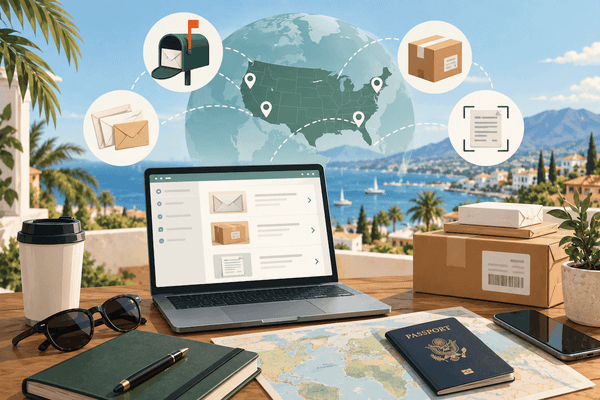
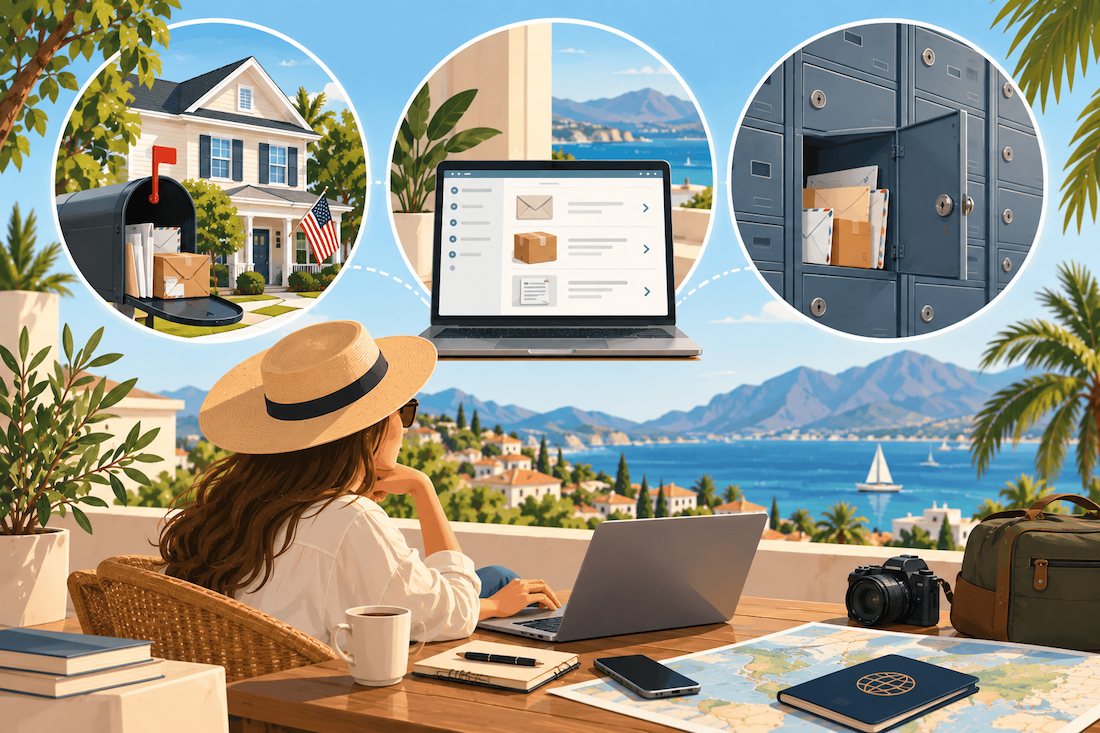
When living abroad, Americans have three principal choices for obtaining a U.S. address: a P.O. box, a virtual mailbox, or a residential address. The P.O. box is the least expensive option but also the most restricted; it accepts only mail from the U.S. Post Office, is rejected by banks and motor vehicle departments when used as a primary address, and cannot receive packages from FedEx, UPS, or DHL. A virtual mailbox is a more affordable alternative to a P.O. box since it accepts all carriers and provides a genuine street address. However, most virtual mailbox services use addresses flagged as CMRA addresses, which banks and motor vehicle departments also reject when submitted as a primary address. A residential address obtained through a qualifying domicile service is not CMRA-flagged, passes banking CIP checks, can be used to apply for a driver's license, and is acceptable for domicile documentation. It is the most costly option and the only one that meets all the requirements an expatriate needs for a U.S. address. If you only need to receive and forward mail, a virtual mailbox is a good solution, costing between $10 and $20 per month. But if you need the address for banking or to apply for a driver's license, you'll need a residential address.
Why the type of US address matters for Americans abroad
An American living abroad still needs a U.S. address because banks require it for account compliance with the PATRIOT Act. The IRS uses the address to send correspondence; state DMVs ask for it when you apply for a driver's license, and investment accounts, insurance companies and government agencies all require one on file.
The issue is that not all addresses in the United States are treated the same way. The type of address determines whether it will pass a bank's compliance check, whether the DMV will accept it when applying for a driver's license, and whether it can be used as a legal domicile. A mistake here could result in rejected bank account applications, failed driver's license applications, and an invalid domicile claim.
Three types of addresses are available for people living abroad: PO boxes, virtual mailboxes with CMRA-flagged addresses, and residential addresses without the CMRA flag. Each of these serves a different function and fails for different reasons.
To figure out which type you need, ask: does the address need to work with a bank or for a driver's license? In that case, only the residential address will do; if not, a virtual mailbox deals with forwarding mail very well at a much lower price.
Physical address verification for US banks explains what banks check when verifying an address and which address types pass.
PO box: the most limited option
A PO box is a numbered box that you rent directly from the USPS at a post office and it is the cheapest option with annual rates ranging from about $25 to $150 depending on its size and location. It is also the most unsuitable choice for Americans who are abroad and need a working US address.
The function of a PO box is that it only accepts mail from the USPS; letters, bills, and USPS packages go to the post office and remain in the box until you retrieve them or they are forwarded.
What a PO box cannot do:
You can have deliveries made by FedEx, UPS, or DHL. With private carriers you need a physical street address as they won't deliver to a PO box. Deliveries will fail if you place an order with Amazon or any retailer that uses a private carrier.
Act as the main address for banking purposes; banks thoroughly reject PO boxes when verifying customers as part of the Customer Identification Program, with no exceptions and no possible workarounds.
Can be used as the address on a driver's licence. All the state DMVs require a physical residential street address and specifically exclude a PO box number.
Provide documentation of your domicile. It is not possible for a P.O. box to establish a legal residency claim in any state, since voter registration, Declaration of Domicile filings, and all government records require a physical address.
A PO box should only be used not as a substitute. Some expats keep a PO box for minor USPS correspondence while using their residential address for banking and DMV dealings. Yet, if it is used as a standalone solution for Americans living abroad, it causes more problems than it resolves.
Can you send mail from a PO box? This section explains the mechanics of forwarding mail with the US Post Office and outlines the specific limitations regarding what can and cannot be forwarded.
Virtual mailbox: a better alternative to a PO box for packages and mail, but not for banking
A virtual mailbox is a genuine US street address where our staff receives your mail and parcels, scans them digitally, and makes everything available through an online dashboard or mobile app. It accepts all carriers, including USPS, FedEx, UPS, and DHL, so it's a worthwhile upgrade from a PO box for anyone who gets packages from US retailers.
Most services cost between $10 and $20 per month; when you factor in package delivery, scanning, and digital access, a virtual mailbox is cheaper than a PO box over the long term.
The virtual mailbox performs the following functions: it accepts all mail and packages sent by every carrier, will scan when requested, forwards mail internationally, and offers a genuine street address for use in general correspondence.
The limitation of CMRA: essentially all standard virtual mailbox services use addresses that have been registered with the USPS as Commercial Mail Receiving Agencies. The USPS marks these addresses in its Delivery Point Validation database, and both banks conducting CIP checks and state DMVs check this database. Most banks treat an address that has been flagged as a CMRA as an invalid primary address, and all state DMVs reject such an address when it comes to issuing a driver's license, no matter how legitimate the street number may appear.
A virtual mailbox is not suitable for use as a primary address when verifying bank details or for applications to the DMV for a driver's license; it is appropriate for receiving and forwarding mail and packages at a low cost.
Regarding alternatives to using a PO box for the purpose of maintaining privacy: a virtual mailbox offers a greater degree of privacy than a PO box since the address appears as a normal suite number rather than stating "PO Box XXXX". The privacy benefit is genuine when it comes to correspondence with retailers, various services, and non-institutional parties. However, for banking and government purposes, the CMRA flag remains searchable in the USPS databases and therefore the privacy advantage does not extend to these types of institutions.
What is a CMRA address guide Explains how to check whether a specific address carries the flag before signing up for any service.
Residential address: the only PO box alternative that works for banking and the DMV
A genuine physical street address from a qualifying domicile service is one that is not marked as CMRA in the USPS database and which is accepted by all carriers; it passes the banking CIP checks, is accepted by the state DMVs when applying for a driver's licence, and can be used to establish a legal domicile in the state where the address is located.
That is why it is fundamentally different from both a PO box and a virtual mailbox: the type of address itself decides whether banks and DMVs will accept it. The issue isn't concerned with the quality of the service, the street number, or how professional it appears on paper; it is whether the CMRA flag is there.
SavvyNomad's residential address in Florida and his residential address in Rockport, Texas are not flagged by the CMRA. These addresses serve as the basis for setting up a complete domicile, including the filing of the Declaration of Domicile, obtaining a driver's license, registering to vote, and arranging for continued mail forwarding. We do not offer the address on its own when carrying out the domicile setup since it is only when the setup is completed that the address becomes valid and defensible for use with banks, the DMV, and government records.
The basic plan costs $60 per month with annual billing and includes the residential address together with the essential domicile setup; the more expensive plans offer mail forwarding, business services, and in the case of Florida, a registered agent for one LLC.
Two SavvyNomad customers who came from abroad and needed the address to work for banking and the driver's license:
Everything is fine, which includes the banking arrangements, the new phone, and the driver's licence under the Savvy Nomad address. I'm really pleased that I won't have to worry about any of that for eight years! — a customer who lives in Thailand.
We got our new addresses very quickly. Before the coffee pot was empty, all our accounts — such as cell phone and bank — had their addresses updated. — a couple who are now living abroad.
Florida residency requirements for tax purposes cover what Florida specifically requires for a complete domicile claim.
Which PO Box alternative is right for you
| PO Box | Virtual Mailbox | Residential Address | |
|---|---|---|---|
| Accepts USPS Mail | Yes | Yes | Yes |
| Accepts FedEx, UPS, DHL | No | Yes | Yes |
| Passes Banking CIP Check | No | Usually no CMRA flagged |
Yes |
| Accepted by State DMVs | No | No | Yes |
| Supports Domicile Documentation | No | No | Yes |
| Privacy (Hides Box Number) | No | Yes Looks like suite |
Yes |
| Cost | $25–150/year | $10–20/month | $60–265/month |
| Best For | Cheapest USPS-only mail | Mail and package forwarding | Full U.S. home base |
One question decides everything: does this address need to work for banking or a driver's license?
If so, you'll need a residential address since no virtual mailbox or PO box will pass the checks carried out by these organizations, and the only alternative to a PO box that will work for this purpose is one from a qualifying domicile service.
If not, then your US home address is already set up and all you need to do is to receive and pass on the mail. A virtual mailbox is a better, more economical choice than a PO box for packages and general forwarding, since most services cost between $10 and $20 per month.
It is never appropriate to use a P.O. box as an American's main address when living abroad. If it is the only U.S. address that you are currently using, the gaps it causes with banks and the DMV should be dealt with at this time, not postponed.
Best virtual mailbox services for expats and nomads covers which providers to use for mail-only purposes.
Frequently asked questions
Can I use a PO box as my primary US address abroad?
No, PO boxes are rejected by banks when it comes to CIP compliance, rejected by the state DMVs when applying for a driver's license, and are regarded as an inadequate primary residential address by most government agencies; they are the only type of address that will accept mail from the USPS and cannot have private carriers deliver letters there. A PO box may be used to supplement a primary address but cannot be used in place of it.
How does a virtual mailbox differ from a residential address?
A CMRA-flagged commercial address receives and scans mail, while a residential address is a real, non-CMRA street address that has passed checks by banks and the DMV. Both types of addresses appear as ordinary street addresses from the outside. The banks and the DMV use the CMRA flag to distinguish between them.
Will a virtual mailbox serve my US bank account?
For most correspondence and mailing purposes, the answer is generally yes. However, most banks will reject a virtual mailbox address as your primary CIP address. Before relying on a virtual mailbox for banking compliance, check your bank's policy. If you want to use a physical address as your primary banking address, you need a residential address that is not flagged as CMRA.
What is the lowest cost alternative to a PO box?
Virtual mailbox services start at about $9.99 to $10 each month and accept all carriers, such as FedEx and UPS, so they offer a more feasible and usually cheaper option than a PO box for packages and regular mail. However, they cannot be used for banking or DMV requirements. Residential addresses from a domicile service start at $60 per month and can be used for banking, DMV matters, and for providing domicile documentation.
What is the difference between a residential address and a virtual mailbox?
The CMRA designation: most virtual mailbox services use addresses that are listed as CMRA addresses in the USPS database. When banks and DMVs check these addresses, they reject any with the CMRA flag as the primary address. An address from a qualifying domicile service is not marked as CMRA and therefore passes those checks.
Conclusion
A PO box is the cheapest option but also the most restricted. Instead of a PO Box, a virtual mailbox is a more affordable option for handling packages and forwarding general mail. Only a residential address is suitable for banking, driver's licenses, and domicile.
For most Americans living abroad, having a residential address in a state that doesn't impose an income tax is the best basis. The Florida and Texas residential addresses offered by SavvyNomad aren't flagged as CMRA addresses and provide full domicile establishment, along with mail forwarding.