Is a virtual address legal in the USA?
Are virtual addresses legal in the USA? Learn how they work for individuals and LLCs, where they’re accepted, and where they’re not.

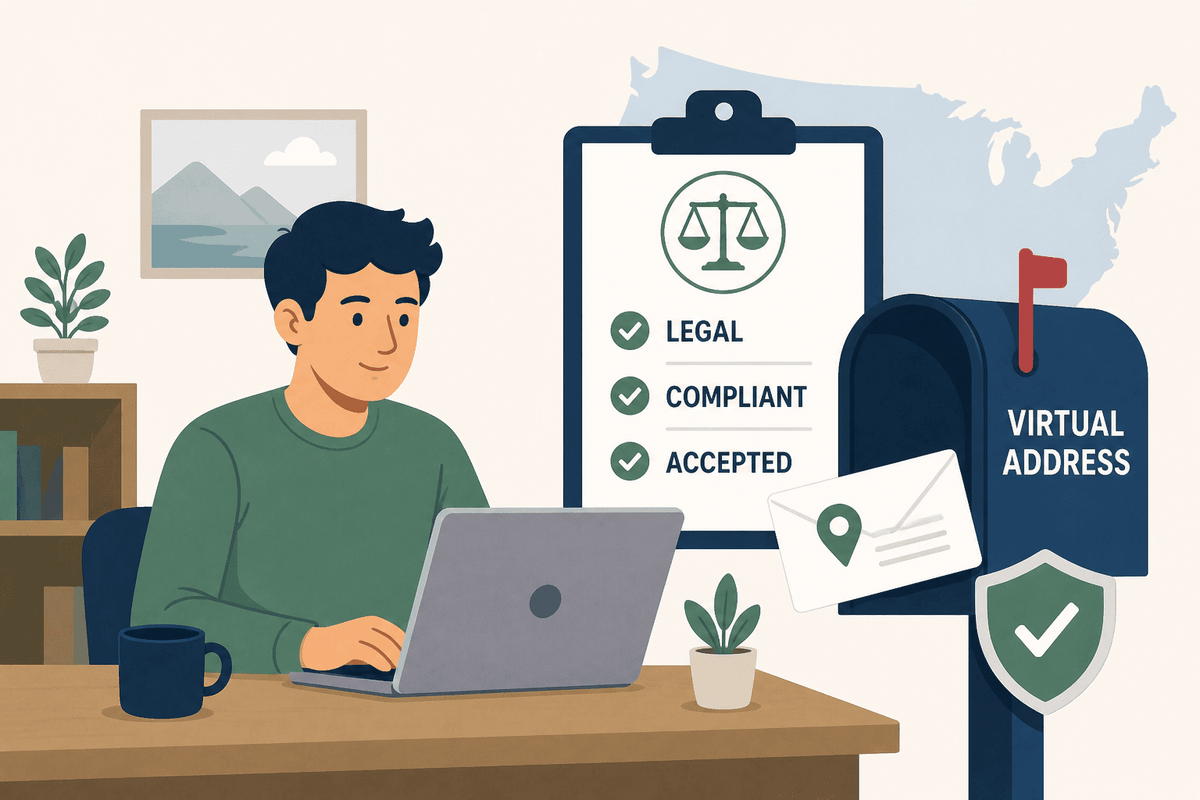
Virtual addresses are widely used across the U.S., especially by digital nomads, expats, and remote business owners. They offer flexibility, privacy, and the ability to manage mail from anywhere.
But one question often comes up: Is a virtual address actually legal in the United States?
The short answer is yes. However, legality is only part of the picture. Whether a virtual address works in practice depends on how it’s structured and how you use it.
This distinction matters because your address affects banking, taxes, licensing, and compliance. Understanding the differences between types of virtual addresses determines whether your setup works smoothly or causes problems.
Virtual addresses are legal in the U.S., but whether they work depends on their type. CMRA virtual addresses are widely used for mail and business correspondence, but they are often not accepted as a primary address for banking, taxes, or licensing. Residential virtual addresses are accepted in most cases the same way as a regular home address and can be used for both everyday and official purposes.
For LLCs, a virtual address can support business operations, but it does not replace a registered agent and may not meet all compliance requirements on its own. The most reliable approach is to choose the right type of virtual address for your needs, rather than assuming all virtual addresses work the same way.
Are virtual addresses legal? Short answer
Yes, virtual addresses are legal in the United States.
There is nothing inherently illegal about using a virtual address to receive mail or manage correspondence. Millions of individuals and businesses rely on them every day.
However, legality is not the same as acceptance.
A virtual address may be perfectly legal, but it may not be accepted for certain official purposes, such as opening a bank account or proving residency. Institutions apply their own rules based on the type of address, not just because it is virtual.
The key idea is simple: virtual addresses are legal, but whether they work depends on how they are classified and used.
What is a virtual address?
A virtual address is a real U.S. address that you can use to receive mail while managing everything remotely.
Not all virtual addresses are the same. There are two main types:
- CMRA virtual addresses — operated by Commercial Mail Receiving Agencies. Most virtual mailbox services fall into this category. They are authorized to receive mail, but they are flagged differently by banks and government agencies.
- Residential virtual addresses — real residential addresses provided as a service (not commercial-mail classified). These are generally accepted by banks, the DMV, and the IRS, just as any home address would be.
The classification (CMRA vs residential) is what determines whether your address will be accepted for banking, licensing, and tax records. The fact that you access your mail digitally doesn’t change this.
Are virtual addresses legal for individuals?
For individuals, virtual addresses are widely used and completely legal.
They are commonly used to receive mail while traveling, manage documents remotely, and maintain privacy by not using a personal home address.
For example, a digital nomad living abroad might use a virtual address to receive tax documents or bank statements and access them online. In this context, the setup works perfectly.
The difference appears when the address is used for official purposes. A CMRA address may work for receiving mail, but it may not be accepted as your primary address for banking, a driver’s license, or tax residency.
A residential virtual address, on the other hand, can typically be used for both mail and official purposes, because it is not classified as commercial mail.
Comment
by u/FlyAggravating6502 from discussion
in digitalnomad
Where limitations start
The challenges begin when a virtual address is used for official or compliance-related purposes.
Many institutions require a residential address, not a CMRA address. This includes:
- Banks and financial institutions (CIP/KYC requirements)
- Driver’s license applications (DMV)
- Tax residency or domicile records
- Government services
In these cases, a virtual address may be rejected or require additional verification.
Are virtual addresses legal for businesses (LLCs)?
Virtual addresses are also commonly used by businesses and LLCs.
They can be used for business registration, receiving mail, and presenting a professional business address. This is especially useful for online businesses or remote teams that don’t operate from a physical office.
However, there are limitations depending on how the address is used.
For example, while an LLC may be registered using a virtual address in some cases, opening a business bank account or passing compliance checks may require a residential or operational address. This is where the distinction between CMRA and residential addresses becomes important.
Virtual address vs registered agent
A registered agent must have a physical address in the state where the business is registered. This address is used to receive legal documents and official notices.
Check out the Reddit conversation:
Comment
by u/SeaUnderstanding6731 from discussion
in digitalnomad
A virtual address does not automatically replace this requirement.
However, it’s important to clarify that registered agent services themselves often use commercial street addresses to receive legal mail on behalf of LLC owners. The key requirement is that the agent must be physically located in the state where the business is registered.
This means the limitation is not that the address is “virtual,” but rather whether it meets the state's requirements for a registered agent.
CMRA addresses and why they matter
CMRA addresses are the most common type of virtual address, and this is where many issues begin.
A CMRA (Commercial Mail Receiving Agency) is authorized to receive mail, but its addresses are identified as commercial mail locations. Because of this classification, banks and government agencies often treat them differently from residential addresses.
For example, a bank may allow you to use a CMRA address as a mailing address but not as your primary address for identity verification. Similarly, government agencies may require a residential address for records.
This doesn’t make CMRA addresses invalid: it simply means they are not suitable for every use case.
When using a virtual address can cause problems
Problems usually arise when the address type does not meet the institution's requirements.
For example, using a CMRA address when a residential address is required can lead to delays, requests for additional documents, or even rejections. It can also make it harder to prove residency if your records don’t align.
Another issue comes from inconsistent setups. If your bank, tax filings, and identification documents show different types of addresses, it may trigger additional verification or scrutiny.
When using a virtual address can become illegal
While virtual addresses themselves are legal, how you use them can cross the line into illegality.
For example, claiming residency in a state where you do not actually live in order to avoid taxes can be considered tax fraud. Using an address to misrepresent your business presence to avoid state nexus rules can also expose you to legal liability.
More serious cases include using an address for fraudulent activities. In these situations, the issue is not the address itself, but the intent and how it is used.
When a residential address is required instead
There are specific situations where a residential address is expected.
This includes opening bank accounts, applying for a driver’s license, establishing tax residency, and completing certain legal or compliance-related processes.
In these cases, a residential virtual address can often work, while a CMRA address may not.
Can you combine a virtual address with a residential setup?
Yes, and this is often the most effective approach. Many people use a hybrid setup that combines a virtual address for everyday mail management with a residential address for official and compliance purposes.
This allows you to stay flexible while still meeting institutional requirements. For example, you might use a virtual mailbox to handle your daily mail, while keeping a compliant residential address on file for banking and legal use.
Common mistakes to avoid
Many issues with virtual addresses stem from a misunderstanding of how they’re meant to be used. People often assume that any virtual address will work everywhere, without realizing that institutions look at how the address is classified.
A common mistake is using a CMRA address as a primary address for banking or tax purposes, which can lead to delays or rejections. Others rely on a virtual address as their only address, without considering whether it complies with the requirements.
There is also confusion around how personal and business use overlap. Using the same address across different systems without understanding how each system evaluates it can create inconsistencies that later raise questions.
How to choose the right setup
Choosing the right setup depends on how you plan to use your address.
If your goal is simply to receive and manage mail, a CMRA-based virtual address may be enough. But if you need your address to work for banking, licensing, or tax purposes, you should look for a residential virtual address.
For example, someone running an online business may start with a virtual mailbox, but when opening a business bank account, they may be asked for a residential address. In contrast, someone using a residential virtual address from the beginning can often avoid that friction entirely.
The key is not choosing between “virtual” and “physical,” but choosing the correct type of virtual address for your needs.
How SavvyNomad can help
If you’re living abroad or running a business remotely, your address, domicile, and documentation must all work together.
SavvyNomad provides both virtual address and mail-forwarding solutions, along with support for setting up a compliant residential address when needed.
The goal is to help you build a setup that is flexible enough for your lifestyle while still meeting the requirements of banks, government agencies, and other institutions.
Conclusion
Virtual addresses are legal in the United States, but not all virtual addresses are the same.
The difference between CMRA and residential classification is what determines whether your address will be accepted for banking, licensing, and tax purposes.
Understanding this distinction allows you to avoid common issues and build a setup that actually works in practice.
When used correctly, a virtual address can be both flexible and compliant. The key is choosing the right type for your specific needs.
FAQs
Are virtual addresses legal in the USA?
Yes, virtual addresses are legal. However, whether they are accepted depends on how they are classified and used.
Can I use a virtual address for my LLC?
In many cases, yes. But depending on the situation, you may still need a registered agent and a compliant address for banking or licensing.
Can I use a virtual address for banking?
It depends on the type. Most virtual addresses are CMRA-classified, and banks generally accept them as mailing addresses but not as your primary address for CIP/KYC. Residential virtual addresses (non-CMRA) can usually be used as both mailing and primary addresses. If banking is important, confirm the address type in advance.
Is a virtual address the same as a residential address?
No. Most virtual addresses are CMRA-classified, which are treated differently from residential addresses by institutions.
Do I need a registered agent if I have a virtual address?
Yes. A registered agent is a separate requirement and must meet state-specific rules.