Virtual mailbox vs. mail forwarding service: what’s the actual difference?
Not sure if you need a virtual mailbox or mail forwarding? Learn the key differences, pros, and when to use each option.

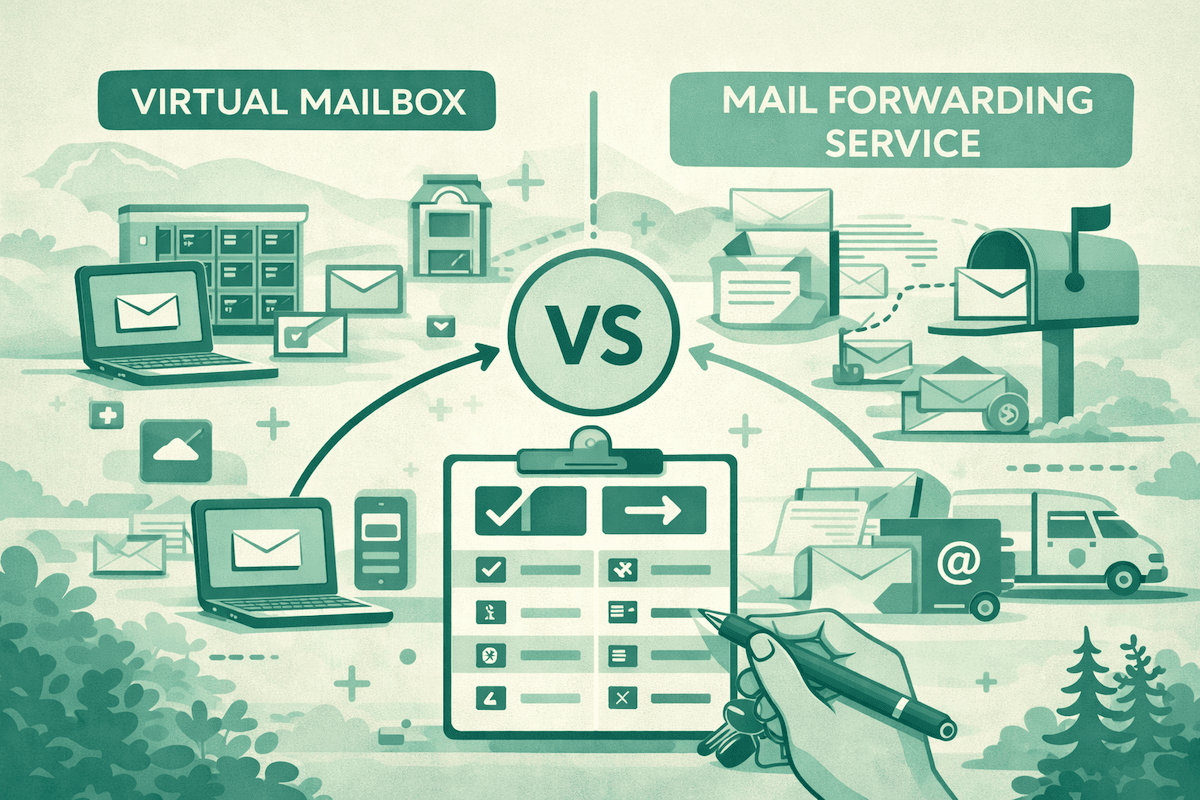
“Virtual mailbox” and “mail forwarding” are words often used as if they mean the same thing, though they have different meanings.
At a glance, both services let you receive mail somewhere else and access it remotely. But the way they work, what they’re best for, and how they fit into a compliant setup can vary widely.
This matters more than most people expect. If you’re an expat, digital nomad, RVer, or remote worker, the type of service you choose can affect how you manage documents, how quickly you receive important mail, and even whether your address is accepted by banks or government agencies.
This guide breaks down the key differences between a virtual mailbox and a mail-forwarding service, so you can choose the right setup for your situation.
A virtual mailbox gives you digital access to your mail. You can view, scan, and manage everything online without needing physical delivery.
A mail forwarding service sends your physical mail and packages to your current location.
Both require USPS Form 1583, but neither automatically gives you a legal residential address or domicile.
The best choice depends on your needs: go with a virtual mailbox for convenience and digital access, choose mail forwarding if you need physical documents regularly, or use both together for flexibility.
What is a virtual mailbox?
A virtual mailbox is a digital-first mail service that lets you manage your mail online.
When mail arrives at your chosen address, the provider scans the envelope and uploads it to your account. From there, you can log in and decide what to do next.
You can choose to open and read the email, forward it, save it for later, or delete it.
The key advantage is visibility. You can see your mail from anywhere in the world without waiting for it to be physically delivered.
Typical features include:
- Mail scanning and digital storage
- Online dashboard access
- Notifications when new mail arrives
- Options to open, forward, or discard items
This setup works well for people who prefer to handle most of their mail digitally and only request physical forwarding when necessary.
What is a mail forwarding service?
A mail forwarding service focuses on physical delivery.
Instead of scanning your mail by default, the provider receives your items and sends them to your current location based on your instructions.
This can be done on demand or on a regular schedule, such as weekly or monthly shipments.
Some providers offer basic scanning, but the core function is still physical forwarding.
Typical features include:
- Receiving and storing mail
- Forwarding letters and packages to your location
- Consolidating shipments to reduce costs
- Handling parcels and larger deliveries
Mail forwarding services are often used by people who need reliable access to original documents, such as contracts, legal notices, or physical packages.
Key differences at a glance
The main difference comes down to how you access your mail.
A virtual mailbox gives you immediate digital access. You can view your mail online and decide what to do without waiting.
Mail forwarding focuses on getting the physical item into your hands. You may not see the contents until it arrives.
Other differences include:
- Speed: Virtual mailbox = instant visibility. Mail forwarding = depends on shipping time.
- Cost structure: Virtual mailbox services often charge for scans and actions. Mail forwarding costs are tied to shipping and handling.
- Use case: Virtual mailbox is ideal for digital management. Mail forwarding is better for physical delivery.
- Flexibility: Virtual mailbox offers more control over individual items. Mail forwarding is more batch-oriented.
Understanding these differences helps you match the service to your needs.
How USPS Form 1583 fits into both
Regardless of which service you choose, you’ll need to complete USPS Form 1583.
This form authorizes a third party to receive and handle your mail. It’s required for all Commercial Mail Receiving Agencies (CMRAs), which include both virtual mailbox providers and mail forwarding services.
You’ll need to verify your identity with two forms of ID and have the form notarised.
Without this step, no provider can legally accept your mail.
Address type: the most important difference people miss
The biggest misunderstanding isn’t about how these services work. It’s about the type of address they provide.
Most virtual mailbox and mail forwarding services use CMRA addresses. These are commercial mailing addresses, not traditional residential ones.
This distinction matters.
While CMRA addresses are perfectly fine for receiving mail, they may not always be accepted for:
- Banking and financial services
- Driver’s licenses
- Voter registration
- Tax residency purposes
In other words, choosing between a virtual mailbox and mail forwarding doesn’t automatically solve your address needs. You also need to consider whether the address itself is suitable for your intended use. If you need to maintain US address while living abroad, there are many options available.
When to use a virtual mailbox
A virtual mailbox works best if you want to manage most of your mail digitally.
It’s a good fit if:
- You travel frequently and don’t want physical mail shipped often
- You prefer to view and organize mail online
- You only need physical documents occasionally
- You want quick access to important correspondence
This makes it a popular choice for digital nomads and remote workers who prioritize flexibility and speed.
When to use mail forwarding
Mail forwarding is the better option when you need regular access to physical items.
It’s a good fit if:
- You receive important original documents
- You expect packages or larger deliveries
- You prefer to handle mail physically
- You want consolidated shipments sent to your location
This is common for RVers and expats who rely on receiving documents in their current location rather than managing everything digitally.
Can you use both together?
Yes, and many people do.
A hybrid setup can give you the best of both worlds.
For example, you might use a virtual mailbox to monitor incoming mail and only forward selected items when needed. This reduces unnecessary shipping while still ensuring you receive important documents.
Some providers, like SavvyNomad, offer both services on a single platform, while others require you to combine solutions.
The right setup depends on how you balance convenience, cost, and access.
Common mistakes to avoid
Most problems with mail services stem from a misunderstanding of how they fit into a larger setup.
One common mistake is assuming that a virtual mailbox and mail forwarding are interchangeable. While they overlap, they serve different purposes.
Another issue is relying on a CMRA address when a residential address is required. This can lead to rejected applications or delays with banks and government agencies.
Choosing a service based only on price is another risk. A cheaper option may not meet your needs if it lacks flexibility or compliance features.
Finally, failing to consider long-term use can create problems later. Your needs may change as your lifestyle evolves, so it’s worth choosing a service that can scale with you.
Virtual mailbox vs domicile: not the same thing
It’s important to separate mail services from legal residence.
A virtual mailbox or mail forwarding service does not establish a domicile. It only handles your mail.
Domicile is your legal home base, which determines your tax obligations, licensing, and official residency status.
Confusing the two can lead to compliance issues, especially if you rely on your mailing address for purposes beyond receiving mail.
How to choose the right option for your situation
The best choice depends on how you live and what you need from your setup.
If your lifestyle is highly mobile and you prefer digital access, a virtual mailbox may be the better option.
If you regularly need physical documents or packages, mail forwarding may make more sense.
If you want flexibility, combining both can be a practical solution.
Beyond the service itself, think about how your address will be used. Make sure it aligns with your broader goals, whether that’s banking, taxes, or establishing a domicile.
How SavvyNomad can help
Choosing between a virtual mailbox and mail forwarding is only part of the process. If you’re living abroad or on the move, you also need to consider how your address, domicile, and documentation fit together.
SavvyNomad mail forwarding and virtual address solutions meet your needs. Beyond that, it helps organize your domicile and align your records across systems, so everything works together as a consistent, compliant foundation.
Conclusion
Virtual mailbox services and mail forwarding services both solve the same core problem: receiving mail when you’re not in one place.
But they do it in different ways.
A virtual mailbox gives you digital access and flexibility. Mail forwarding ensures you receive physical items when you need them.
The right choice depends on your lifestyle and how you manage your mail. Just as importantly, it depends on how your address fits into your overall setup.
By understanding the differences and making careful choices, you can create a system that supports your life on the road or abroad without unnecessary complications.
FAQs
Is a virtual mailbox the same as mail forwarding?
No. A virtual mailbox focuses on digital access, while mail forwarding focuses on physical delivery.
Can I use a virtual mailbox as my legal address?
Not always. Many services provide CMRA addresses, which may not meet all legal requirements.
Do both require USPS Form 1583?
Yes, both types of services require Form 1583 for mail handling authorization.
Which is better for expats or RVers?
It depends on your needs. Many people use both.
Can I switch between them later?
Yes, but it may require updating your address and documentation.