7 best mail forwarding services for US expats
Long-term expats need more from a mail service than travelers do: bank-friendly addresses, IRS and Social Security letters on time, check deposits and affordable international shipping. Here's how 7 services compare, plus Anytime Mailbox vs US Global Mail.


Living abroad long term, you still get bank letters, IRS notices, Social Security forms and paper checks at a US address.
This guide compares seven mail forwarding services for expats on what matters for a long stay: address type, check deposits, storage and international shipping. If you mainly travel rather than live abroad, see our guide to mail services for travelers and nomads.
The best mail service for expats depends on one question: do you need an address your bank and the DMV accept, or just a place for mail? If it's only mail, iPostal1, Anytime Mailbox and PostScan Mail start around $10 a month, Traveling Mailbox at $15, VirtualPostMail around $20 and US Global Mail at $49 for heavier volume. Their standard mailbox addresses are commercial mail receiving agency (CMRA) addresses that banks often reject as a home address. If you also need a US residential address, SavvyNomad pairs one in Florida or Texas with a Florida mailing address for forwarding, from $90 a month billed annually.
Expat mail forwarding services compared
| Service | Address Type | Check Deposit | Free Storage | Starting Price |
|---|---|---|---|---|
| SavvyNomad | Residential (FL or TX) + Florida mailing address | $6 + $9.99 postage | Packages 7 days; scans kept online | $90/mo billed annually with forwarding |
| Traveling Mailbox | CMRA | $4.95 + postage | 30 days | $15/mo |
| US Global Mail | CMRA | Free on Scale plan | 30 days | $49/mo |
| Anytime Mailbox | CMRA | Select locations only | Set by location | ~$9.99/mo |
| iPostal1 | CMRA | Extra fee | Varies by plan | $9.99/mo |
| VirtualPostMail | CMRA mailbox; separate business and home address products | Pay per deposit | 60 days physical | ~$20/mo |
| PostScan Mail | CMRA | Not listed | Varies by plan | $10/mo |
Prices are list prices at the time of writing. Check each provider's site before you sign up.
What long-term expats need from a mail service
Good mail forwarding for expats has to handle five kinds of mail well.
Bank and brokerage mail
Your bank keeps sending statements, replacement cards and security letters. Banks generally expect a residential street address as your home address under their identity rules, and CMRA-flagged addresses are routinely rejected. Most banks let you list a residential address and a separate mailing address. See physical address verification for US banks and how to keep a US bank account while living abroad.
IRS and Social Security letters
The IRS sends notices to your last known address, usually the one on your latest tax return. If you change it, file IRS Form 8822 so letters don't go to an old home. IRS notices often carry response deadlines, so fast content scanning matters.
If you receive Social Security abroad, the Social Security Administration mails a Foreign Enforcement Questionnaire (Form SSA-7162) every one or two years, usually between May and June. If you don't return it, your payments can stop. Make sure the SSA has an address where that form will actually reach you.
Check deposits
Tax refunds, dividends, insurance payouts and old-employer checks still arrive on paper. A service that deposits checks for you saves an international trip or a mailed check that can get lost.
International package forwarding and customs
Forwarding a package abroad means a customs declaration listing the contents and value. The recipient often pays import duties or VAT on arrival, depending on the country. Many carriers restrict items such as lithium batteries, aerosols and some medications. Look for services that consolidate several orders into one box and let you choose the carrier, since shipping usually costs more than the monthly plan.
Storage
If you batch shipments every few months, check how long mail is held free before storage fees start.
Best virtual mailbox for expats: mailbox vs residential address
A virtual mailbox gives you a US mailing address. Mail is scanned, and you choose to open, forward, shred or deposit it. For many expats, that's all they need.
A residential address is different. It's a place of abode that can go on your bank's identity file and your driver's license. Under the Patriot Act, banks verify a residential address, and CMRA addresses are flagged by the verification tools banks use.
So the best virtual mailbox for expats depends on your situation. If you only need mail handled, pick by mail volume and shipping cost. If your bank or license depends on the address, you need a residential address, and many expats pair it with a mailing address. Our virtual mailbox comparison covers mailbox-only options in more depth.
Top 7 mail forwarding services for American expats
Here's an updated comparison of some top mail forwarding providers for American expats, including pricing and feature highlights:
1. SavvyNomad

Who it's for: Expats who need a US address for banking, a driver's license or state domicile, not only for mail.
How it works: You get a residential address in Florida or Texas. It's an RV park lot or, on the Florida-only Domicile Premium plan, a home address. It's a place of abode, not a CMRA, so you can use it with banks and on your driver's license. The residential address accepts essential mail only, such as cards and government letters, and no packages. On the SavvyNomad plan and up, you also get a mailing address in Brandon, Florida for everyday mail and packages, even if your domicile is in Texas.
Key features:
- Residential address in Florida or Texas, plus domicile support such as your Declaration of Domicile (filed for you in Florida)
- Free scanning, worldwide forwarding, shredding and check deposit through an online portal
- Business mail at the mailing address on the SavvyNomad plan and up
Pricing:
- Basic Domicile: $60/mo billed annually ($75/mo quarterly). Residential address only. No mail forwarding.
- SavvyNomad: $90/mo billed annually ($105/mo quarterly). Adds the Florida mailing address and mail forwarding.
- Domicile Premium (Florida only): $265/mo billed annually ($295/mo quarterly). Adds a home address and a monthly utility bill.
Forwarding costs postage plus a $5 handling fee. Check deposits cost $6 plus $9.99 postage. Packages are stored free for 7 days, then $3 per item per day.
Drawbacks: It costs more than a virtual mailbox, and forwarding starts on the SavvyNomad plan. Residential addresses are only in Florida and Texas. No address guarantees acceptance by every bank or agency.
Comment
by u/bohdandr from discussion
in digitalnomad
2. Traveling Mailbox

Who it's for: Expats who forward mail in batches and want predictable shipping costs.
Key features:
- Several US address locations, all CMRA, with a home base in Sanford, North Carolina
- Forwarding costs postage plus $2 per shipment, not per item, so batching saves money
- Check deposit for $4.95 plus postage
- Junk mail you flag doesn't count toward your plan
- Envelopes and packages stored free for 30 days
Pricing: Basic $15/mo (40 envelopes), Extended $25/mo (100 envelopes), Small Business $55/mo (200 envelopes). Annual plans get two months free.
Drawbacks: CMRA address only. Envelopes and page scans over your plan limit cost extra.
Comment
by u/twilight-2k from discussion
in expats
3. US Global Mail

Who it's for: Expats with a business, rental property or high mail volume who want automated sorting.
Key features:
- Permanent US street address, with the price depending on the address you choose
- 360 mail opens and scans a year on the Scale plan, then $3 each
- AI summaries of scanned mail
- Free check deposits on Scale
- 30 days of free physical mail storage, then $0.05 per item per day
Pricing: Scale from $49/mo, Teams from $99/mo, Enterprise on request.
Drawbacks: US Global Mail has moved upmarket and is no longer a budget option. CMRA address only.
Comment
by u/twilight-2k from discussion
in expats
4. Anytime Mailbox

Who it's for: Expats who want an address in a particular city or state and receive little mail.
Key features:
- 2,500+ locations, each run by an independent mail center
- Add-ons for open and scan, forwarding, check deposit (at select locations) and shredding
- Unlimited online storage of scans
- Mobile app and web dashboard
Pricing: Plans from about $9.99/mo, with some locations lower. Each mail center sets its own prices and extra fees.
Drawbacks: Service quality and fees vary by location, so compare the exact address before you sign up. Most addresses are CMRA addresses. For a head-to-head with a residential option, see SavvyNomad vs Anytime Mailbox.
Comment
by u/65498564231 from discussion
in digitalnomad
5. iPostal1
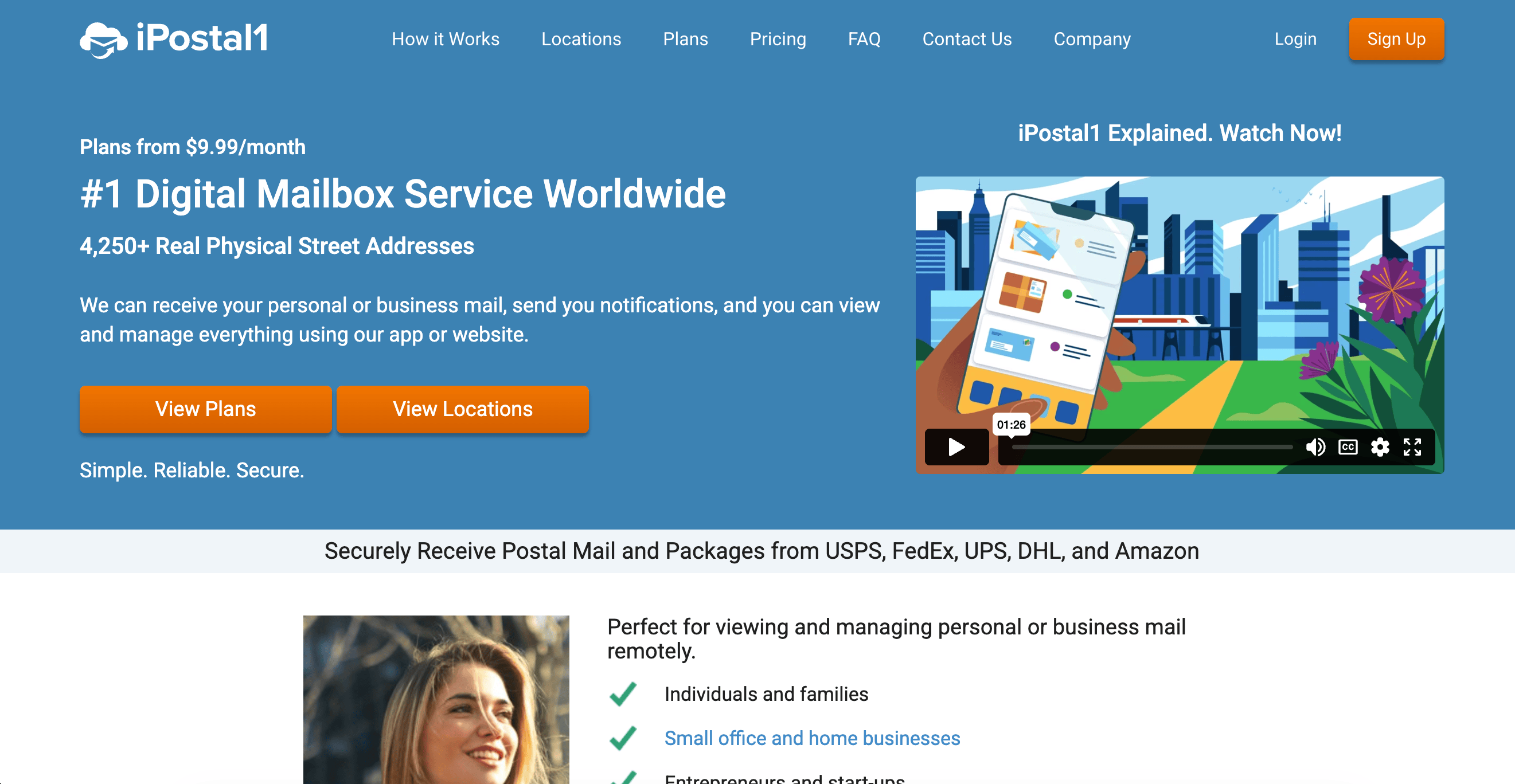
Who it's for: Budget-minded expats who want to pick from many US addresses.
Key features:
- Thousands of mailbox locations
- App-based scanning, forwarding and package handling
- Published plan tiers by mail volume
Pricing: Green $9.99/mo (30 items), Blue $14.99/mo (60), Silver $24.99/mo (120), Gold $39.99/mo (240). Prices vary by location tier. Annual billing gives you two months free.
Drawbacks: Every iPostal1 address is a CMRA, so it won't work as a home address for banking or residency. Forwarding, extra scans and overages cost extra.
Comment
by u/bananadotorg from discussion
in llc
6. VirtualPostMail
Who it's for: Expats running a US business who want a mailbox plus a business address product for verification.
Key features:
- Virtual mailbox with physical addresses in Delaware, Florida and California
- TruLease, a commercial address product marketed as "verified proof of address" for businesses, in Brandon FL, Claymont DE, Covina CA, Henderson NV and Keller TX
- TruResidence, a separate home address product in NV, FL, CA, SD and TX, priced well above its mailboxes
- Unlimited digital storage and 60 days of free physical storage on all mailbox plans
- Check deposits billed per deposit
Pricing: Mailbox plans from about $20/mo. TruLease and TruResidence are priced separately and cost considerably more.
Drawbacks: VirtualPostMail itself says "a virtual mailbox won't work for banking, lease agreements, or utility bills." Pricing isn't shown in full on its plan pages, so confirm at signup.
Comment
by u/Monkey_Socrates from discussion
in longtermtravel
7. PostScan Mail
Who it's for: Expats who want a cheap mailbox with item-based plans and bundled forwarding.
Key features:
- A large network of locations across the US
- Plans by mail volume: Starter 30 items, Standard 60, Premium 120
- Mail can be bundled into one package for forwarding, at $2 for the first item plus $0.50 per additional item, plus shipping
- Annual billing discounts
Pricing: Starter from $10/mo, Standard from $20/mo, Premium from $30/mo. Prices vary by location.
Drawbacks: CMRA addresses only. Free scans are limited on the Starter plan, and international shipping rates aren't published on the pricing page.
Anytime Mailbox vs US Global Mail
These two often come up together, but they're built for different people.
| Feature | Anytime Mailbox | US Global Mail |
|---|---|---|
| Pricing Model | Each location sets its own price | Plans set by US Global Mail; price varies by address |
| Starting Price | ~$9.99/mo | $49/mo (Scale) |
| Locations | 2,500+ independent mail centers | Fewer, company-run addresses |
| Mail Included | Varies by location and plan | 360 opens and scans a year on Scale |
| Check Deposit | Select locations only | Free on Scale |
| Free Storage | Set by location | 30 days for physical mail |
| Extras | Add-on services per location | AI summaries, automated sorting, team features |
| Address Type | Mostly CMRA | CMRA |
| Best For | Low mail volume, choosing a specific city | Higher volume, businesses, automation |
Which should you pick? If you get a few letters a month and want the cheapest address in a specific state, Anytime Mailbox usually wins on price. If you get a lot of mail, deposit checks regularly or run a business from abroad, US Global Mail's included scans and free check deposits can justify the higher fee. Neither gives you a residential address, so neither solves a bank's address check.
Options for keeping a US address while living abroad
- Domicile service. Provides a residential street address you can use with banks and on your license, often with mail forwarding. It can be one part of establishing residency in a no-income-tax state like Florida or Texas, but the address alone doesn't establish residency or guarantee a tax outcome.
- Virtual mailbox. Cheap and flexible for receiving mail, but a CMRA address won't work as your home address for banking.
- A friend's or family member's address. Works for informal mail. It gets harder when a bank asks for proof of address in your name, and it can tie you to a state you meant to leave.
More options are in how to maintain a US address as a US citizen abroad.
Choosing the right mail forwarding service
Factors to Consider
When choosing a mail forwarding service, there are several factors to consider, including:
- Reliability and Reputation: Look for providers with a strong track record of reliability and customer support.
- Cost and Pricing Structure: Evaluate the service's cost, including any additional fees for features such as package forwarding or mail scanning.
- Speed and Efficiency of Delivery: Consider the speed and efficiency of delivery, including the availability of same-day shipping options.
- Security Measures and Privacy Protection: Ensure the provider has robust security measures to protect your email and personal information.
- International Coverage and Restrictions: If you need to forward mail internationally, consider providers that offer international shipping options and have experience with customs clearance.
- Customer Support and Service Quality: Evaluate the level of customer support and service quality, including the availability of online support and phone support.
By considering these factors, individuals and businesses can choose a mail forwarding service that meets their specific needs and provides a secure, efficient, and convenient way to manage their mail and packages.
Why a U.S. residential address matters for expats
For American expats, having a U.S. residential address (rather than a Commercial Mail Receiving Agency, or CMRA) address is often critical for official purposes. A true residential address can help you fulfill key legal, banking, and tax requirements that CMRA addresses often do not meet for certain purposes.
- Legal and Tax Compliance: Residential addresses are recognized for IRS tax filings, certain state tax obligations, and other official records.
- Banking Access: Many banks require a residential address to verify accounts, prevent closures, and maintain credit scores.
- Address for Government Agencies: For certain processes—such as voter registration (if you are eligible), DMV renewals, and Social Security—residential addresses are often required. Eligibility and requirements vary by agency and state, so always check with the relevant government offices. Voter registration is a supporting indicator of domicile, not determinative on its own.
A residential address service like SavvyNomad's enables American expats to maintain essential connections and meet requirements without the limitations of a CMRA address.
FAQ
What is the best mail forwarding service for expats?
It depends on what you need the address for. For mail only, iPostal1, Anytime Mailbox, PostScan Mail and Traveling Mailbox are the cheapest. For heavy mail volume, US Global Mail adds automation and free check deposits. If you also need an address for your bank or driver's license, SavvyNomad pairs a residential address with mail forwarding.
What is the best virtual mailbox for expats?
For low mail volume, iPostal1, Anytime Mailbox or PostScan Mail at around $10 a month. For batched international forwarding, Traveling Mailbox, which charges $2 per shipment plus postage. For heavy volume or a business, US Global Mail. All of these are CMRA addresses, so if your bank needs a residential address, pair a mailbox with a residential address service.
Is Anytime Mailbox or US Global Mail better for international expats needing a US address?
It depends on your mail volume. Anytime Mailbox is cheaper and lets you pick from 2,500+ locations, which suits low mail volume. US Global Mail costs more but includes 360 scans a year and free check deposits on its Scale plan, which suits heavier mail. Both give you a CMRA mailing address, not a residential address, so if you need a US address for your bank or driver's license, neither is enough on its own.
Can I use a mail forwarding address for my US bank account?
Usually not as your residential address. Banks generally require a residential street address and flag CMRA addresses. You can often use a mail forwarding address as your mailing address and a separate residential address as your home address.
What address should I give the IRS and Social Security?
Use an address where letters will reach you quickly. Many expats give a US mailing address with fast scanning. Update the IRS with Form 8822 if you change it. If you receive Social Security abroad, make sure the SSA can reach you with Form SSA-7162, since payments can stop if you don't return it.
Can my mail service deposit checks for me?
Most can. Traveling Mailbox charges $4.95 plus postage, US Global Mail includes check deposits on its Scale plan, SavvyNomad charges $6 plus $9.99 postage, VirtualPostMail bills per deposit and Anytime Mailbox offers it at select locations.
How do I forward US mail and packages internationally?
You set up a US mailbox, update your address with senders, and request shipments from the provider's app. Most charge postage plus a handling fee. International packages need a customs declaration, and you may owe import duties when they arrive. Batching items into one shipment usually costs less, so the best international mail forwarding service for you is the one with low per-shipment fees to your country.
Conclusion
The best mail forwarding service for an expat depends on whether you need a mailbox or a home address. For mail alone, pick by volume: iPostal1, Anytime Mailbox or PostScan Mail for a few letters; Traveling Mailbox for batched shipments; US Global Mail for heavy volume. If your bank, license or state residency depend on the address, you need a residential address, and many expats pair it with a mailing address for everything else.