Child Born Abroad: Citizenship, SSN & Tax Considerations
A baby born abroad to a US citizen parent may be a US citizen from birth, but citizenship doesn't register itself. Here's what expat parents need to do: apply for the CRBA and passport, get an SSN, and claim the tax credits most miss.

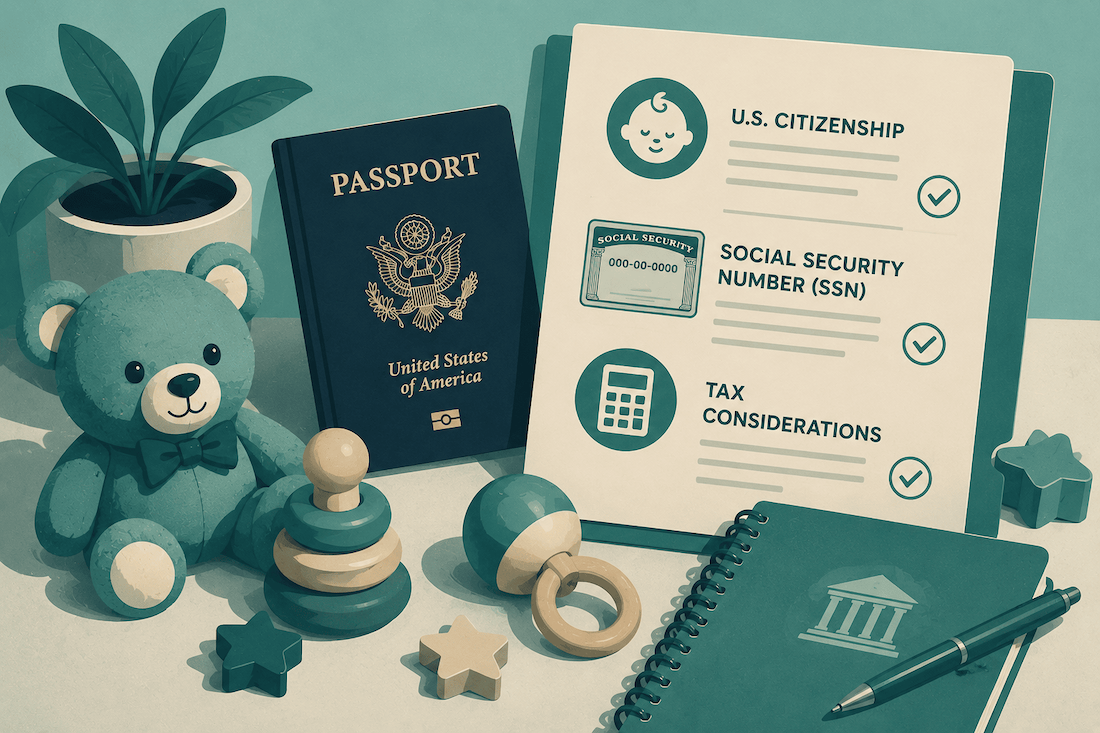
Having a baby abroad comes with a to-do list that most hospitals won't hand you on the way out. The local birth registration is obvious. What comes next is less so.
If one or both parents are US citizens, the child may be a US citizen from birth, regardless of where they were born. But citizenship acquired abroad does not register itself. It requires a specific application at a US embassy or consulate, a separate Social Security Number application, and a US passport the child will need before they can ever travel to the US.
There are also tax benefits that most expat parents miss entirely because they never got their SSNs sorted in time to claim them.
This guide covers the full sequence: confirming citizenship eligibility, applying for the CRBA and passport, obtaining an SSN, and understanding the tax considerations that come with raising a US-citizen child abroad.
A child born abroad to a US citizen parent may acquire US citizenship at birth under the Immigration and Nationality Act. The process requires three separate applications: a Consular Report of Birth Abroad (CRBA, Form FS-240) at the nearest US embassy or consulate, a US passport for the child applied for simultaneously, and a Social Security Number applied for through the embassy or directly with the SSA. The SSN is essential for tax purposes. Without it, the child cannot be claimed as a dependent and the Child Tax Credit cannot be claimed. Once the SSN is in hand, most expat parents qualify for the Child Tax Credit of up to $2,000 per qualifying child, including a refundable portion up to $1,700 (verify 2026 figures) that can generate a refund even when no US tax is owed. The child inherits the US citizenship-based tax filing obligation and will need to file US returns once their income exceeds the filing threshold.
Does my child born abroad have US citizenship?
A child born outside the United States may acquire US citizenship at birth if at least one parent is a US citizen and certain physical presence requirements are met.
- If both parents are US citizens, the child acquires citizenship if at least one parent had resided in the United States at any point before the child's birth. This is a relatively straightforward requirement for most US citizen couples.
- If only one parent is a US citizen, the citizenship-transmitting parent must have been physically present in the US for at least 5 years before the birth, of which at least 2 were after the parent's 14th birthday. This is the requirement that most commonly catches people off guard. A US citizen who grew up abroad or left the US as a teenager may not have accumulated enough qualifying US physical presence to transmit citizenship to their child. If this applies to you, document your US physical presence carefully and review the rules with a legal professional before assuming eligibility.
- If the parents are not married: rules vary depending on which parent is the US citizen. An unwed US citizen mother must show at least one year of continuous physical presence in the US before the birth. An unwed US citizen father must provide a sworn statement of child support and demonstrate 5 years of US physical presence (2 after age 14), among other requirements.
If there is any question about whether your child qualifies, the State Department's eligibility wizard at travel.state.gov can help, and many consulates will confirm eligibility before you travel to the appointment.
| Situation | U.S. Physical Presence Requirement | Key Condition |
|---|---|---|
| Both parents are U.S. citizens | At least one parent must have had any U.S. residence before the child's birth. | Straightforward for most couples. |
| One parent is a U.S. citizen (married) | The U.S. citizen parent must have been physically present in the United States for at least 5 years before the birth, including 2 years after age 14. | The requirement that most commonly catches people off guard. |
| Unwed U.S. citizen mother | At least 1 year of continuous physical presence in the United States before the child's birth. | Continuous presence is required. |
| Unwed U.S. citizen father | At least 5 years of physical presence in the United States before the birth, including 2 years after age 14. | Must also provide a sworn statement agreeing to financially support the child until age 18. This is the most complex scenario. |
Taxes on American citizens living abroad
The CRBA: what it is and how to apply
The Consular Report of Birth Abroad (CRBA, Form FS-240) is the primary proof of US citizenship for a child born abroad. It is not a birth certificate and it is not a travel document. It is the official document that certifies your child's US citizenship, and it is what you will use when your child applies for passports, starts work, or needs to prove their citizenship at any point in their life.
CRBA applications must be submitted before the child's 18th birthday. The strong recommendation from the State Department is to apply as soon as possible after birth, while evidence is fresh and parents are available.
The application process
Most US embassies and consulates now use the eCRBA system through the MyTravelGov portal. The process works like this:
- Register for a MyTravelGov account at mytravelgov.com
- Complete the eCRBA application online and upload supporting documents
- Pay the fee (approximately $100 per child; verify current fee at travel.state.gov before applying)
- Schedule an in-person appointment at the US embassy or consulate
- Attend the appointment in person with the child and the US citizen parent or parents
At most embassies, the CRBA and the child's first US passport are processed during a single combined appointment. This is worth taking advantage of — it saves a separate trip.
Documents typically required
- The host country birth certificate (original and copies)
- Evidence of the US citizen parent's citizenship: a US passport or US birth certificate
- Evidence of the US citizen parent's physical presence in the US: school or university transcripts, employment records, tax returns, military records
- Marriage certificate if the parents are married (required when one parent is a foreign national)
- Completed application forms and fee payment confirmation
Different embassies may have slightly different requirements. Check the specific embassy website for your country before your appointment.
The US passport: apply at the same time
Every child who is a US citizen must use a US passport to enter and exit the United States. This applies even if the child holds citizenship of another country through birth or by descent. A French passport alone is not sufficient for a dual French-American child to travel to the US.
Apply for the child's US passport at the same combined consulate appointment as the CRBA. You will need Form DS-11, the standard passport application for first-time applicants.
Both parents must either both be present at the appointment or one parent must provide a signed and notarised form of consent (Form DS-3053) from the absent parent. This is a firm requirement for children under 16.
US passports for children under 16 are valid for 5 years. Children 16 and older receive the standard 10-year passport.
Do not wait to apply for the passport after the CRBA is issued. Apply simultaneously. The child cannot travel internationally on a US passport they do not yet have, and processing times vary by embassy and season.
How to renew a US passport from abroad
The Social Security Number: getting it right from the start
The Social Security Number is not just an administrative detail. For US tax purposes, the SSN is essential. Without it, you cannot claim your child as a dependent on your US tax return, and you cannot claim the Child Tax Credit for that child. Every year without an SSN is a year of tax benefits the IRS cannot process.
Apply for the SSN as soon as the CRBA is in process. Many US embassies offer simultaneous SSN processing at the CRBA appointment. The embassy submits Form SS-5 to the Social Security Administration on the parent's behalf. If the embassy does not offer this service, apply directly through the SSA using Form SS-5 and attaching the CRBA once it is issued.
SSN processing for overseas applicants typically takes 4 to 6 weeks or longer after the embassy submits the paperwork. Plan accordingly before the end of your tax year if you want to claim credits on that year's return.
Before the SSN arrives
If you are applying for the CRBA and passport before the SSN has been issued, enter 000-00-0000 in the SSN field on the passport application and complete a Social Security Declaration confirming the child does not yet have one. Do not delay the passport and CRBA applications just because the SSN has not arrived.
Once the SSN is issued, note it and store it in a safe place. The Social Security card will be sent to a US address, so if you use a US mail forwarding address, make sure it can receive this document securely.
How to maintain a US address while living abroad
Tax benefits expat parents often miss
This is the section most guides leave out. Once your child has a SSN, several US tax benefits become available that apply even when you live abroad and owe little or no US income tax.
| Credit | Max Amount (2026) | Refundable? | SSN Required? | Key Catch for Expats |
|---|---|---|---|---|
| Child Tax Credit (CTC) | $2,000 per child | Partially | Yes | The non-refundable portion only provides a benefit if you owe U.S. income tax. |
| Additional Child Tax Credit (ACTC) | Up to $1,700 per child | Yes | Yes | Electing the Foreign Earned Income Exclusion (FEIE) may reduce the refundable amount, so both FEIE and FTC scenarios should be compared before filing. |
| Child and Dependent Care Credit | Varies | No | Yes | Often difficult for expats to claim because of the rules for qualifying foreign care providers and eligible expenses. |
Child Tax Credit
The Child Tax Credit is worth up to $2,000 per qualifying child under 17 for 2026 (verify current figure before filing). To qualify, the child must be a US citizen, national, or resident alien with a valid SSN, claimed as a dependent on your return. A child born abroad who is a US citizen and has an SSN qualifies.
For expat parents who use the FEIE to eliminate most or all of their US income tax, the non-refundable portion of the Child Tax Credit may not reduce a tax bill that is already zero. But the Additional Child Tax Credit (ACTC) is refundable. This means it can generate a cash refund even when no US tax is owed. The refundable portion is up to $1,700 per child for 2026 (verify). Expat families who are unaware of this often leave real money on the table each year simply because they did not claim it.
There is one complication. Expats who elect the FEIE may face limitations on the refundable ACTC if earned income is excluded. The interaction between the FEIE and the ACTC is one of the cases where professional advice is worth the cost. Depending on your income level and the FEIE election, it may be worth calculating whether FEIE or the Foreign Tax Credit produces a better overall result once the ACTC is factored in.
Claiming the child as a dependent
The child must be claimed as a dependent on your Form 1040 to unlock these credits. Requirements: the child must have lived with you for more than half the year, be under 19 at year-end (or under 24 if a full-time student), and have a valid SSN. Children born abroad who live with US citizen parents abroad meet these requirements.
Child and Dependent Care Credit
This credit is generally more difficult for expats to access because the expenses must be for care that enables you to work and the rules around foreign care providers are complex. Discuss with a CPA whether this applies to your situation.
How to file taxes as a US citizen living abroad
The child's own US tax obligations
This is worth understanding now even though it will not be practically relevant for years.
Your child, as a US citizen, inherits the citizenship-based taxation obligation. At any point in their life when their income exceeds the annual filing threshold, they are required to file a US federal tax return and report worldwide income. This applies whether they grow up in Germany, Mexico, or Singapore. It applies when they get their first job, when they invest, when they inherit. The obligation follows citizenship.
For now, as an infant or young child, the practical implications are limited. A child with no income has no filing obligation. But two situations can arise earlier than parents expect.
- FBAR for the child's foreign accounts. If you open a savings account or investment account in the foreign country in your child's name and the balance exceeds $10,000 at any point during the year, FBAR reporting may be required on the child's behalf. A minor can be subject to FBAR requirements. Keep this in mind if planning education savings or other accounts for the child.
- Dual citizenship and the other country's tax system. A child born in France to a US citizen parent may acquire French citizenship at birth. A child born in Germany may acquire German citizenship if the foreign national parent is German. Many countries grant citizenship by birth (jus soli) or by descent (jus sanguinis). Dual citizenship from birth means two countries' tax systems will eventually have claims on your child's income when they reach working age. For most expat families, this is manageable, but it is worth understanding the implications early.
Dual tax residency for US citizens abroad
Practical checklist and timeline
Within the first few weeks after birth
- Register the birth with local authorities in the country where the child was born. Obtain the official host country birth certificate. This is required for the CRBA application and cannot be substituted.
- If the child has a claim to citizenship of the host country or the other parent's country by birth or descent, understand what registration steps apply in those countries as well.
Within the first few months
- Create a MyTravelGov account and begin the eCRBA application online.
- Schedule an in-person appointment at the nearest US embassy or consulate. Check the embassy website for current wait times and requirements. Some embassies have significant appointment backlogs, so book early.
- Apply for the US passport simultaneously at the same appointment.
- If the embassy offers SSN processing at the CRBA appointment, request it. If not, plan to submit the SSN application once the CRBA is issued.
- Pay the CRBA fee (approximately $100; verify current fee) and the passport fee before the appointment.
After the CRBA is issued
- Apply for the SSN if not already processed at the embassy appointment.
- Store the CRBA, US passport, and SSN card securely. Consider making certified copies of the CRBA for the child's records.
- The child can now travel to the US on their US passport.
At tax season
- Claim the child as a dependent on your US tax return once the SSN has been issued.
- Claim the Child Tax Credit and evaluate whether the refundable Additional Child Tax Credit applies.
- If the child's SSN was not received before the filing deadline, file for an extension rather than filing without a dependent claim.
Frequently asked questions
What if only one parent is a US citizen?
The US citizen parent must have been physically present in the US for at least 5 years before the child's birth, at least 2 of which were after the parent's 14th birthday. If this requirement is not met, the child may not automatically acquire US citizenship at birth. Consult a US immigration attorney if you are unsure whether the physical presence requirement is satisfied.
Can I apply for the SSN at the same appointment as the CRBA?
Many US embassies offer this. Check the specific embassy website before your appointment. If available, take advantage of it: it simplifies the process significantly. If the embassy does not offer it, apply through the SSA directly once the CRBA is issued.
My child has dual citizenship. Do they have to file US taxes?
Yes, once their income exceeds the filing threshold. US citizenship carries the filing obligation regardless of what other citizenship the child holds. Dual citizenship adds the other country's tax system on top, not instead of. When the child reaches working age and earns income, both countries may have claims. This is typically managed through treaty provisions and the Foreign Tax Credit.
What if I don't apply for a CRBA? Does my child still have citizenship?
If the eligibility requirements are met, the child acquired US citizenship at birth regardless of whether the CRBA is applied for. The CRBA is documentation of citizenship, not the source of it. However, without the CRBA and SSN, the child has no practical way to exercise citizenship rights, cannot travel to the US on a US passport, and cannot be claimed on US tax returns. Apply for the CRBA as early as practical.
What tax credits can I claim for my child born abroad?
Once the child has an SSN and is claimed as a dependent, the Child Tax Credit (up to $2,000 for 2026) is available. The refundable Additional Child Tax Credit (up to $1,700 for 2026) can generate a refund even when no US tax is owed. The interaction with the FEIE can limit the refundable portion in some cases — a cross-border CPA can model which approach produces the best overall result.
Can I open a US bank account for my child?
Generally yes, once the child has an SSN. Some banks require the child to be at a certain age or require a joint account with an adult. A US mailing address is typically required.
Conclusion
The CRBA and SSN are not as urgent as medical appointments. But they determine whether your child can travel to the US, whether you can claim tax credits, and whether your child has a documented citizenship that opens educational and professional opportunities decades from now. Getting them done in the months after birth, rather than years later when memories and records are harder to reconstruct, makes the whole process easier.
The earlier you apply, the simpler the appointment. The earlier the SSN arrives, the sooner the tax benefits are available.
SavvyNomad's CPA-access service can help you understand exactly which credits apply to your family's situation and how to structure your US return to claim them fully.