What to expect in a residency audit for US expats
If you're a US expat or digital nomad, a residency audit determines where you actually owe taxes. Here’s how to prepare and reduce your risk.

If you're a US expat or digital nomad, a residency audit rarely comes out of nowhere.
In most cases, it starts when a tax authority believes your life on paper doesn’t match where you say you live. That can mean your former US state thinks you never really left, or a foreign country believes you’ve become a tax resident there.
Either way, the stakes are high. A residency audit determines which jurisdiction has the right to tax your income, and that can directly impact how much you owe.
Understanding how these audits work makes a big difference. It helps you stay compliant, reduce stress, and avoid costly mistakes.
A residency audit is a review by tax authorities to determine where you actually live for tax purposes, and whether you still owe taxes in a specific state or country.
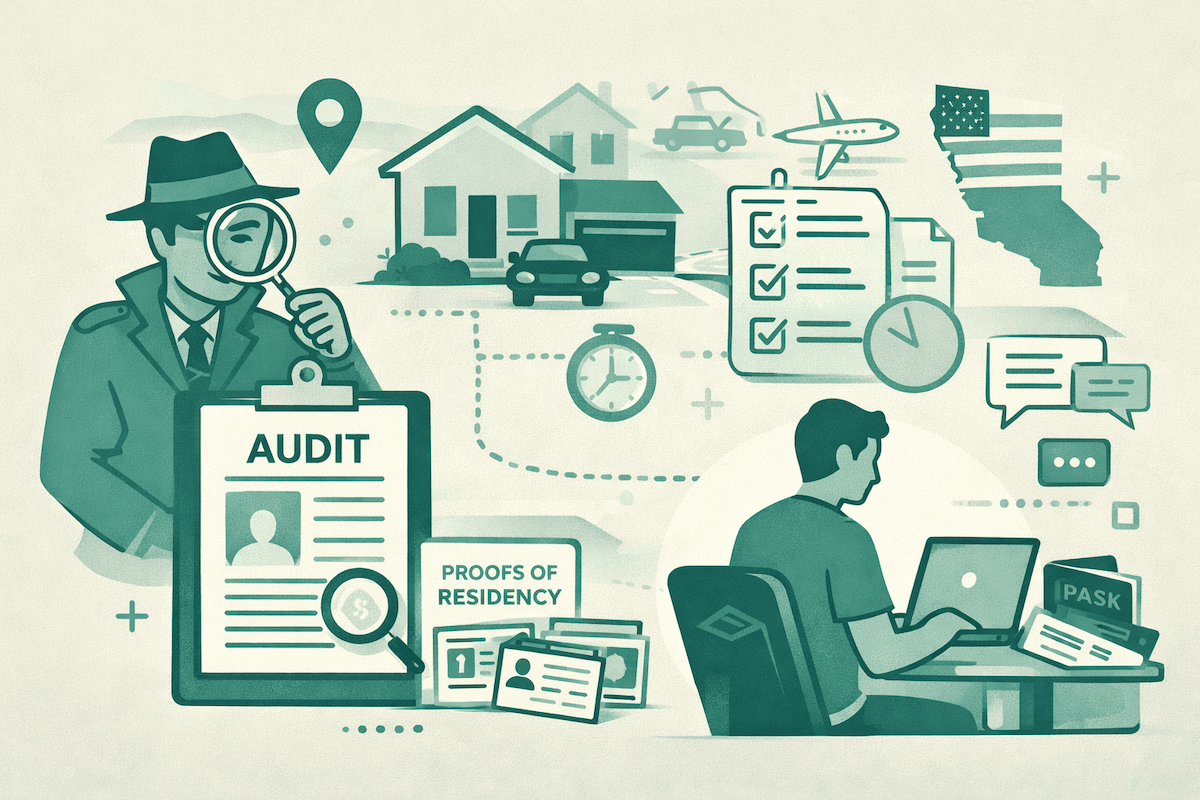
They typically occur when your situation raises questions, such as moving abroad, maintaining ties to a high-tax state, or having inconsistent records. During the audit, you may be asked to provide detailed documentation, including proof of address, financial records, and travel history.
The outcome depends on how well your records support your claimed residency. If your documentation is clear and consistent, the process is much easier to manage.
The best way to protect yourself is to prepare in advance: establish a clear domicile, cut ties with your previous location, and keep organized records from day one.
What is a residency audit?
At its core, a residency audit is a fact-check.
Tax authorities are not just looking at your address. They’re trying to understand where your life is actually based. That includes where you spend your time, where you manage your finances, and where your personal ties are strongest.
For US expats, this often becomes more complicated because you’re dealing with multiple systems at once. A US state, for example, California, may still consider you a resident, while your new country may also consider you taxable under local rules. In some cases, both sides can make a valid argument.
Life as an expat is complex enough, but when countries start introducing residency rules, it can become a nightmare.
That’s why residency isn’t just about location. It’s about consistency across your entire setup.
Why residency audits happen
One of the biggest misunderstandings is the difference between residency and domicile.
Residency is usually based on where you physically live. Domicile, on the other hand, is your permanent home, the place you intend to return to. For US state taxes, domicile often carries more weight.
You can live abroad for years and still be considered domiciled in a US state if you haven’t properly cut ties. Keeping a driver’s licence, using a US address for banking, or maintaining strong financial connections can all signal that your move wasn’t permanent. Surprisingly, many people who move from a high-tax state to a lower one can still be taxed there for years, even decades.
From the perspective of tax authorities, the question is simple: “Did you truly leave, or did you just spend time elsewhere?”
That distinction is where many audits begin.
Who is most likely to be audited
Not everyone faces the same level of risk.
For the ‘digital nomad’ lifestyle, increased vulnerability arises due to the transient nature of their activities and the absence of a fixed and stable place of residence, often making it difficult to establish a clear concept of base.
The expat is not the only foreigner who may draw attention to their true residency status. People who have recently moved to a new country may be viewed with skepticism by immigration authorities if they have not sufficiently severed all ties with their country of origin. Maintaining a home, residence, or business interests in the previous country could suggest that the move was not permanent.
One class of employees that may be affected by changes in the domicile rules is remote workers. These are individuals who are working for a particular company in a state where they previously resided and still have other connections in that prior state or other states. Depending on the specifics of their situation, their domicile status may be called into question due to remote work.
Rich people, families, and sometimes even students are often audited. However, higher earners and self-employed individuals, including business owners, are more often the subject of tax inquiries due to their greater potential to generate tax revenue.
What triggers a residency audit
Audits don’t happen randomly. They’re usually triggered by patterns that don’t fully align.
For US expats, this often starts with ties to a previous state. High-tax states like California and New York are particularly known for examining people who claim to have left. If you still have property there, use a local address, or spend extended time back in the state, it can raise questions.
At the same time, your life abroad can also create exposure. Many countries apply a version of the 183-day rule, meaning that spending enough time there can make you a tax resident. Registering for healthcare, renting a long-term apartment, or building local connections can strengthen that claim.
Another major trigger is inconsistency. If your tax returns, bank records, and reporting obligations, such as FBAR in which your US tax position and your state or foreign residency status or FATCA, don’t align, it may signal that something is off. Even small mismatches, like different addresses across accounts, can prompt deeper review.
In reality, it’s rarely one issue that causes a problem. It’s the overall pattern that makes authorities look closer.
The added complexity of FEIE
If you’re claiming the Foreign Earned Income Exclusion, residency becomes even more important.
To qualify, you need to meet either the physical presence test or the bona fide residence test. That means your travel history, your base of life, and your long-term intentions all come under scrutiny.
If audited, the IRS won’t just check your income. They’ll want to see whether your daily life supports your claim of living abroad. Travel logs, housing arrangements, and even your routine can become part of the evaluation.
This creates a situation in which your US tax position and your state or foreign residency status overlap, making consistency even more critical.
How real-life situations create risk
In practice, residency issues often come from everyday decisions.
Imagine you move to Spain but keep a California mailing address for convenience. Your bank accounts, subscriptions, and official records still point back to the US, and you return a few times a year. From your perspective, you’ve relocated. From California’s perspective, your ties may still look strong enough to keep you within their tax system.
Or take a different scenario. You relocate to Portugal but keep your New York apartment and rent it out short-term. You visit regularly and still use it as a base when in the US. In that case, New York may argue that you maintain a permanent place of abode, even if you spend most of your time abroad.
For digital nomads, the situation can be even more complex. Without a clear base, it becomes harder to demonstrate where your center of life actually is. That ambiguity can increase audit risk on multiple fronts.
How the audit process typically starts
A residency audit typically begins with a notice. It might be a letter requesting clarification or requesting supporting documents.
At first, it can feel formal but manageable. Over time, however, the process can become more detailed. Authorities may request additional records, ask follow-up questions, and expect you to reconstruct timelines across months or even years.
Your initial response plays an important role. Clear, organized documentation can help keep the process straightforward, while gaps or inconsistencies can lead to deeper investigation.
In many cases, audits take several months to resolve, and sometimes longer if the situation is complex.
What authorities actually look at
One of the biggest surprises for many expats is how comprehensive these audits can be.
Tax authorities don’t rely on a single document. Instead, they piece together a full picture of your life using multiple sources. They look at where you live, how you spend your money, how often you travel, and where your personal ties are strongest.
What matters most is not the individual documents themselves, but how well they align. If your lease, bank statements, and travel records all point to the same place, your position becomes much stronger. If they tell different stories, questions start to arise.
Increasingly, digital activity also plays a role. Login locations, payment data, and even social media posts can contribute to the overall picture. This doesn’t mean every detail is scrutinized, but inconsistencies across digital footprints can raise flags.
What documents may you be asked for?
One of the most surprising aspects of a residency audit is the level of detail involved. Tax authorities don’t just look at where you say you live, they try to understand how your life is actually structured day to day.
To do this, they may request a wide range of documents across different areas of your life:
Proof of residence and physical presence
These documents help establish where you actually live:
- Lease agreements or property ownership documents
- Utility bills (electricity, water, internet)
- Rental receipts or accommodation records
- Mail address to your primary residence
Financial records
These show where you spend your time and manage your money:
- Bank account statements
- Credit card statements
- Investment or brokerage account records
- Loan or mortgage documents
Travel and movement records
These help determine how much time you spend in each location:
- Flight tickets and itineraries
- Passport stamps
- Travel logs or calendars
- Immigration records (if applicable)
Employment and income documentation
These provide insight into where your work is based:
- Employment contracts
- Pay stubs or income statements
- Business registration documents
- Client agreements (for freelancers)
Personal and lifestyle connections
These help authorities understand where your life is centered:
- Driver’s license and vehicle registration
- Voter registration
- Insurance policies (health, car, home)
- Medical providers or school records
- Memberships (gyms, clubs, subscriptions)
No single document determines your residency. Instead, tax authorities look at the overall pattern. The more consistent your records are with your claimed domicile, the stronger your position will be during an audit.
How authorities evaluate your residency
Residency is not determined by a single rule.
Tax authorities do not follow the residency rules outlined above; instead, they use a "closest connection" approach to determine your tax residency, often considering your "center of life".
Physical presence, personal attributes, financial means and social relationships – all are often considered when formulating scenarios.
Your home environment would be assessed based on where you live with your family, where you manage your finances, and where you spend most of your time engaging in daily activities.
The assessment of the danger potential cannot be traced to a single factor; thus, it must be evaluated from an overall perspective.
What an audit can feel like
For most people, the challenge isn’t just the technical side. It’s the level of detail involved.
You may need to revisit past movements, track down records, and explain patterns that didn’t seem important at the time. The process can feel intrusive, especially when it touches on different aspects of your life.
That said, it becomes far more manageable when your documentation is clear and consistent. When everything aligns, the audit becomes a verification rather than a dispute.
Possible outcomes of a residency audit
At the end of the audit, the tax authority will conclude whether the taxpayer is a resident.
They may agree with you that you are no longer a resident for tax purposes and you will owe no additional tax.
In some cases, a taxpayer may be deemed a resident for part of the year rather than for the entire year. As a result, such a person may have tax obligations for a portion of the year.
Depending on how you were classified by customs, they may consider you a resident, in which case you will have to pay taxes on your income and also potentially pay interest and penalties.
The outcome depends on the quality and consistency of your documentation.
How to prepare for a residency audit
Preparation is another way to reduce stress and gain an edge.
It is important to keep a record of all paperwork and changes to details from the start when moving abroad. This will include registering with a new doctor, updating credit reference agencies and travel companies, and recording any spending and journeys. Your new address should be recorded in as many places as possible.
It’s also a good idea to keep track of how many days you’re staying in each location – especially if you’re staying in multiple places at the same time.
IRS likes to see consistency in how a person represents their address, their people record, and their general behavior as it relates to residency.
Consent of all parties is a major factor. When everything points to the same thing it's easier to know you're on the right path when people ask questions.
Common mistakes to avoid
Many issues during audits come from simple oversights.
Some people assume that moving is enough, without updating their official records or changing their financial setup. Others keep strong ties to their former state, which weakens their position.
Poor record-keeping is another common problem. Without clear documentation, it becomes difficult to demonstrate where you actually live. Check out the Reddit conversation about audit checks:
California Audit Risk - Multi-state Withholding vs Residency
by u/Cultured_dude in tax

Inconsistencies between different records can also raise red flags. For example, if your tax filings show one address but your bank statements show another, it can create confusion.
Avoiding these mistakes can make a significant difference if your residency is ever questioned.
How SavvyNomad can help
Having residency in both foreign countries or states and in the United States can be complicated.
SavvyNomad provides overseas Americans and foreigners with practical guidance and information to fulfill requirements and plan for an appropriate domicile. We cover necessary documentation, addresses and record update requirements.
Organizing the building work could save problems later.
Conclusion
A residency audit isn’t about what you say. It’s about what your life looks like on paper.
If your records, finances, and behavior don’t align, tax authorities may challenge your position. If they do align, the process becomes much easier to handle.
You can’t completely eliminate audit risk. But by setting up your domicile correctly and keeping your documentation consistent from the start, you can significantly reduce it.
The earlier you put that structure in place, the fewer problems you’re likely to face later.
FAQs
What is a residency audit?
This is a test by the tax authorities to determine whether you are a tax resident in a particular country.
How long does a residency audit take?
As this is a bespoke service, the time it takes to resolve your case can range from several months to over a year, depending on your individual circumstances.
What documents do I need?
We are often asked for copies of documents such as proof of address, financial information and travel history.
What triggers a residency audit?
Any of these conditions can be a trigger for a trigger. Such a trigger might include having two different versions of a record in the system, having a strong tie back to a previous state or location, or noticing large sums of money flowing in or out.
Can I avoid an audit?
There is little that can be guaranteed, but endeavoring to document all elements and adhere to a consistent method should greatly reduce the chances of something going amiss.