
10 stickiest US states for residency exit, ranked
Some states don't let you walk away. California, New York, and Illinois have dedicated audit units and billions in incentives to argue you never really left. Here's how the stickiest states rank, and what a clean exit takes.

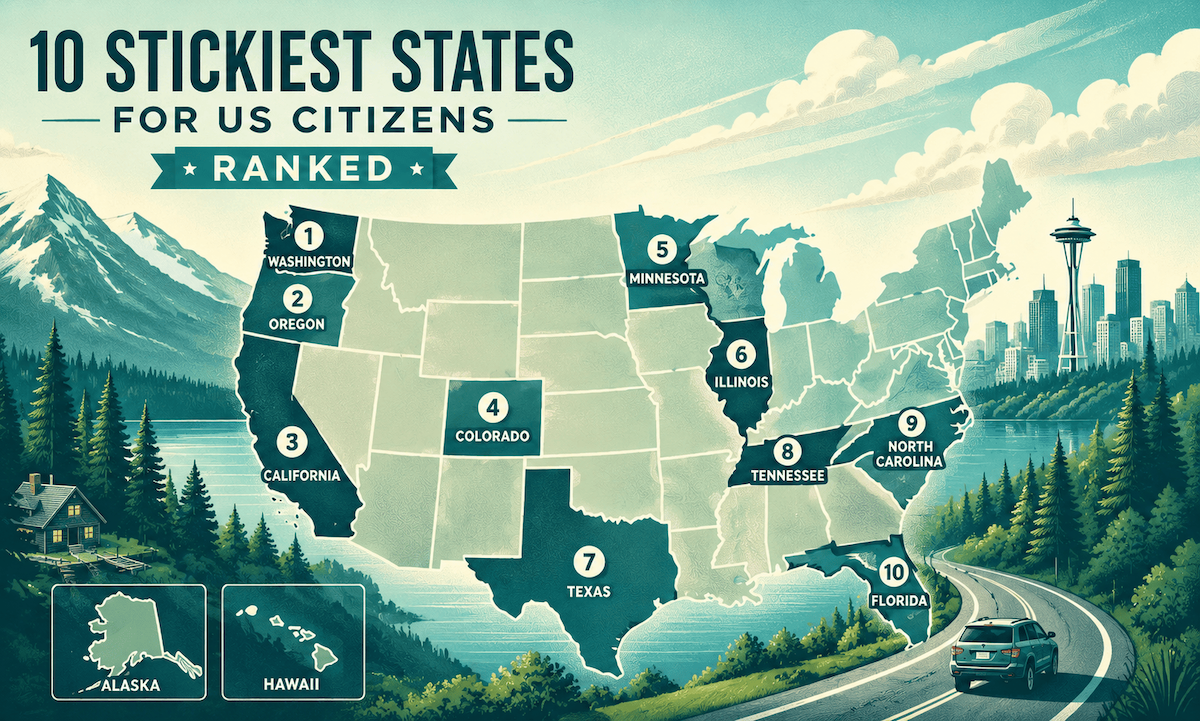
Most people assume that moving away from a state ends their tax obligation there. Pack your boxes, update your address, and you're done.
For some states, that assumption is expensive.
A handful of US states have built residency enforcement into a serious operation. They have dedicated audit units, broad legal definitions of who counts as a resident, and a financial incentive (measured in billions of dollars of tax revenue) to argue that people who left haven't really left at all. California, New York, and Illinois lead this list. But several others are stickier than most people realize.
This article ranks the most aggressive states by four factors: top income tax rate, enforcement intensity, residency definition, and the difficulty of demonstrating a clean exit. The higher a state scores across all four, the stickier it is.
California, New York, and Illinois are the stickiest: all use aggressive enforcement, high rates, and broad residency definitions that catch people who believe they've already left. Oregon, Virginia, Minnesota, New Jersey, and Hawaii are stickier than most people expect. No-income-tax states such as Florida, Texas, Nevada and South Dakota are the natural destinations because they have no financial incentive to pursue you. The fix isn't just moving. It's cutting ties cleanly, documenting the exit, and establishing a new domicile that holds up.
What makes a state "sticky"?
Not all high-tax states are equally aggressive about keeping you in their tax base. Stickiness comes from four factors working together.
- Tax rate. The higher the rate, the more revenue a state loses when a high earner leaves, and the stronger the incentive to argue they haven't. California's 13.3% top rate gives the Franchise Tax Board a powerful reason to audit departures.
- Enforcement intensity. Some states have dedicated residency audit programs staffed to pursue former residents who claim to have relocated. Others rarely initiate residency reviews. The rate alone doesn't tell you how aggressively it will be applied.
- Residency definition. States that use a day-count rule (typically 183 days) alongside a domicile test create two independent ways to tax you. States that use domicile only give you a clearer path out: change your domicile convincingly, and you're done. States with both tests are harder to escape.
- Exit difficulty. Some states accept a straightforward domicile change with minimal scrutiny. Others require you to have severed every meaningful connection (home, business, family, social clubs, medical providers) before they'll stop asserting jurisdiction. The more they look at it, the harder a clean exit becomes.
These states fall into what tax practitioners call Category 1 residency states — the 30 US states that tax residents on worldwide income until domicile is truly ended. Unlike the 11 Category 3 states (Florida, Texas, Nevada, South Dakota, and others) that have clear exit rules or no income tax, Category 1 states rely on intent-and-presence tests that auditors interpret broadly
The stickiest states ranked
1. California
California — Stickiness: 5/5 Top rate: 13.3% · Test: domicile + 183-day rule · Enforcement: very high
California is in a category of its own. The Franchise Tax Board runs one of the most sophisticated residency audit operations in the country, and the state has both the legal tools and the financial motivation to use them.
California applies a "closest contacts" framework: auditors map where you sleep, where your family lives, where you bank, where your doctors are, where your car is registered, and where your social and professional relationships are centered. If the majority of those points back to California, the state will argue you never left.
The 183-day rule adds a second trap. Spend more than nine months of the year in California, even if your domicile is elsewhere, and California may tax you as a statutory resident regardless of your claimed home state. Former residents who keep an apartment in San Francisco while living primarily in Austin or abroad have been caught by this rule.
California does offer one narrow safe harbor: the 546-day foreign-employment rule (FTB Pub 1031). If you work abroad under an employment contract for at least 546 consecutive days and spend no more than 45 days per year in California, you can claim temporary nonresident status without changing domicile. This works for 18–24-month overseas assignments, but it's temporary — it doesn't end your California domicile. For indefinite expatriation, establishing a new domicile (typically Florida) is simpler and more durable.
A proposed exit tax on high-net-worth residents has not yet been enacted, but California has separately asserted tax jurisdiction over deferred compensation and stock options earned while a resident, even years after departure.
How to leave California residency
2. New York
New York — Stickiness: 5/5 Top rate: 10.9% state + up to 3.876% NYC · Test: domicile + statutory residency rule · Enforcement: very high
New York's residency rules have a trap that California's don't: the permanent place of abode rule. Under New York law, if you spend 183 or more days in New York AND maintain a permanent place of abode there, you are taxed as a New York resident, even if your domicile is Florida, even if you've filed a Declaration of Domicile, even if every other record points elsewhere.
What counts as a permanent place of abode? New York's Division of Tax Appeals has interpreted this broadly. An apartment you keep for convenience, a home maintained by a spouse or family member, and in some cases even a room you regularly use in someone else's residence have all been considered abodes. If you're leaving New York and intend to keep any connection to housing in the state, get specific legal advice before assuming you've escaped.
New York also has a foreign-assignment safe harbor: 548 consecutive days abroad with no permanent New York abode and no more than 90 days per year in the state. It's narrower and stricter than California's version, and New York auditors aggressively verify day counts and housing status. Like California's rule, this is a temporary nonresident status — it doesn't change your domicile
The combined state-plus-city rate for New York City residents reaches nearly 15%, making the financial stakes of a failed exit among the highest in the country.
How to leave New York residency
New York residency laws explained
3. Illinois
Illinois — Stickiness: 4/5 Top rate: 4.95% flat · Test: domicile-based · Enforcement: high
Illinois's flat rate looks modest compared to California's and New York's, but its enforcement intensity is disproportionate to that rate.
The Illinois Department of Revenue has conducted documented audit campaigns targeting Chicago-area professionals who claim Florida or Texas domicile while maintaining Illinois business relationships, property, or family ties.
Business ownership is a particular trigger — if your company is headquartered in Illinois, your departure will receive scrutiny.
How to terminate Illinois residency
4. Oregon
Oregon — Stickiness: 4/5 Top rate: 9.9% · Test: domicile-based (no day-count rule) · Enforcement: moderate-high
Oregon's 9.9% top rate is the second-highest in the country after California, and the absence of a 183-day rule creates a counterintuitive problem: there is no safe harbor to hit. In California, spending fewer than 183 days in-state gives you a defensible position.
Oregon also does not recognize the federal Foreign Earned Income Exclusion (FEIE, §911). If you're living abroad and exclude $120,000 of foreign earned income from your federal return, that income is still fully taxable to Oregon if you remain an Oregon resident. Combined with the lack of a day-count safe harbor, this makes Oregon one of the most expensive states for Americans abroad who haven't formally changed domicile.
With Oregon, there is no bright line; the state evaluates the totality of your facts and circumstances, which means exit is harder to prove conclusively.
5. Virginia
Virginia — Stickiness: 3.5/5 Top rate: 5.75% · Test: domicile-based · Enforcement: moderate-high
Virginia is stickier than its moderate rate suggests, largely because of its concentration of federal employees, military personnel, and government contractors: populations that frequently relocate but often fail to formalize domicile changes.
The Virginia Department of Taxation regularly audits residency changes for this population. Failing to file a formal domicile change while continuing to use a Virginia address on federal records is a common mistake.
How to leave Virginia residency
Moderately sticky
These states don't match California or New York for enforcement intensity, but their rates, definitions, or specific rules create meaningful exposure for expats and nomads who leave without a clean exit strategy.
Minnesota (top rate of 9.85%) has aggressively pursued snowbirds who claim Florida as their domicile while continuing to spend significant time in the state. Minnesota expat taxes
New Jersey (top rate of 10.75%) borders New York, creating dual-state exposure for commuters and former residents who maintain ties to both. Leaving New Jersey residency
Massachusetts (9% rate on certain income) applies "Massachusetts source income" rules to former residents on investment income and business earnings that originated in the state. Massachusetts expat taxes
Hawaii (top rate 11%) is geographically isolated in a way that makes exit ties obvious to auditors — if you're no longer on the island, what are you still doing with a Hawaii address, vehicle, and voter registration? How to leave Hawaii residency
Maryland (up to 5.75% state + up to 3.2% county) layers a local income tax on top of the state rate, which adds complexity to departure and creates a higher combined rate than the headline figure suggests. How to leave Maryland residency
What sticky states actually look for in an audit
Audits from the stickiest states share a common logic: they're not looking for proof that you moved; they're looking for proof that you didn't.
California's FTB maps your "closest contacts" across six categories: home, spouse and family, business, social and recreational ties, time spent, and "near and dear" items (family heirlooms, significant personal property). The state with the majority of contacts in each category wins the argument.
New York's audit teams pay particular attention to day counts: they will subpoena travel records, credit card statements, EZ-Pass logs, and mobile phone location data to establish how many days you were physically in the state. One day over 183, combined with a maintained abode, is enough.
The thread running through every successful audit finding is the same: inconsistency. A California driver's license three years after claiming to have moved. A New York address on a brokerage account. An Illinois gym membership. Any single document pointing back to the old state can be used to argue that the departure wasn't real.
As one SavvyNomad client, an IT Chief who had been managing US state residency from overseas, described the experience before getting structured help:
"Managing state requirements from thousands of miles away can feel like trying to solve a puzzle without all the pieces. There was always a lingering uncertainty in the background."
That uncertainty is precisely what sticky states exploit. Incomplete exits, inconsistent records, and deferred paperwork are what keep former residents in someone else's tax base.
What to expect in a residency audit
The least sticky states, and why people move there
The natural counterpart to sticky states is the destination domicile cluster: Florida, Texas, Nevada, South Dakota, and Wyoming. None has state income tax. None has a financial incentive to pursue former residents. All have relatively clear, well-established procedures for establishing domicile.
Florida stands out because it has built explicit statutory infrastructure for people whose lives are based elsewhere. The Declaration of Domicile under Florida Statute §222.17 is a formal, legally recognized mechanism. The driver's license process works for expats.
The mail forwarding ecosystem is established. For someone leaving California, New York, or Illinois, Florida is the most common destination precisely because it is the easiest state to move to, while the sticky state is the hardest to move from.
- Florida Residency Guide
- Easiest states to establish residency
- Best and worst domicile states for nomads
How to exit a sticky state cleanly
The exit from a sticky state follows the same logic regardless of which state you're leaving. Five things matter most, roughly in order:
Establish a new domicile first. Before you can prove you left somewhere, you need to prove you arrived somewhere else. File a Declaration of Domicile in your new state, get the driver's license, and start building a paper trail in the new location.
For expats moving abroad, establishing a foreign domicile (Portugal, Spain, Thailand, etc.) is the alternative to a US no-tax state. It's more documentation-intensive — you'll need a visa or residency permit, foreign lease or deed, local tax ID, and banking/ID changes — and states like California and New York scrutinize foreign domicile claims heavily. But if you're genuinely relocating overseas long-term, a foreign domicile can work. Just expect to prove it thoroughly."
Update driver's license and vehicle registration immediately. These are two of the highest-weight documents in any residency determination. Keeping an old state licence two years into a claimed move is difficult to explain.
If eligible, you may update your voter registration with the applicable election authority. Voting activity can be relevant to a domicile analysis, but voter eligibility and tax domicile are governed by separate rules and should not be treated as determinative of one another.
Change every address. IRS, financial institutions, investment accounts, insurance providers, credit cards, government agencies. Consistency across all records is what makes an exit defensible.
Remove or relinquish any abode in the old state. For New York especially, this is non-negotiable. For all sticky states, maintaining a home available for personal use is the single most common reason a claimed departure fails.
How to change your state of residencyDeclaration of Domicile in Florida
Conclusion
Sticky states are sticky on purpose. High income tax rates create a direct financial incentive to retain high earners in the tax base, and dedicated audit programmes are the mechanism. The answer isn't to avoid the process — it's to execute a clean, documented, consistent exit into a state that has no interest in pursuing you.
If you're leaving California, New York, Illinois, or any other state in this ranking, the domicile side is where the exit either holds or doesn't.