How to leave Virginia residency
A guide to leaving Virginia residency for expats, retirees, and remote workers, including domicile, taxes, vehicle registration, and common mistakes.


Year after year, many Americans move from Virginia to other countries as digital nomads, retire to other parts of the world or move to new states with no income tax in the US. The majority of Americans mistakenly believe that by moving from Virginia, they will automatically cease to be considered residents of Virginia for tax purposes. But is that really true?
The new foreign country or new state within the U.S. where you are establishing a new home will not end your domicile in Virginia for tax purposes.
Your driver’s license, vehicle registration, voter registration, banking relationships, the way you use addresses, and your domicile profile in general are all factors that the state of Virginia will consider when trying to determine your status as a resident subject to taxation by the state of Virginia or not.
Expats and remote workers face a particularly complex situation. As they move from country to country, they are generally unaware that, while living outside their country of origin, Virginia requires their employer to withhold payroll taxes on their behalf, that they must file a state tax return in Virginia, and that they could face a serious residency dispute years later.
This guide explains how Virginia treats individuals for tax purposes and lays out a clear roadmap for severing domicile in Virginia and, more importantly, avoiding being considered a Virginia resident in the future.
Leaving Virginia residency requires more than simply moving away or living abroad. Virginia looks at your overall domicile profile, including your driver’s license, voter registration, vehicle registration, banking relationships, insurance records, and mailing address.
To successfully leave Virginia residency, you typically need to establish domicile in another state, update your records consistently, and reduce ongoing ties to Virginia. Start by securing a residential address in your new state and obtaining that state's driver's license. Those two steps anchor the rest of the domicile transition.
Many expats and remote workers choose Florida because it offers no state income tax, strong banking compatibility, residential address solutions, and infrastructure designed for people living abroad.
The key is consistency. The more your licenses, registrations, addresses, financial accounts, and tax records point to your new state instead of Virginia, the stronger your position becomes if Virginia ever questions your residency status.
Quick answer: How do you stop being a Virginia resident?
To stop being treated as a Virginia resident, you generally need to establish domicile elsewhere and reduce your ties to Virginia.
This usually means:
- Establishing domicile in a new state
- Updating your licenses and registrations
- Aligning banking and insurance records
- Using a new primary address consistently
- Reducing ongoing Virginia ties
Virginia does not determine residency using a single factor. Instead, the state looks at the overall picture of your legal and financial connections.
The more your records consistently point outside Virginia, the stronger your position becomes.
Virginia domicile vs residency
Domicile and residency are related, but they are not identical.
You can have multiple residences, meaning places where you temporarily live or stay, but you can only have one domicile at a time. Your domicile is your permanent legal home state and the state you intend to maintain long-term legal ties with.
For tax and legal purposes, domicile is what usually matters most.
This distinction becomes important for expats because physically living abroad does not automatically eliminate Virginia domicile. You can spend years overseas and still appear connected to Virginia if your records remain there.
Virginia examines the broader residency picture rather than simply counting travel days alone.
Why Virginia may continue treating you as a resident
Virginia evaluates many factors when determining whether someone remains a resident.
These can include:
- Driver’s licenses
- Vehicle registration
- Voter registration
- Property ownership
- Banking relationships
- Mailing addresses
- Insurance records
- Time spent in Virginia
No single factor automatically determines residency. Instead, Virginia evaluates how your life is structured overall.
For example, someone living abroad but still using a Virginia driver’s license, Virginia vehicle registration, Virginia mailing address, and Virginia voter registration may continue appearing tied to the state.
This is why consistency matters so much.
Step 1: Establish domicile in a new state
For many expats and remote workers, this is the most important step.
Leaving Virginia successfully usually means replacing the Virginia domicile with a new domicile elsewhere. Virginia wants to see evidence that you not only left Virginia but also established a new permanent legal home elsewhere.
In practical terms, this usually means:
- Establishing a qualifying address in your new state
- Obtaining a new driver's license
- Registering vehicles there
- Updating banking, insurance, and tax records
- Filing a Declaration of Domicile if the new state offers one
Establishing domicile generally means: securing a qualifying residential address in the new state, obtaining that state's driver's license, and filing a Declaration of Domicile (required in FL, optional in some other states). Many people choose no-income-tax states such as Florida, Texas, or South Dakota because they combine no income tax with a strong expat infrastructure.
The goal is to create a clear paper trail showing that your permanent home moved from Virginia to another state. The stronger and more consistent that evidence is, the harder it becomes for Virginia to argue that you remained domiciled there.
Related:
- Florida residency guide
- Domicile in South Dakota
- Texas Residency
- Nevada residency for nomads
- How to select the state of domicile
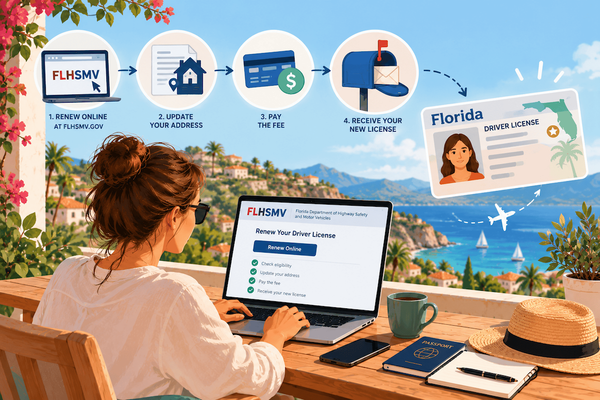
Step 2: Driver’s license
Driver’s licenses are one of the strongest indicators of domicile.
If you continue using a Virginia driver’s license after claiming another domicile state, it weakens your overall residency position significantly.
If eligible, you may also update your voter registration — confirm eligibility and the correct address with your county election authority.
Virginia tax authorities may examine both records carefully during residency disputes.
The goal is consistency. Once you establish domicile elsewhere, your licenses and address records should generally align with the new state.
For married couples, this issue becomes even more important.
If spouses file jointly and one spouse continues to maintain strong Virginia ties, the state may argue that the household never fully left Virginia. For example, if one spouse retains a Virginia driver's license or voter registration while the other fully transitions to Florida, it can weaken the overall domicile position.
The strongest setups are usually those where both spouses align their licenses, addresses, and other residency records.
Step 3: Move your banking, insurance, and mailing records
This is one of the most overlooked parts of leaving Virginia residency.
Many people update their address with the DMV but continue using Virginia banking records, Virginia insurance policies, or Virginia mailing addresses for years afterward.
These lingering ties can create problems because states often evaluate financial relationships as part of domicile analysis.
To strengthen your residency transition, it helps to align:
- Banking records
- Credit card addresses
- Insurance policies
- IRS records
- Payroll systems
- Investment accounts
The more your records consistently point to the new domicile state, the stronger your position becomes.
Step 4: Change vehicle registration
Vehicle registration is another major residency factor.
Maintaining Virginia vehicle registration while claiming domicile elsewhere creates conflicting residency signals. States frequently evaluate vehicle registration together with licensing and insurance records.
Many expats moving abroad first transfer vehicle registration into their new domicile state before leaving the country.
Florida is particularly popular because it offers:
- No annual vehicle inspections
- Relatively simple renewals
- Strong RV infrastructure
- Good compatibility with remote lifestyles
This matters for expats because some states require in-person inspections, emissions testing, or other renewal requirements that become difficult or impossible to maintain while living abroad. Florida's vehicle-registration system is generally easier to manage remotely, allowing many expats and long-term travelers to renew registrations without making a special trip back to the United States.
When your registration, insurance, driver's license, and domicile all point to the same state, the residency structure becomes much more consistent.
Related:
Step 5: Reduce Virginia ties
Successfully leaving Virginia residency is not just about creating new ties elsewhere. It also involves reducing old Virginia connections where possible.
This can include:
- Selling or renting out Virginia property
- Stopping use of Virginia mailing addresses
- Ending Virginia voter registration
- Moving primary financial relationships elsewhere
- Updating insurance and licensing records
Virginia tax withholding while abroad
One of the most common frustrations for expats is continued Virginia payroll withholding after moving overseas.
This often happens because payroll systems continue to use old Virginia records unless properly updated.
Employers may continue withholding Virginia taxes because:
- Payroll systems default to old residency records
- HR departments are cautious about compliance
- Virginia residency status appears unclear
Changing payroll records alone is usually not enough if the rest of your residency profile still points to Virginia.
This is why domicile changes and payroll updates need to happen together.
Related:
Leaving Virginia while living abroad
Many people assume that moving overseas automatically ends state residency. Unfortunately, it usually is not that simple.
Living abroad does not automatically replace Virginia domicile with another state. If your records still point to Virginia, the state may continue treating you as a resident despite physical absence.
This is why many expats establish Florida domicile before moving abroad. Creating a clear new legal home state generally produces a much stronger residency position than simply “leaving Virginia” without replacing it.
For expats, consistency across systems becomes even more important because physical presence in the U.S. becomes less relevant over time.
Common mistakes to avoid
One of the biggest mistakes is assuming that physical relocation alone ends Virginia residency.
Another common issue is updating one system while leaving the rest unchanged. For example, changing payroll records but keeping Virginia licensing and vehicle registration still creates conflicting residency signals.
People also frequently underestimate how important address consistency is. Using Virginia for banking, Florida for taxes, and another state for insurance creates a fragmented domicile profile that increases residency risk.
As they said on Reddit, you need to gather evidence that you left Virginia:
Comment
by u/kaelne from discussion
in legaladvice
Some expats also rely entirely on mailbox services without understanding address classifications. CMRA-classified addresses may work for mail forwarding but can create complications for banking, licensing, and compliance purposes.
The more your systems align consistently outside Virginia, the stronger your position becomes.
How SavvyNomad can help
Leaving Virginia residency successfully requires more than changing one address.
Your domicile, driver’s license, insurance, vehicle registration, banking records, tax documents, and mail setup all need to work together consistently.
SavvyNomad helps expats, digital nomads, retirees, and remote workers establish a Florida domicile with:
- Residential address solutions
- Mail forwarding
- Florida residency support
- Help aligning records across systems
This creates a stronger long-term residency structure for Americans living abroad or transitioning away from high-tax states.
Conclusion
Leaving Virginia residency is not a single action. It is a process of shifting your overall domicile profile away from Virginia and consistently aligning your records with a new state.
For expats and remote workers, this usually means establishing a clear domicile elsewhere, updating licenses and registrations, reducing ties to Virginia, and keeping all major systems aligned.
The more consistent your records become, the stronger your residency position will be if questions arise later.
For many internationally mobile Americans, Florida remains one of the most practical and stable domicile options for long-term life abroad.
FAQs
How do I stop being a Virginia tax resident?
Usually, by establishing domicile elsewhere and reducing Virginia ties across licensing, banking, taxes, and residency records.
Does moving abroad automatically end Virginia residency?
No. Virginia may still treat you as a resident if strong ties remain.
Can Virginia still tax me after I move?
Potentially yes, especially if Virginia still considers you domiciled there.
What state do expats usually switch to?
Florida is one of the most common choices because of its no-income-tax structure and strong expat infrastructure.
Can I keep my Virginia driver’s license after moving abroad?
Keeping a Virginia license while claiming domicile elsewhere may weaken your residency position.