South Dakota residency for tax purposes: pros, cons & how it compares
South Dakota has no income tax, the easiest domicile setup of any zero-tax state, and no minimum day count to maintain residency. But House Bill 1208 changed how South Dakota classifies PMB-address nomads in 2026. Here's the full picture before you commit.

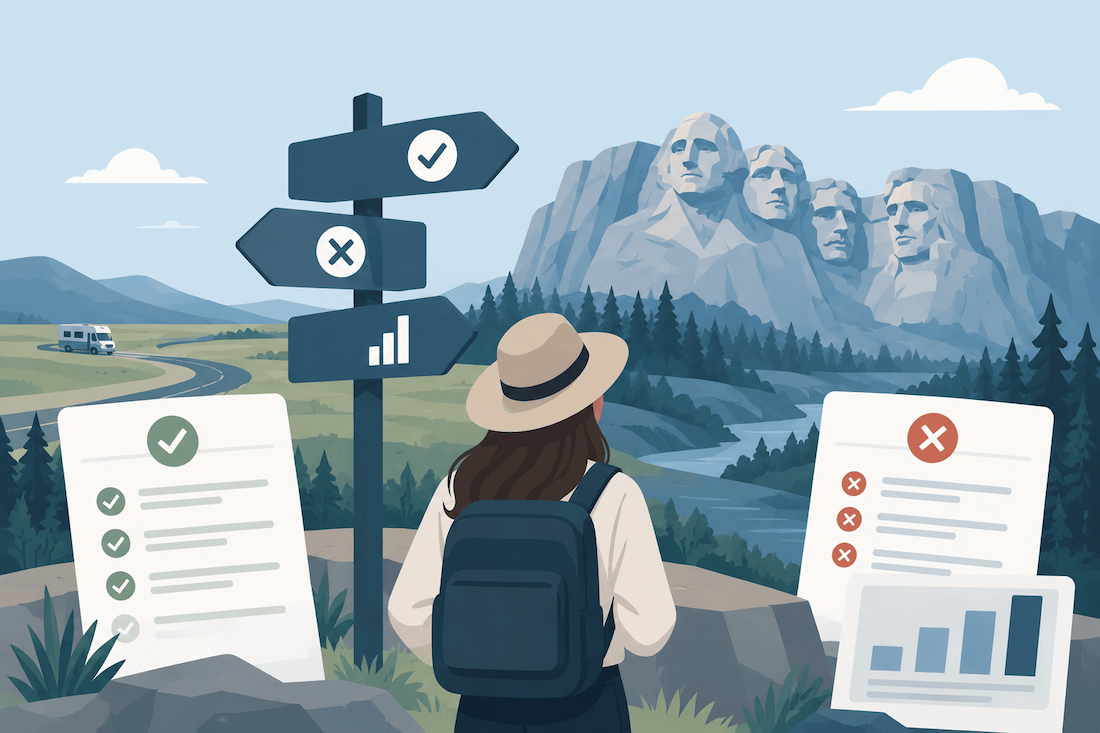
South Dakota has been the go-to domicile state for full-time RVers and digital nomads for decades. Not just because it has no income tax, but because it has the most accessible setup process of any no-income-tax state. One overnight stay. A mail forwarding address. A driver's license appointment. That is the whole thing.
2026 brought a meaningful change: House Bill 1208, passed during the 2025 legislative session, affects how South Dakota classifies residents whose only address is a mail forwarding service. Every nomad considering South Dakota needs to understand what changed before committing.
This guide covers the full tax picture, the practical advantages and limitations, the HB 1208 update, and how South Dakota compares to Florida, Nevada, and Texas for expats and nomads.
South Dakota has no state income tax, capital gains tax, estate tax, inheritance tax, or business franchise tax. Its income-tax prohibition has been constitutionally protected since 2018. The setup is the most accessible of any no-income-tax state: one overnight stay at a qualifying location, a registered mail forwarding address, a driver's license, and vehicle registration, with no minimum day count required to maintain residency. House Bill 1208, passed in 2025 and effective in 2026, clarifies that residents using private mailbox addresses may be classified as overseas voters rather than full residents in some contexts. South Dakota's practical limitations for expats are limited international infrastructure, CMRA-related banking friction, and no formal Declaration of Domicile mechanism. For full-time RVers and US-based travelers, South Dakota remains the easiest setup. For expats living abroad long-term, Florida's stronger paper trail and established expat infrastructure make it the stronger choice post-HB 1208.
South Dakota residency for tax purposes: the tax benefits
South Dakota's tax profile is one of the strongest of any US state. For individual income, the answer on every major category is the same: zero.
What South Dakota does not tax
South Dakota has no state income tax. The rate is 0% on wages, salaries, self-employment income, investment income, and all types of retirement distributions. South Dakota has no state capital gains tax. There is no estate tax. There is no inheritance tax. There is no business franchise tax, unlike Texas, which imposes a franchise tax on business entities above approximately $2.47 million in annual revenue, South Dakota has no equivalent.
As does Texas have state income tax article explains, even that state's no-income-tax status comes with a franchise tax that South Dakota avoids entirely.
The constitutional protection is meaningful. South Dakota voters approved a constitutional amendment in 2018 that explicitly prohibits a state income tax. This is the same level of protection as Texas and Florida: any income tax would require a constitutional amendment, meaning a legislative supermajority plus a statewide voter referendum. This is stronger than Nevada's statutory-only approach and makes South Dakota's no-income-tax commitment among the most durable of any state.
What South Dakota does tax
South Dakota's state sales tax rate is 4.2% (reduced from 4.5% in 2023). Local additions bring the average combined rate to approximately 6.4%, the lowest average combined sales tax of the four major no-income-tax domicile states. Property tax is approximately 1.2% effective average, higher than Florida and Nevada but lower than Texas. For nomads who do not own property in South Dakota, property tax is irrelevant to the decision.
South Dakota residents file only their federal Form 1040. They do not file a state income tax return.
For a broader comparison of how South Dakota stacks up across all the key factors, best and worst domicile states for nomads and expats guide covers the complete picture.
The overnight stay advantage: the easiest domicile setup of any no-income-tax state
This is South Dakota's primary differentiator and the reason it became the default choice for the nomad community years before Florida or Texas built comparable infrastructure.
The physical presence requirement to establish South Dakota residency is a single overnight stay at a qualifying location: a campground, hotel, motel, or RV park in South Dakota. That one night satisfies the SDCL Title 32 requirement that a driver's license applicant demonstrate physical presence in the state. Paired with a registered mail forwarding address and the driver's license appointment, it establishes the domicile claim.
Once established, South Dakota imposes no minimum day count to maintain residency. You can spend the rest of the year entirely outside South Dakota. This differs from states that require ongoing presence to defend a domicile claim.
The South Dakota DMV accepts mail-forwarding addresses from registered South Dakota service providers for driver's license purposes. Established services such as Dakota Post, Americas Mailbox, and My Dakota Address provide real street addresses the state recognizes. Unlike Nevada, which requires a genuine residential address or a 30-day continuous hotel stay, South Dakota's DMV accepts registered mail-forwarding providers from the outset.
Compared to the alternatives: Nevada requires 30 consecutive days of physical presence and does not accept mail forwarding addresses for the driver's license. Florida typically requires a focused week-long visit, with a Declaration of Domicile filing and a DMV appointment. Texas requires the DL-5 affidavit for people without standard residency documents, with a non-family certifier who must accompany the applicant to DPS in person. South Dakota's single overnight stay makes every other no-income-tax state look complicated by comparison.
South Dakota driver's license requirements for non-residents and digital nomads guide covers the driver's license process in full detail. Can a digital nomad get a US driver's license article compares the process across all major nomad-friendly states. And for the complete South Dakota domicile how-to including every step from the overnight stay through voter registration, South Dakota Domicile for Digital Nomads blog post is the detailed guide.
HB 1208: what changed in 2026 and what it means for nomads
This is the most important section for anyone deciding about South Dakota domicile in 2026.
South Dakota passed House Bill 1208 during the 2025 legislative session. The law clarifies how South Dakota treats residents whose mailing address is a private mailbox (PMB), the designator used by CMRA-registered mail-forwarding services.
What HB 1208 says: residents using PMB addresses may be classified as overseas voters under South Dakota election law (SDCL §12-1-4) rather than as standard in-state residents in all contexts. This classification applies to people whose only South Dakota address is a mail forwarding service's PMB address and who do not physically reside in South Dakota.
What this means practically: for voter registration purposes, PMB-address holders may be treated as overseas voters, they can still participate in federal elections and South Dakota elections depending on their registration, but their classification differs from residents with a genuine physical address. The downstream implications for domicile documentation and tax purposes are still being assessed as the law takes effect through 2026.
What HB 1208 does not change: South Dakota still has no income tax. The driver's license process through registered mail forwarding providers is still operational. The overnight stay still satisfies the physical presence component. Domicile in South Dakota is still viable.
What nomads should do: use a registered South Dakota mail forwarding service rather than a generic CMRA provider; ensure voter registration reflects the correct classification under the updated statute; consult a South Dakota-familiar CPA about how HB 1208 affects your specific residency documentation package. The three established providers such as Dakota Post, Americas Mailbox, and My Dakota Address have the most experience navigating this alongside their clients.
The honest assessment: HB 1208 creates more administrative complexity for the PMB-address nomad population that forms the core of South Dakota's digital nomad community. It does not eliminate South Dakota as a viable domicile option, but it reduces the margin of advantage over Florida for expats living abroad specifically. Florida's Declaration of Domicile mechanism, a notarised, publicly recorded document that creates a single authoritative domicile start date, looks more attractive relative to South Dakota's totality-of-facts approach in the post-HB 1208 environment.
The documentation gap, no Declaration of Domicile
South Dakota does not have a formal Declaration of Domicile equivalent to Florida's county-filed document under Florida Statute §222.17. In Florida, the Declaration creates a single dated, notarised, publicly recorded document that establishes precisely when domicile was declared. It is the strongest single piece of domicile documentation available in any no-income-tax state.
South Dakota's domicile claim rests on the totality of facts: the overnight stay receipt with its date, the driver's license issuance date, the voter registration date, and updated financial records all pointing to a South Dakota address. Each has a date. Together they build the claim.
If a former high-tax state challenges the domicile change, the South Dakota argument draws on multiple documents rather than a single authoritative declaration. This is defensible when documentation is thorough, and for nomads leaving states with moderate enforcement postures, it presents no practical problem. For California leavers who know they may face Franchise Tax Board scrutiny, the absence of a single definitive document requires more record-keeping discipline than Florida's approach.
Florida residency requirements for tax purposes guide covers the Florida Declaration of Domicile process and why it provides a stronger paper trail for readers who want to compare directly.
The banking and expat ecosystem limitation
South Dakota's biggest practical limitations for expats living abroad specifically are not about taxes, it is about the infrastructure built around the residency.
Banking friction
South Dakota mail forwarding addresses, like all CMRA-flagged addresses, can encounter friction with bank compliance systems and brokerage accounts. Banks running Customer Identification Program checks cross-reference the USPS CMRA database. Addresses flagged as commercial mail receiving agencies may be rejected as primary addresses for CIP purposes.
This is not a South Dakota-specific problem, it affects all mail forwarding addresses regardless of state. But it comes up more frequently in practice with South Dakota addresses than with Florida addresses, partly because Florida has developed more established non-CMRA domicile service infrastructure over decades of serving the expat and nomad community. The three major South Dakota forwarding services have worked extensively with this challenge, but the issue persists for some financial institutions.
Physical address verification for US banks: a guide for expats and nomads covers the full banking address mechanics in detail, including which address types pass CIP checks and which are commonly rejected.
Limited expat-specific infrastructure
South Dakota's nomad-friendly setup was designed for full-time RVers physically traveling the US, not for expats living abroad. The difference shows in several ways.
Airport access: Sioux Falls and Rapid City are small regional airports with no direct international routes. For expats who make periodic US visits specifically to handle administrative tasks, South Dakota requires a connecting flight, an extra friction point compared to Florida, which has major international airports in Miami, Orlando, and Fort Lauderdale with direct routes across Europe, Latin America, and beyond.
The CPA ecosystem: fewer accountants specialise in the South Dakota plus international expat combination compared to Florida. Finding a CPA familiar with both South Dakota domicile documentation and cross-border expat tax filing is possible but requires more searching.
International mail forwarding infrastructure: South Dakota's established forwarding services are well-developed for domestic forwarding across the US. International forwarding infrastructure and document-scanning services are thinner than Florida's mature, expat-oriented services.
South Dakota vs Florida vs Nevada vs Texas
All four are no-income-tax states popular with expats and nomads. The right choice depends on existing connections, setup preferences, former-state audit risk, and whether you are a US-based traveler or an expat living abroad.
| South Dakota | Florida | Nevada | Texas | |
|---|---|---|---|---|
| Income Tax | 0% | 0% | 0% | 0% |
| Capital Gains Tax | None | None | None | None |
| Estate & Inheritance Tax | None | None | None | None |
|
Property Tax
Effective average
|
~1.2% | ~0.86% | ~0.57% | ~1.6% |
|
Sales Tax
Avg. combined
|
~6.4% | ~7.1% | ~8.23% | ~8.19% |
| Business Franchise Tax | None | None | None |
Yes above ~$2.47M |
| Constitutional Income Tax Protection | Yes — 2018 amendment | Yes | Statutory only | Yes — voter referendum required |
| Formal Declaration of Domicile | No |
Yes County-filed |
No | No |
| Physical Presence to Establish | 1 overnight stay | 1-week focused visit | 30-day continuous stay | DL-5 affidavit and DPS visit |
| Mail Forwarding for Driver's License | Yes — registered providers | Yes | No | DL-5 required |
| HB 1208 PMB Classification | Yes — affects some nomads | N/A | N/A | N/A |
| Banking & Expat Infrastructure | Moderate | Strong | Limited | Moderate |
| Best For | RVers; fastest setup; U.S.-based travelers | Most expats; strongest paper trail; international setup | LLC privacy; existing Nevada ties | Existing Texas connections; employer in Texas |
Who South Dakota residency works well for?
South Dakota is a genuinely strong choice in specific situations.
Full-time RVers and US-based travelers are the clearest fit. South Dakota's infrastructure was built for this community and remains the most frictionless option for people physically moving around the country. The overnight stay, the campground receipt, the established mail forwarding services, the process is seamless for someone already on the road in the US.
Nomads who want the fastest possible domicile setup find no competitor. One overnight stay beats every other no-income-tax state for physical presence minimalism. If speed of setup is the priority, South Dakota wins.
People leaving moderate-enforcement states are well-served by South Dakota's totality-of-facts domicile documentation. Moving from Colorado, Missouri, Virginia, or another moderate-audit-risk state means the absence of a formal Declaration of Domicile creates no practical disadvantage; no one is running an aggressive audit.
People who spend significant time in the US find South Dakota's no-ongoing-day-count requirement particularly attractive. You can visit freely without triggering residency maintenance thresholds.
Who should consider Florida or Nevada instead?
For expats living abroad full-time, Florida's infrastructure is better suited to international expats than South Dakota's RV-oriented setup. The Declaration of Domicile creates the cleanest paper trail. Established mail-forwarding services with non-CMRA addresses create less banking friction. The international airport access makes periodic administrative visits straightforward. The expat CPA ecosystem is deeper. Post-HB 1208, the marginal advantage of South Dakota's simpler setup is partially offset by increased documentation complexity for PMB-address users.
For California leavers who want the strongest possible audit defence, Florida's Declaration of Domicile creates a single authoritative document that South Dakota's totality-of-facts approach cannot match. California's Franchise Tax Board applies aggressive scrutiny, and a single dated public record is the strongest defence.
For business owners who want LLC privacy, Nevada's anonymous member registry is a meaningful advantage that neither Florida nor South Dakota provides at the same level. Nevada residency for tax purposes guide covers Nevada's specific advantages for that audience.
If you have decided South Dakota is the right state and want the full how-to, South Dakota Domicile for Digital Nomads article covers every step in detail.
Frequently asked questions
Does South Dakota have state income tax?
No. South Dakota has no state income tax, 0% on all individual income including wages, capital gains, and retirement distributions. Voters approved a constitutional amendment in 2018 prohibiting a state income tax, making this one of the most constitutionally protected no-income-tax commitments in the country.
What did HB 1208 change for South Dakota nomads?
House Bill 1208 (2025, effective 2026) clarifies that South Dakota residents whose only address is a Private Mailbox (PMB) address may be classified as overseas voters rather than standard residents in some contexts. It does not eliminate South Dakota as a viable domicile state but adds administrative complexity for nomads using CMRA-flagged mail forwarding addresses. Use a registered South Dakota mail forwarding provider and consult a South Dakota-familiar CPA about current documentation requirements.
How do I establish South Dakota residency in one night?
Book one night at a qualifying campground, hotel, motel, or RV park in South Dakota. Set up a South Dakota mailing address through a registered mail forwarding service. Attend a DMV appointment for a South Dakota driver's license. Update financial and government records. The full step-by-step process is in South Dakota Domicile for Digital Nomads article. If eligible, you may also update your voter registration with the applicable county auditor.
Is South Dakota or Florida better for expats?
For expats living abroad long-term, Florida's established infrastructure, Declaration of Domicile mechanism, and banking-friendly addresses make it the stronger choice in most cases. For full-time RVers and US-based travellers, South Dakota's simpler and faster setup often wins. How to select the state of domicile guide walks through the decision framework based on your specific situation.
Can I use a mail forwarding address for a South Dakota driver's license?
Yes, established South Dakota mail forwarding services are accepted for driver's license purposes. Note the HB 1208 changes around PMB classification for voter registration purposes and use a registered provider. South Dakota driver's license requirements post covers the full process.
Does South Dakota have estate or inheritance tax?
No. South Dakota has no estate or inheritance tax. Assets passing to heirs are subject only to federal estate tax rules, with the 2026 federal exemption at $15 million per person.
Conclusion
South Dakota delivers 0% income tax with the most accessible physical presence requirement of any no-income-tax state. The overnight stay, registered mail forwarding address, and lack of an ongoing day count make it the fastest domicile setup available. For full-time RVers and US-based nomads, it remains the clear answer.
For expats living abroad, HB 1208 and the relative immaturity of South Dakota's international expat infrastructure shift the balance toward Florida for most situations. Florida's Declaration of Domicile creates a stronger paper trail, its established infrastructure is better designed for international expats, and its banking-friendly addresses carry less friction. South Dakota is not wrong for expats, but it requires more documentation discipline in 2026 than it did before.