Nevada residency for tax purposes: pros, cons & how it compares
Nevada has no income tax, no estate tax, and stronger LLC privacy than Florida or Texas. But establishing residency in Nevada for tax purposes is harder for nomads, the driver's license requires a 30-day physical stay, and there's no formal Declaration of Domicile. Here's the honest comparison.

Nevada is one of nine US states with no income tax, and for people leaving California, it is often the first destination that comes to mind. Las Vegas and Reno are close, the time zone is familiar, and the tax savings are real.
Establishing residency in Nevada for tax purposes has genuine advantages. It also has some practical limitations that Florida and South Dakota do not share. Both matter before making the decision.
This guide covers what Nevada offers on the tax side, where the setup process is harder than most guides acknowledge, and how it compares to the main alternatives for expats and nomads.
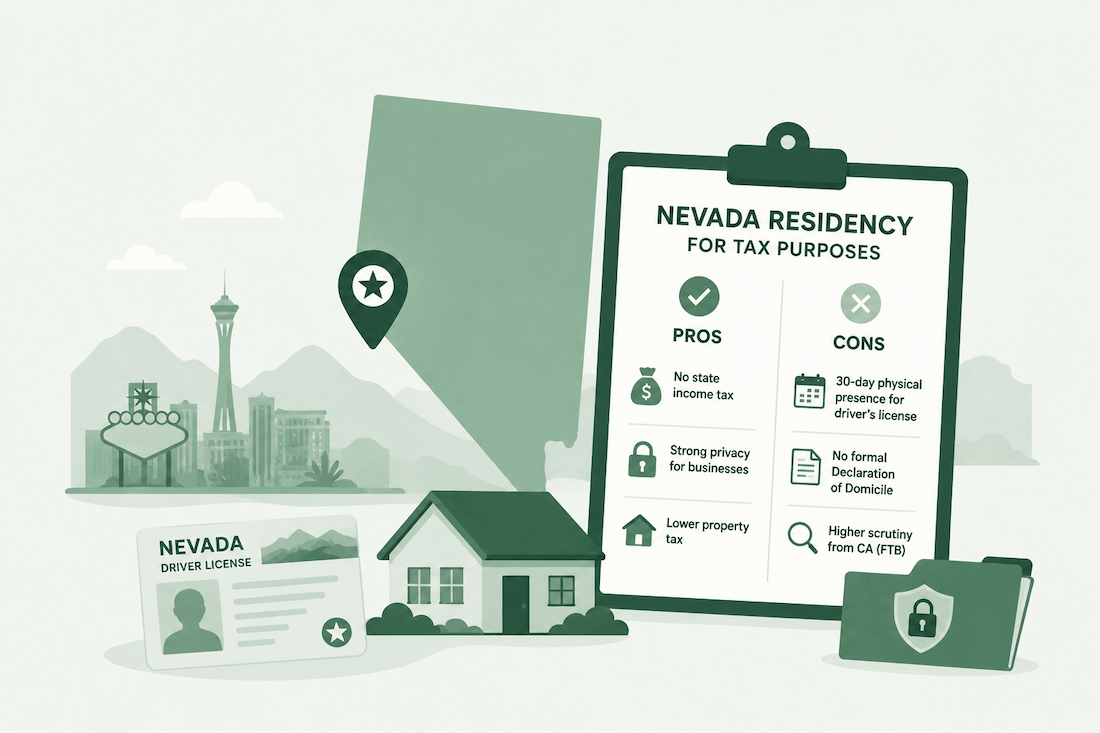
Nevada has no state income tax, capital gains tax, estate tax, inheritance tax, or business franchise tax. Its effective property tax rate of about 0.57% is lower than both Florida and Texas. Nevada LLCs offer strong anonymity through privacy laws that prevent public disclosure of member names. The practical challenge for nomads and expats is the driver's license: Nevada requires a genuine physical residential address, not a mail forwarding address or CMRA. Establishing that address typically requires a 30-consecutive-day stay at a hotel, motel, or campground, or a signed lease. Nevada also lacks Florida's formal Declaration of Domicile mechanism, which makes the domicile start date harder to document precisely. For California leavers specifically, Nevada's proximity triggers heightened scrutiny from the California Franchise Tax Board. Florida and South Dakota are generally simpler for expats with no existing Nevada connections.
Nevada residency for tax purposes: the tax benefits
Nevada's tax profile is genuinely attractive. For most income types, the state takes nothing.
What Nevada does not tax
Nevada has no state income tax. The rate is 0% on wages, salaries, self-employment income, investment income, and retirement distributions. There is no state capital gains tax. There is no estate tax. There is no inheritance tax.
Nevada has no individual franchise or business margin tax; unlike Texas, which imposes a franchise tax on business entities with annual revenue above approximately $2.47 million, Nevada has no equivalent at the state level.
One distinction worth noting: Nevada's no-income-tax status is statutory rather than constitutionally protected in the same explicit way as Texas or Florida. Texas requires a statewide voter referendum to introduce an income tax.
Florida has a constitutional prohibition. Nevada's protection is strong by history and political culture, but it does not carry the same formal legal barrier. In practice, no Nevada income tax has ever been enacted, and political will to change that is essentially absent — but the technical distinction is real.
You can read more about how Texas structures its constitutional protection in Does Texas Have State Income Tax guide.
What Nevada does tax
Nevada imposes a statewide sales tax of 6.85%. Local additions bring the average combined rate to approximately 8.23% and the maximum combined rate to 8.375%. Most goods and services are taxable; groceries and prescription drugs are among the notable exemptions.
Nevada's effective average property tax rate is approximately 0.57%, according to Tax Foundation data. This is lower than Florida (approximately 0.86%) and significantly lower than Texas (approximately 1.6%). For nomads who do not own Nevada property, this is irrelevant to the decision. For those who do, it is a genuine advantage.
Nevada also imposes a Modified Business Tax on payroll above $50,000 per quarter. This applies to employers rather than individual income and is not relevant for most expats and nomads.
The LLC privacy advantage
Nevada LLCs do not require public disclosure of member names. Nevada maintains one of the strongest business privacy regimes of any US state: there is no publicly searchable member registry for Nevada LLCs. For business owners, entrepreneurs, and anyone who values financial privacy in their entity structure, this is a meaningful differentiator that Florida and Texas do not match at the same level.
For a broader comparison of how Nevada stacks up against the full range of no-income-tax domicile options, Best and worst domicile states for nomads and expats guide covers the complete picture.
| Pros | Cons |
|---|---|
| 0% state income tax on all individual income | No formal Declaration of Domicile — weaker paper trail than Florida |
| No capital gains tax | Driver's license requires a 30-day physical stay — no mail forwarding accepted |
| No estate tax | No DL-5-equivalent affidavit for people without a standard address |
| No inheritance tax | No established expat domicile service infrastructure |
| No business franchise tax (unlike Texas) | Constitutional protection weaker than Texas or Florida — statutory only |
| Lowest property tax of the four popular domicile states (~0.57%) | Higher audit scrutiny for California leavers due to geographic proximity |
| Strongest LLC privacy — anonymous member registry | 30-day accommodation cost adds up — budget for an extended stay |
| No payroll tax on individuals | California FTB closely monitors Nevada domicile claims |
| Business-friendly LLC and corporate law | No single "start date" document if a former state challenges the move |
| Pacific time zone — convenient for West Coast remote workers | Less developed nomad/expat community infrastructure than Florida |
The Nevada driver's license challenge for nomads and expats
This is the section most Nevada residency guides understate, and it is the most important practical consideration for anyone without existing Nevada ties.
Establishing residency in Nevada for tax purposes requires a Nevada driver's license as one of the core documented steps. And Nevada's driver's license requirements are stricter than Florida's and at least as strict as Texas's for people who do not already have a qualifying residential address.
Nevada requires a genuine physical Nevada residential address. Mail forwarding addresses are not accepted. CMRA-flagged addresses are not accepted. A PO box is not accepted. Unlike Florida, which accepts mail-forwarding addresses with supporting documentation, and unlike Texas, which has the DL-5 affidavit system that lets a certifying individual vouch for the applicant's address, Nevada has no equivalent route for people without a physical Nevada presence.
For a comprehensive look at how the driver's license process varies across nomad-friendly states, Can a digital nomad get a US driver's license article compares the options in detail.
The 30-day stay option
The most practical route for nomads is a stay receipt for at least 30 consecutive days at a hotel, motel, RV park, or campground. Nevada accepts this as evidence of a Nevada residential address for driver's license purposes.
This works, but it requires a genuine month-long commitment. Compare this to Florida, where a focused week-long visit can complete the full domicile setup including the Declaration of Domicile filing and the DMV appointment. Compare it to South Dakota, where certain counties accept an overnight stay at a campground as the physical presence requirement. Nevada's 30-day minimum is a meaningful time cost.
Budget for the accommodation as well. Thirty nights in a Nevada hotel or extended-stay property at Las Vegas or Reno prices adds up. An extended-stay motel or furnished apartment by the week is usually the most cost-effective route.
For the full step-by-step Nevada residency process, including what to do at the DMV and how to document the visit, Nevada Residency for Nomads guide covers the complete how-to.
The documentation gap: no Declaration of Domicile
Nevada does not have a formal Declaration of Domicile equivalent to the document Florida uses. Under Florida Statute §222.17, a Florida resident can file a notarised Declaration of Domicile with the county clerk, creating a dated, publicly recorded document that establishes precisely when they declared Florida their permanent home. That document is Exhibit A in any residency dispute.
Nevada has no equivalent. Domicile in Nevada is established through the totality of the facts: the date on the Nevada driver's license, the voter registration date, the hotel stay receipts, the lease start date (if applicable), and the dates financial records were updated to a Nevada address. Each of these has a date. Together they build the domicile claim. But no single document creates a clean, authoritative domicile start date the way Florida's Declaration does.
The practical consequence: if a former high-tax state challenges the domicile change, the Nevada argument relies on a collection of dated documents rather than one anchor document. The argument is defensible when the documentation is thorough, but it requires more record-keeping discipline than the Florida approach.
For expats who want the cleanest possible paper trail, this is a genuine weakness. Declaration of Domicile in Florida guide explains why that mechanism is so valuable, and Florida residency requirements for tax purposes blog post covers the full Florida process for comparison.
The California proximity problem
Nevada is the most common destination state for California leavers. Las Vegas is a four-hour drive from Los Angeles. Reno is a 3.5-hour drive from the Bay Area. That proximity makes it convenient to wrap up California affairs, and it is also why the California Franchise Tax Board pays particular attention to people who claim Nevada domicile.
California uses a closest-connections test to determine whether a departed resident has genuinely changed domicile. Auditors examine: where your primary home is and how it compares to your claimed new home, where your family lives, where you work and maintain business interests, where your professional advisors (accountant, attorney, doctor) are located, where your vehicles are registered, where you bank, and how many days you spend in California after the claimed departure.
The most common audit triggers for California leavers claiming Nevada residency are retaining California real estate available for personal use, continuing California-based employment, having a spouse or children who remain in California, keeping California professional licenses without transferring them, using California-based medical providers, and spending substantial time in California in the first one to three years after the claimed move.
California's 546-day safe harbor rule says that spending fewer than 546 days in California over any 24-month period supports a nonresidence claim, but the closest-connections test operates separately. You can spend zero days in California and still fail the closest-connections test if your financial, professional, and family life remains centered there.
Nevada's proximity to California is not disqualifying; many people successfully establish Nevada domicile after leaving California. But it requires a more thorough and deliberately documented severance of California ties than a move to Florida or South Dakota would. A Nevada driver's license is necessary but not sufficient.
How to leave California residency article covers the full tie-severing process. Stickiest states for US citizens guide ranks California alongside New York and other aggressive audit states. And What to expect in a residency audit guide explains what happens when a former state challenges your domicile change.
Nevada vs Florida vs Texas vs South Dakota
All four are no-income-tax states popular with expats and nomads. The choice comes down to practical setup, existing connections, business needs, and the state you are leaving.
| Nevada | Florida | Texas | South Dakota | |
|---|---|---|---|---|
| Income Tax | 0% | 0% | 0% | 0% |
| Capital Gains Tax | None | None | None | None |
| Estate / Inheritance Tax | None | None | None | None |
|
Property Tax
Effective average
|
~0.57% | ~0.86% | ~1.6% | ~1.2% |
| Business Franchise Tax | None | None |
Yes above ~$2.47M |
None |
| LLC Privacy |
Strong Anonymous |
Moderate | Moderate | Strong |
| Formal Declaration of Domicile | No |
Yes County-filed |
No | No |
| Driver's License for Nomads | 30-day physical stay required | Mail forwarding accepted | DL-5 affidavit | Overnight stay in some counties |
| California Departure Audit Risk | Highest | Moderate | Moderate | Lowest |
| Best For | LLC-owning business owners; existing Nevada ties | Most expats; clean setup; established infrastructure | Existing Texas connections; employer in Texas | Full-time travellers; RVers; minimal presence |
One-sentence summary: Florida is the best overall for most expats because of the Declaration of Domicile, mail-forwarding address acceptance, and established infrastructure. Texas is strong if you have existing Texas connections or an employer in the state. South Dakota has the simplest physical presence requirement and is particularly popular with full-time travellers and RVers. Nevada is the strongest choice for business owners who want LLC privacy, or for people who already have Nevada ties.
Who Nevada residency works well for
Nevada domicile is a strong choice in specific situations.
- Business owners and entrepreneurs who want Nevada's anonymous LLC structure are the clearest fit. If you run a business and want your name kept off public registries, Nevada's privacy laws are the strongest available among popular domicile states.
- People with existing Nevada ties such as property, family, employment, or business presence in Las Vegas or Reno find the setup much simpler. The 30-day stay requirement and driver's license process are straightforward when Nevada is already part of your life.
- People who are not leaving California, or who have already completely severed California ties, avoid the heightened audit risk. Nevada domicile is cleanest for people coming from moderate-enforcement states.
- High earners and high-net-worth individuals who want the combination of no income tax, no estate tax, and anonymous business ownership find Nevada uniquely positioned among the available options.
Who should consider Florida or South Dakota instead
For expats and nomads with no existing Nevada connections, Florida or South Dakota will usually be the simpler path.
If you want the cleanest possible documented domicile start date, Florida's Declaration of Domicile filed with the county clerk is the most defensible single document available in any no-income-tax state. If you want to establish residency without a month-long physical stay, Florida accommodates mail forwarding addresses in a way Nevada does not.
If you are leaving California and want to put the maximum administrative distance between yourself and the FTB's audit radar, South Dakota's geography and minimal presence requirements make it a strong choice. Florida residency requirements for tax purposes guide covers the Florida option fully.
South Dakota driver's license requirements for non-residents and digital nomads article covers South Dakota.
If you have decided Nevada is the right state and want the full how-to process, Nevada Residency for Nomads blog post covers every step.
Frequently asked questions
Does Nevada have state income tax?
No. Nevada has no state income tax; it is 0% on all individual income, including wages, capital gains, and retirement distributions. The no-income-tax status is statutory and has never been changed. It does not carry the explicit constitutional prohibition that Texas and Florida have, but is firmly established in Nevada law and political practice.
Does Nevada have estate or inheritance tax?
No. Nevada has neither an estate tax nor an inheritance tax. Assets passing to heirs are subject to federal estate tax rules only, with the 2026 federal exemption at $15 million per person.
How do I establish Nevada residency without living there full-time?
The most common route is a 30-consecutive-day hotel, motel, or extended-stay accommodation in Nevada, combined with a Nevada driver's license, voter registration, and updated financial records. Nevada does not have a formal Declaration of Domicile document. Nevada Residency for Nomads guide covers the full process.
Is Nevada or Florida better for expats?
For most expats without existing Nevada connections, Florida is generally simpler: the Declaration of Domicile creates a clean, documented start date, mail-forwarding addresses are accepted for the driver's license, and the established service infrastructure is more developed. Nevada is the stronger choice for business owners who want LLC privacy or people with existing Nevada ties. How to select the state of domicile article walks through the decision framework.
Can I use a virtual mailbox for a Nevada driver's license?
No. Nevada requires a genuine physical residential address. CMRA-flagged addresses and mail forwarding services are not accepted for driver's license purposes. A hotel or extended-stay property stay of at least 30 consecutive days is the standard alternative to a lease for people who do not own Nevada property.
Is Nevada a good state for expats leaving California?
Nevada works for California leavers who thoroughly document and sever their California connections. Nevada's proximity to California means the California Franchise Tax Board pays particular attention to these moves. A Nevada driver's license is necessary but not sufficient; a complete, documented severance of California professional, financial, and personal ties is required for a defensible position. How to leave California residency guide covers the full tie-severing process.
Conclusion
Nevada residency for tax purposes delivers the same headline no-income-tax benefit as Florida, Texas, and South Dakota. It adds genuine advantages in business privacy and lower property tax. The trade-offs are real: the driver's license requires a 30-day physical presence, there is no formal Declaration of Domicile mechanism, and California leavers face heightened audit scrutiny from the FTB.
For business owners who want Nevada's LLC privacy, or for people who already have Nevada connections, the choice is clear. For expats with no existing Nevada ties who want the simplest possible domicile setup, Florida's established infrastructure and Declaration of Domicile mechanism make it the more accessible starting point.