5 RV-friendly states ranked: laws, taxes, and registration costs compared
Looking for the best state for RV living? Compare taxes, laws, and registration costs across top RV-friendly states to choose the right domicile.

Living on the road full-time sounds incredible. You choose your route, park where you want, and enjoy the flexibility of RV life.
But there’s one decision that has a much bigger impact than most people expect: your state of domicile.
Even if you’re constantly moving, your legal home base still determines how you handle taxes, vehicle registration, insurance, and compliance. Choose the wrong state, and you could end up dealing with higher costs or unnecessary complications. Choose the right one, and things become much easier to manage.
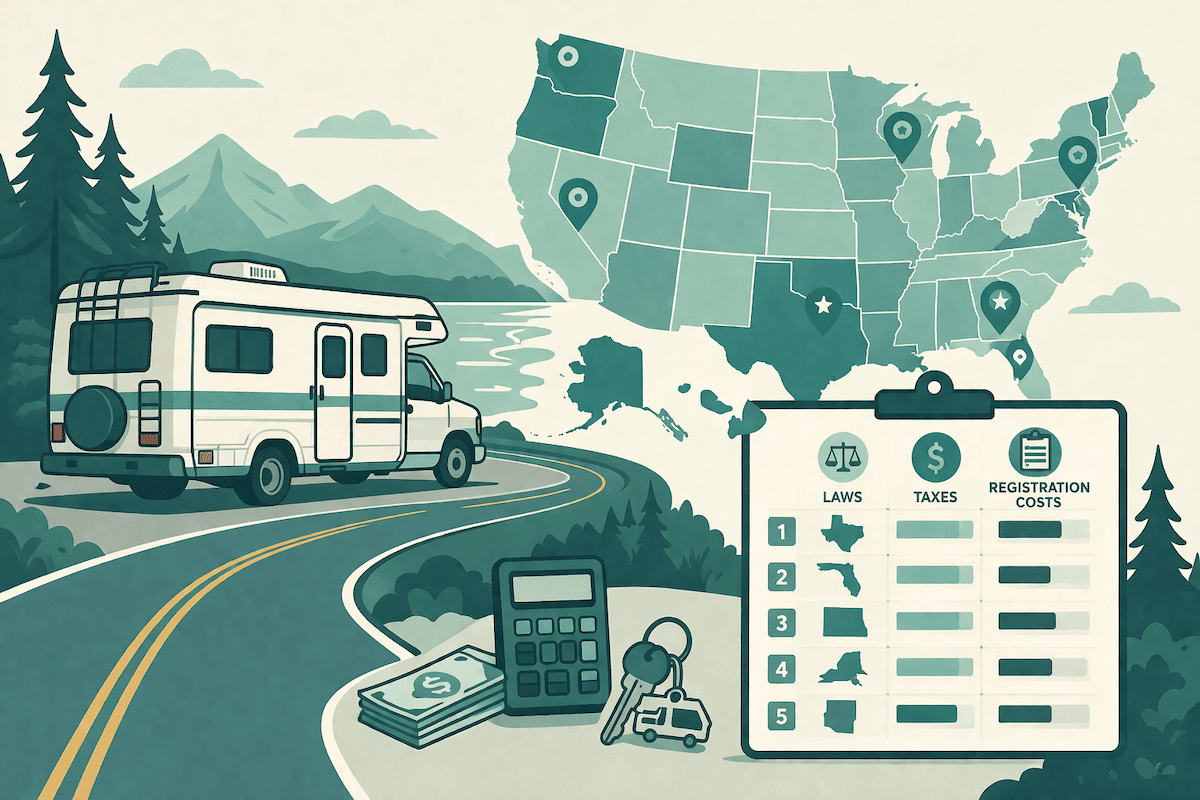
This guide compares the most RV-friendly states based on laws, taxes, and registration costs, so you can make a more informed decision.
Choosing the right state for RV living is about more than just taxes. Your domicile affects registration costs, insurance, and how easy it is to stay compliant.
Top RV-friendly states include Florida, South Dakota, and Texas, thanks to no income tax and relatively simple residency requirements. Nevada and Wyoming also offer tax benefits, but may have higher costs or stricter requirements.
Registration fees vary widely by state, and your RV’s value, and some states require inspections or in-person steps.
The best choice depends on your lifestyle, travel patterns, and how much simplicity vs cost savings you want.
What makes a state RV-friendly?
When considering which states are RV-friendly, it’s not just the RV-friendly camps, nice weather, or scenic byways that need to be evaluated. An important aspect is the ease with which you can live in, register your motorhome, and meet each state's compliance requirements while on the road.
Most full-time RVers care about three things when it comes to their state of residence: taxes, where they reside, and how they register their vehicles. Of course, states with no income tax are extremely popular, especially for folks who earn income in multiple states.
If you buy an RV, you’ll also have to pay registration costs. Some states charge these fees based on car values or weights.
In addition to the tax implications, most RVers are also concerned with the residency requirements of their chosen state. If the state requires RVers to spend significant time physically in the state or wade through pages of paperwork, it could be a problem for those living on the road.
Another consideration is whether the chosen state is address compliant. Many full-time RVers use mail-forwarding or domicile services, and this is an important criterion when choosing where to base your full-time residence.
Top RV-friendly states (ranked overview)
1. Florida
When it comes to RV travel destinations, it’s hard to beat the sunny state of Florida – and for many, it’s the number one spot to hit the open road.
Florida has no state income tax. Easy to establish domicile. Well-suited for individuals who live remotely or abroad.
Vehicle registration is generally manageable, and there are no vehicle inspections required, which makes it easier if you’re rarely in-state.
Florida also has strong infrastructure for mail forwarding and address services, which is critical for RVers who need a stable base for banking, licensing, and official documents.
The main downside is that you’ll need a valid residential address and at least some physical presence to complete certain steps.
2. South Dakota
For years, South Dakota was one of the most popular domicile choices for full-time RVers.
It became a go-to option because of its simplicity. The state offered no income tax, minimal residency requirements, and an easy setup process. In many cases, spending just a short time in the state was enough to establish residency, and vehicle registration could often be handled remotely without much hassle.
However, recent changes have made the situation more complex.
Since 2023, South Dakota has introduced stricter rules around domicile. A personal mailbox (PMB) is no longer sufficient on its own for key purposes like voting or certain tax-related matters. In many cases, you now need to demonstrate a more substantial physical presence, such as a lease or residential address within the state.
These changes also affect payroll taxes and unemployment eligibility, making tax planning more complicated for digital nomads and remote workers. For some RVers, this means dealing with additional administrative steps or reconsidering whether South Dakota still fits their lifestyle.
While the state still offers tax advantages, it is no longer the “set-it-and-forget-it” option it once was. Compared to larger states like Florida, which provide more flexibility and infrastructure, South Dakota may now require more effort to maintain a compliant setup.
3. Texas
Texas offers a strong combination of flexibility and supporting infrastructure.
There’s no state income tax, and the state has a large network of services that cater to RVers, including mail forwarding and domicile support.
Registration is straightforward, but there is a key consideration: vehicle inspections. Depending on your situation, you may need to return to Texas periodically to maintain compliance.
For some RVers, this isn’t a major issue. For others, it can be inconvenient if their travel patterns don’t align with returning to the state.
4. Nevada
Nevada is often considered alongside other no-tax states, but it comes with some differences.
While there’s no state income tax, vehicle registration costs can be higher than in other RV-friendly states, especially for newer vehicles. These costs are often based on the vehicle’s value and age.
Residency requirements are also more demanding. You may need to spend time physically in the state and complete more steps compared to places like South Dakota.
That said, Nevada offers good privacy protections and is geographically convenient for those traveling in the western U.S.
5. Wyoming
Wyoming is another option that combines low taxes with relatively simple requirements.
There’s no state income tax, and business-friendly policies make it attractive for entrepreneurs and remote workers.
Vehicle registration costs are generally lower than in Nevada, but the state doesn’t offer the same level of infrastructure or support services as Florida or Texas.
For RVers who prioritize low costs and simplicity over convenience, Wyoming can still be a strong contender.
Check out a real Reddit conversation from RVers about the states they prefer:
Comment
by u/Erudicial_Extreme from discussion
in VanLife
Best States for RV Residency: Texas vs Florida vs South Dakota
by u/practical_outdoors in RVLiving
Comparison at a glance
While each of these states offers advantages, the differences come down to how they balance cost, convenience, and compliance.
| State | Income tax | Residency requirements | Vehicle registration cost | Ease of domicile | Insurance considerations |
|---|---|---|---|---|---|
| Florida | None | Moderate (address + in-person steps required) | Moderate | High | Wide options, competitive rates |
| South Dakota | None | Very low (short stay required) | Low | Very high | Limited providers, generally affordable |
| Texas | None | Moderate (address + inspection requirements) | Moderate | High | Competitive but varies by region |
| Nevada | None | Higher (30-day stay + documentation) | High (based on vehicle value) | Medium | Higher in urban areas (e.g. Las Vegas) |
| Wyoming | None | Low to moderate | Low to moderate | Medium | Generally lower costs, fewer provider options |
Florida and Texas tend to offer the most complete ecosystems, with strong infrastructure and support services. South Dakota stands out for its simplicity, while Nevada and Wyoming appeal to those who prioritize tax benefits and privacy.
Registration costs explained
One of the most overlooked aspects of RV living is how vehicle registration is calculated.
Registration fees for recreational vehicles differ by state. Some states charge a registration fee as a percentage of the vehicle’s value, while others base it on the vehicle’s weight and age. For example, an RV that costs $29,000 to register in Michigan may cost $40,000 to register in California. Your domicile state can therefore greatly increase the registration fees you pay for the same vehicle.
However, as newer RV models enter the market at higher price points, their registration fees will mirror that increase, possibly canceling out any savings in some states. On the other hand, many states have a flat or modest annual registration fee that may save over time.
Additionally, there are other costs, such as renewal fees, safety inspections and county fees, which vary from county to county.
Understand the costs involved before you start looking for a venue. Find out what the costs are in the state you are planning to get married in.
Laws RVers need to know
Each state has its own rules that affect RVers, and these go beyond taxes and registration.
Some states require periodic vehicle safety inspections or emissions tests, which can require a return to that state in person at some point. Other states make it easier for full-time RVers.
In addition to the basic requirements for motorcycle licenses, there are also insurance requirements. These minimums and rates vary by state, so it's always a good idea to check ahead of time.
But many forget that there is a big difference between a mailing address and a legal address. As many full-time RVers know, mail forwarding has become a big part of our lifestyle, but some addresses aren’t as acceptable to banks and the MVD as others.
So long as you are compliant and choose a setup that works for you, then compliance is simple.
Domicile vs residency for RVers
For RVers, the concept of domicile is especially important.
Your domicile is your legal home base, even if you don’t spend much time there. It determines your tax obligations, where you register your vehicle, and how you interact with financial and government systems.
Residency, unlike domicile, is not limited to a specific state and can be split amongst multiple jurisdictions at any time. Your domicile, however, remains your state of legal residency.
For full-time RVers, establishing a clear domicile is essential. Without it, you may face challenges with taxes, audits, or even basic administrative tasks.
RV infrastructure: why it matters
Beyond taxes and laws, infrastructure plays a big role in how practical a state is for RV living.
Things like the number of RV parks, campgrounds, service centres, and general accessibility can affect your day-to-day experience. Some states are simply better equipped to support full-time RVers, especially when it comes to long stays, maintenance, and connectivity.
Here’s how the most popular RV domicile states compare:
- Texas: One of the most RV-friendly states in terms of infrastructure. Texas has hundreds of RV parks and campgrounds, along with strong support services, repair centers, and large RV communities. It’s especially convenient if you spend time in the southern U.S.
- Florida: Florida also offers extensive RV infrastructure, with a high concentration of parks, especially in coastal and tourist areas. It’s a popular choice for winter stays and long-term parking, with many well-equipped facilities.
- South Dakota: Infrastructure is more limited. While there are campgrounds and RV parks available, they are fewer and often seasonal. This is less of an issue for domicile purposes, but it can be inconvenient if you plan to spend time in the state.
- Wyoming: Similar to South Dakota, Wyoming has fewer RV parks and services, mostly concentrated around national parks and tourist areas. It works well for travel, but not as a long-term base.
- Nevada: Nevada offers moderate infrastructure, with more options around cities like Las Vegas and Reno. Outside of these areas, facilities become more limited, which can affect convenience for longer stays.
If you rarely return to your domicile state, infrastructure may not matter much. But if you plan to spend time there regularly, choosing a state with strong RV support can make a big difference.
Common mistakes RVers make
Many RVers run into issues not because of complex rules, but because of simple oversights.
One common mistake is choosing a state based only on taxes. While avoiding income tax is important, it’s not the only factor. Registration costs, inspections, and compliance requirements also matter.
Another issue is failing to properly establish domicile. Without a clear legal base, it becomes harder to prove where you belong for tax and administrative purposes.
Some RVers also rely on non-compliant addresses, which can create problems with banks or government agencies.
Finally, failing to keep consistent records can lead to complications if your residency is ever questioned.
How to choose the right state for your situation
There’s no single “best” state for every RVer.
The right choice depends on your travel patterns, income sources, and how often you return to your domicile state.
If you want simplicity and minimal requirements, South Dakota may be appealing. If you value infrastructure and long-term flexibility, Florida or Texas might be a better fit.
If privacy or a western location matters more, Nevada or Wyoming could make sense.
The key is to choose a state that aligns with how you actually live, not just the one with the lowest taxes.
Conclusion
Choosing an RV-friendly state is one of the most important decisions you’ll make as a full-time traveler.
It affects your taxes, your costs, and how easily you can manage your life on the road.
While states like Florida, South Dakota, and Texas are popular for good reason, the best choice ultimately depends on your situation.
By understanding the differences and planning ahead, you can create a setup that supports your lifestyle rather than complicates it.
FAQs
What is the best state for full-time RV living?
Depending on what you are looking for, the most popular states would be Florida, Texas or South Dakota.
Which states have no income tax for RVers?
Florida, Texas, Nevada, Wyoming, and South Dakota are key examples.
Can I register my RV in a different state than where I live?
Virtually all states allow registering an RV in the state where the owner resides.
Do RVers need a permanent address?
Yes, a legal address is typically required for registration, banking, and compliance.
How much does RV registration cost by state?
Costs vary widely based on vehicle value, weight, and state-specific rules.