States that don't tax retirement income in 2026: 401(k), IRA, pension, and Social Security by state
Nine states tax no retirement income at all. Most others tax at least some of it. Here is the full breakdown of Social Security, 401(k), IRA, and pension treatment by state in 2026, and why your domicile state matters more than where you actually live.


The state where you reside may tax your 401(k) withdrawals, pension payments, and IRA distributions, sometimes at rates above 10%. In California, most retirement income is taxed at up to 13.3%, while Florida and Texas don't tax it. For an annual retirement income of $100,000, the difference in tax liability can be over $10,000 per year.
Most people discover this problem after they start drawing. One SavvyNomad customer who moved from Pennsylvania described it simply:
We relocated from Pennsylvania, a state that doesn't tax retirement income like some other states, but we still ended up saving about $ 5,000 each year, plus the trouble of filing.
The guide covers the main types of retirement income, including Social Security, distributions from 401(k) and IRA accounts, and pension income, and indicates which states tax them, which partially exempt them, and which exempt them completely.
Nine U.S. states have no state income tax and therefore automatically exempt all retirement income: Florida, Texas, Nevada, South Dakota, Wyoming, Alaska, Washington, Tennessee, and New Hampshire. While Washington imposes taxes on capital gains above a certain level, New Hampshire is gradually removing its tax on dividends and interest. Apart from states with no income tax, around 40 states do not levy a state-level tax on Social Security. Rules on pension exemptions vary widely; in some states, government pensions are exempt but private pensions are taxed, while in others, the exemption applies entirely once a certain age is reached. In most states with an income tax, distributions from 401(k) accounts and traditional IRAs are treated as ordinary income. Pennsylvania is a notable exception: it generally exempts retirement distributions after age 59.5, even though it has a 3.07% flat income tax. The states with the most adverse retirement income taxes are California (up to 13.3%), New York (up to 10.9%), Minnesota, Vermont, and Connecticut. It is the state in which you reside rather than the place where you actually live that decides which state will tax your retirement income.
How states tax retirement income: what you need to know first
Retirement income is subject to taxation at two levels: federal tax applies to all Americans no matter where they live and state tax depends completely on the state that regards you as a legal resident, that is, your domicile state. The key to any retirement tax planning is understanding this difference.
The four main retirement income types and how they are treated:
- At the federal level, up to 85 per cent of the benefits are subject to tax according to the combined income (known as provisional income). About 40 states entirely exempt Social Security, while a smaller number still apply at least partial taxation of it depending on the income.
- 401(k) and traditional IRA withdrawals are subject to ordinary income tax at the federal level and, in most states that have an income tax, are also taxed as ordinary income, although there are some exceptions; in the case of Pennsylvania and Illinois, withdrawals are generally exempt even though these states do have an income tax.
- Distributions from a Roth IRA are free of federal tax once the five-year rule and the age of 59½ have been met, and are generally also exempt from state tax in most states, but you should check with your particular state before assuming this to be the case.
- As for pension income, it is subject to taxation at the federal level as ordinary income, while the treatment by states differs more than that of any other kind of retirement income; in some states all pensions are exempt, in others only government or military pensions are exempt, in some the exemption is based on age or on a dollar limit, and in others private pension income is taxed at the full rate.
It is the domicile that decides which state taxes you. Domicile refers to the state where you have set up your permanent residence legally and is not the state in which you physically spend your time, nor the state where your retirement account was opened, nor the state where you worked. A retiree who is living in Costa Rica but who is still domiciled in California is liable to pay California income tax on the amounts withdrawn from their retirement account. One of the best tax decisions a retiree can make is to change their domicile before starting to draw retirement income.
US state residency requirements guide explains the domicile concept in full. How to select the state of domicile article covers the decision framework for choosing between states.
States with no income tax: all retirement income exempt
Nine US states do not have a state income tax; in each of these states, retirement income, Social Security benefits, distributions from 401(k) plans, withdrawals from IRAs, pension payments, and income from investments is completely free from state income tax by definition, and no state tax return is required to be filed.
| State | Income Tax | Social Security | 401(k) and IRA | Pension | Notes |
|---|---|---|---|---|---|
| Florida | 0% | Exempt | Exempt | Exempt | No estate tax; Declaration of Domicile available under §222.17 |
| Texas | 0% | Exempt | Exempt | Exempt | No estate tax; constitutional no-income-tax protection |
| Nevada | 0% | Exempt | Exempt | Exempt | Strong LLC privacy; 30-day stay required for driver's license |
| South Dakota | 0% | Exempt | Exempt | Exempt | Overnight stay satisfies physical presence for driver's license |
| Wyoming | 0% | Exempt | Exempt | Exempt | Strongest LLC protection in the U.S.; geographically remote |
| Alaska | 0% | Exempt | Exempt | Exempt | Remote; no established nomad or expat infrastructure |
| Washington | 0% | Exempt | Exempt | Exempt | Capital gains tax above threshold |
| Tennessee | 0% | Exempt | Exempt | Exempt | Hall Tax on dividends and interest fully repealed in 2021 |
| New Hampshire | 0% | Exempt | Exempt | Exempt | Dividend and interest tax phase-out |
Two edge cases worth noting before relying on Washington or New Hampshire:
Washington state imposes a tax on capital gains that exceeds a certain amount (about 262,000in202, check the current figure for 2026). This tax does not apply to most retirees who receive income from standard 401(k) and pension distributions, but it may apply to retirees with large investment portfolios who have realized substantial capital gains.
New Hampshire is phasing out the tax it used to charge on income from dividends and interest. However, you should check the current status for 2026 before concluding the tax will be completely removed.
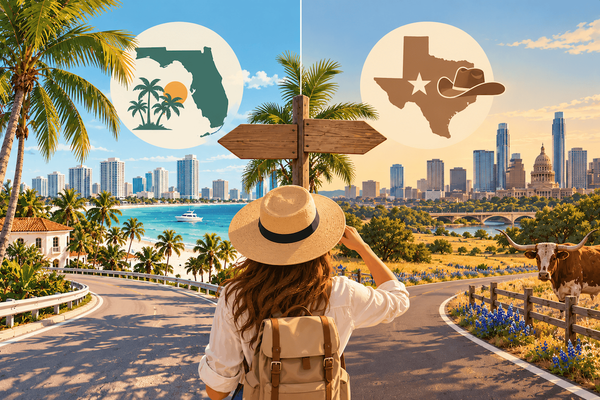
Florida and Texas generally offer the easiest way for retirees to establish domicile without meeting a minimum physical presence requirement. In Florida, you can declare your domicile by using the Declaration of Domicile provided under Florida Statute §222.17, which results in a notarized document that is officially recorded and specifies the exact date on which Florida became your legal domicile. In Texas, you file a Declaration of Domicile with the Aransas County Clerk. SavvyNomad offers both states, including a full residential address, advice on obtaining a driver's license, and mail forwarding services.
Best and worst domicile states guide for nomads and expats covers the full comparison. Florida vs Texas domicile article covers the specific differences between the two most popular choices.
States that don't tax Social Security
In about 40 states and in Washington, D.C., Social Security benefits are completely free from state income tax; for most retirees, how Social Security is taxed isn't a factor when choosing between states because it is essentially the same in most of them.
In 2026, the following states still impose at least some tax on Social Security: Colorado, Connecticut, Minnesota, Montana, New Mexico, Rhode Island, Utah and Vermont. Because each state has its own income-based rules, many retirees will owe little or nothing on their Social Security payments once the phaseouts are applied. Check the most up-to-date list before publishing, as several states have either introduced or are in the process of introducing full exemptions from Social Security taxation.
The key practical consideration is that when retirees assess states mainly on how they treat Social Security taxes, the 40 or so states that provide an exemption yield about the same result. For most retirees, the real differences between states come from how they handle distributions from 401(k) and IRA accounts and income from private pensions, since the next two sections cover these issues.
States that don't tax 401(k) and IRA distributions
In the nine states without an income tax, withdrawals from 401(k) and traditional IRA accounts are completely exempt. In most states that have an income tax, such withdrawals are treated as ordinary income and are taxed at the state rate, subject to a few exceptions.
| State | 401(k) and IRA Treatment | State Income Tax Rate |
|---|---|---|
| Florida | Fully exempt (no income tax) | 0% |
| Texas | Fully exempt (no income tax) | 0% |
| Nevada | Fully exempt (no income tax) | 0% |
| South Dakota | Fully exempt (no income tax) | 0% |
| Wyoming | Fully exempt (no income tax) | 0% |
| Pennsylvania | Generally exempt after age 59.5 | 3.07% flat |
| Illinois | Generally exempt | 4.95% flat |
| Mississippi | Exempt | Up to 5% |
| California | Fully taxed | Up to 13.3% |
| New York | Partially exempt (up to $20,000 for age 59.5 and older) | Up to 10.9% |
| Minnesota | Fully taxed | Up to 9.85% |
A significant exception worth considering is Pennsylvania. Although it has a flat income tax rate of 3.07%, the state usually excludes distributions from retirement accounts, such as withdrawals from 401(k)s and IRAs, after the age of 59.5.
As a result, Pennsylvania is much more advantageous for retirees than its apparent income tax rate suggests. For members of the SavvyNomad audience who are moving from Pennsylvania, the benefits of switching to Florida as their domicile come mainly from getting rid of the administrative work and the need to file returns, rather than from a substantial difference in the tax rate on retirement distributions, although other kinds of income might still see advantages.
Qualified distributions from a Roth IRA are usually tax-free at both the federal and state levels in most states, provided you meet the five-year holding period and are at least 59.5 years old. However, check how your state handles these distributions, since a small number of states treat Roth distributions differently.
The timing point that matters most: your domicile state at the time of each distribution is what determines whether that distribution is taxed. A retiree who changes domicile from California to Florida before taking their first 401(k) withdrawal owes no state income tax on that withdrawal. A retiree who remains a California domiciliary while living abroad owes California income tax at up to 13.3% on every distribution. This cannot be recovered retroactively.
How to use a 401(k) and IRA as an American expat guide covers the full picture of managing retirement accounts from abroad.
States that don't tax pension income
The number of states that do not tax pensions is greater than the number of states that exempt benefits from Social Security or distributions from retirement accounts. States with no income tax offer the most straightforward, complete exemption; in addition, how pensions are treated depends largely on whether they come from a government employer, a military career, or a private employer.
| State | State Government & Military Pension | Private Pension | Notes & Current Verification |
|---|---|---|---|
| Florida | Fully exempt | Fully exempt | No individual income tax. |
| Texas | Fully exempt | Fully exempt | No individual income tax. |
| Illinois | Fully exempt | Fully exempt | Full subtraction for qualified plans despite the 4.95% flat state income tax. |
| Pennsylvania | Fully exempt | Generally exempt after age 59.5 | Flat state income tax applies to non-retirement income; early distributions pre-retirement can be taxed. |
| Alabama | Fully exempt | Partially taxed / Exempt rules | Military and state/federal/public pensions are fully exempt. Private 401(k)/IRAs are taxed at progressive rates (2%–5%), with a $6,000 exclusion per person for residents aged 65+. |
| Mississippi | Fully exempt | Fully exempt | All qualified pensions and retirement accounts are exempt; non-retirement income faces a flat 4.0% rate (on income over $10,000). Early withdrawals are taxed. |
| California | Exempt for state and local government / military partial rules | Fully taxed as ordinary income | Private pensions, 401(k)s, and IRAs face graduated rates up to 13.3%. Social Security is exempt. |
| New York | Exempt for state, local, and federal (including military) | Partially exempt up to $20,000 at age 59.5+ | Private retirement income exceeding $20,000 is taxed at progressive rates up to 10.9%. |
| Minnesota | Partially exempt (Qualified public pension subtraction) | Fully taxed at ordinary rates | No general private pension/IRA exclusion. Public pensions that did not earn Social Security qualify for a subtraction (up to $13,850 single / $27,690 joint), which phases out above $86,410 (single) or $110,780 (joint). Rates range from 5.35% to 9.85%. |
For private-sector retirees, the main point is that even though many states advertise exemptions from taxing retirement income, they actually exempt only government and military pensions. So a retired teacher from a public school system and a retired manager from a private company could end up with very different state tax bills when in the same state. Only states with no income tax offer a complete, unconditional exemption from taxation for all kinds of pensions.
The worst states for retirement income taxes
- California is at the top of the list. The state income tax rate can go as high as 13.3% on most retirement income. While California does not tax Social Security benefits, it taxes distributions from 401(k) plans, withdrawals from IRAs, and income from private pensions at the full ordinary income tax rates. A retiree who is drawing $100,000 each year from a traditional 401(k) and who lives in California will have to pay between $8,000 and $13,300 in California income tax annually, the amount depending on their total income. The Franchise Tax Board in California closely monitors changes in domicile and audits people who leave the state.
- New York has a top rate of 10.9 percent; it excludes Social Security income and grants an annual exemption of $20,000 for income from pensions and retirement accounts for people age 59.5 or older, but it applies full rates to any income that exceeds this limit. For retirees who receive large distributions, New York is the second most expensive state for earning retirement income, after California.
- Minnesota has the highest rate at 9.85 percent and imposes taxes on Social Security benefits where income exceeds certain thresholds, as well as on most distributions from retirement accounts and pension income; it offers a partial exemption from Social Security tax on the basis of income but taxes the remainder at the full rate.
- Vermont has a top rate of 8.75 percent and imposes taxes on Social Security above the income thresholds. For higher earners, income from 401(k) accounts, IRAs, and pensions is taxed at the full rate.
- In Connecticut, the top rate is 6.99 percent; it imposes taxes on Social Security benefits once the income thresholds have been exceeded, and it applies full rates to the distribution of pensions and 401(k) funds with only limited exemptions.
The common thread across all five: they tax 401(k) and IRA distributions and private pension income at high rates with limited or no exemptions. For retirees with substantial distributions from these income types, the annual state tax bill is the most compelling reason to change domicile before drawing.
Stickiest states for US citizens guide covers which of these states are most aggressive about maintaining their residency claims after a departure. Do I have to file taxes in two states if I moved article covers the part-year return mechanics in the year of a domicile change.
What this means for nomads, expats, and retirees who move
Your domicile state taxes your retirement income regardless of where you physically live. A retiree who has moved to Southeast Asia but remains domiciled in Minnesota owes Minnesota income tax on 401(k) distributions. Moving abroad doesn't change this unless you formally change domicile through the documented four-step process: a new state address, driver's license, voter registration, and updated financial and government records.
The most effective tax strategy for retirement is to move your domicile to a state that doesn't impose income tax before you take your first retirement distribution. Any distribution taken while you are domiciled in a high-tax state will be taxed at that state's rate and will not be recoverable.
For retirees who receive between $80,000 and $150,000 each year from taxable retirement accounts, the amount saved annually through domiciling in Florida or Texas can be between $5,000 and $15,000 per year, and this amount will compound over a 20 to 30 year retirement to become a very large total.
For nomads and expats seeking the most comprehensive exemption covering all types of retirement income, along with the simplest arrangement, Florida and Texas are the two most accessible states with no income tax. The Declaration of Domicile in Florida provides the most thorough written record of any state that does not have an income tax. Texas is the better choice for retirees with existing ties to the State. In both states, Social Security, distributions from 401(k) and IRA accounts, pension income, and investment income are completely exempt.
Four SavvyNomad customers on what the retirement domicile change delivered:
"We moved from PA, which doesn't tax retirement income like some states, but we still saved around $5k per year plus the hassle of filing." — Head of retirement planning, moving from Pennsylvania
"I like the fact that I was able to move my residency from Connecticut to Florida. I would anticipate $6,000 in savings which is a bonus since I plan on moving to Florida for my retirement." — Engineer, moving from Connecticut
"We compared Nevada residency vs Florida residency for our retirement. Florida became our choice and SavvyNomad our portal for this tax saving move." — Retired couple planning to live overseas
"The service will save me over $1,000 after all the fees of the service. But most importantly it will provide me a Florida residency and Domicile and Mail forwarding while my wife and I travel Southeast Asia in our retirement!" — Retired couple
Frequently asked questions
Which states do not tax retirement income?
Nine states have no income tax, Florida, Texas, Nevada, South Dakota, Wyoming, Alaska, Washington, Tennessee, and New Hampshire, and none impose a tax on retirement income. Several other states offer full or partial exemptions for certain kinds of income. Although Illinois and Pennsylvania have an income tax, they do exempt most retirement income. Check current exemptions before deciding on domicile or tax matters.
Does Florida tax 401(k) distributions?
Florida has no state income tax, so withdrawals from 401(k) accounts, money taken from IRAs, pension income, and Social Security are exempt from state taxation. It is the most favored state among retirees and expats who are setting up their domicile there.
Does Texas tax Social Security?
Not at all, Texas does not have a state income tax. Social Security payments, pension income, distributions from 401(k) plans, and all other retirement income are exempt from state taxation. The protection provided by the Texas Constitution against the imposition of a state income tax ensures that this situation will always continue.
What is the best state to retire in for taxes?
Any of the nine no-income-tax states provides a 0% state tax rate on all retirement income. For retirees who cannot or do not want to live in the state full-time, Florida and Texas are the most accessible for establishing domicile without a minimum physical-presence requirement. Florida's Declaration of Domicile creates the strongest documented paper trail; Texas works best for people with existing Texas connections.
Do I pay state tax on my IRA if I live abroad?
Your domicile state taxes your IRA distributions regardless of where you physically live. If you are still domiciled in California while living in Thailand, California taxes your IRA withdrawals at up to 13.3%. Changing domicile to Florida or Texas before drawing eliminates state income tax on those distributions permanently.
What states don't tax pensions?
The nine no-income-tax states exempt all pension income, including private pensions. Several income-tax states exempt government and military pensions but tax private pensions at full rates, California and New York being the most significant examples. Illinois and Pennsylvania are notable for exempting most private pension income despite having an income tax.
Does changing state domicile affect my retirement taxes?
Yes, significantly. Your domicile state taxes your retirement income. Changing domicile from a high-tax state to a no-income-tax state before you take retirement distributions eliminates state income tax on all future distributions. To be defensible, you must formally document the change: driver's license, Declaration of Domicile, updated financial records. The timing matters: every distribution taken before the change is taxed at the old state's rate.
Conclusion
For retirees who want to eliminate state income tax on all retirement income types, Social Security, 401(k) distributions, IRA withdrawals, and pension payments, the nine no-income-tax states are the cleanest solution. Florida and Texas are the most accessible for those who cannot or do not want to live there full-time.
The timing matters more than most retirees realize. Changing domicile before the first retirement distribution is the highest-leverage move. Every distribution taken while domiciled in a high-tax state is taxed at that state's rate and cannot be recovered. The savings compound over a 20- to 30-year retirement into a significant total.
SavvyNomad handles Florida and Texas domicile establishment for retirees who want a no-income-tax state without needing to live there, the residential address, the Declaration of Domicile, the driver's license guidance, and the mail forwarding that keeps the US home base working while you live anywhere.