Leaving the USA: guide for Americans moving abroad 2026


More and more Americans are moving abroad, and there are plenty of good reasons. Some want a lower cost of living, better healthcare, or a slower pace of life. Others are attracted by the affordable cost of high-quality healthcare and overall cost of living in countries like Panama and Portugal, which also offer lenient residency requirements and appealing lifestyles.
At the same time, moving abroad isn’t just about the positives. It comes with challenges like visa paperwork, cultural adjustments, and financial planning. But with the right preparation, it can be one of the most rewarding decisions you ever make.
This guide walks you through everything you need to know about leaving the US. We’ll cover where to go, visa options, cost of living, job opportunities, and life as an expat. Whether you’re a retiree, a remote worker, or someone looking for a fresh start, you’ll find useful information to help you make the right choice.
Choosing the right country
Before picking a country, think about what’s most important to you. When considering the best country for Americans to relocate to, factors such as lower living costs, a warm climate, and a strong healthcare system are crucial. Your priorities will help narrow down your options.
Here are some key questions to ask yourself:
- Cost of living – Can you afford to live comfortably there?
- Visas and residency – How easy is it to get a long-term visa?
- Work and income – Will you need a job, or do you have savings or remote income?
- Language – Do you need an English-speaking country, or are you open to learning a new language?
- Culture and lifestyle – Do you prefer a big city, a beach town, or somewhere quiet?
- Safety and healthcare – Is the country safe? Does it have good medical care?
Best countries for different needs
Here’s a quick look at some of the best countries depending on what you’re looking for:
- Easiest visas → Mexico, Portugal, Panama, Thailand
- Cheapest cost of living → Philippines, Mexico, Vietnam, Colombia
- Best for remote workers → Portugal, Costa Rica, Spain, Thailand
- Best for retirees → Mexico, Panama, Portugal, Costa Rica
- Best for job opportunities → Canada, Germany, Australia, New Zealand
Each country has its pros and cons, so take your time researching what fits your needs. Visa requirements and residency laws vary in different countries, making it essential to understand the specific regulations for each destination. In the next chapter, we’ll dive deeper into visas and residency options.
Visas and residency
How long can you stay?
Every country has its own rules for how long Americans can stay without a visa. Most allow 90 days on a tourist visa, but if you want to stay longer, you’ll need a residency visa. Some countries make this easy, while others have strict requirements.
Here’s a breakdown of the easiest long-term visa options based on your situation.
Easiest visas to get
Retirement visas (for those with a pension or savings)
These visas are designed for retirees who can prove a steady income. Many countries offer low-cost residency in exchange for a guaranteed pension or savings.
Mexico – Temporary Resident Visa
- Income Requirement: Around $2,500–$4,500 per month (varies by consulate) OR savings of $69,000 USD
- Stay Length: 1 year (renewable for up to 4 years), then apply for permanent residency
- Tax Benefits: No local taxes on foreign income unless you become a tax resident
Panama – Pensionado Visa
- Income Requirement: $1,000 per month pension (additional $250 per dependent)
- Stay Length: Permanent residency from day one (no renewals required)
- Key Benefit: Huge discounts on healthcare, utilities, and travel
Costa Rica – Pensionado Visa
- Income Requirement: $1,000 per month (covers spouse and minor children too)
- Stay Length: 2 years (renewable), can apply for permanent residency after 3 years
- Healthcare: Must enroll in Costa Rica’s public health system (Caja)
Thailand – Retirement Visa (O-A Visa)
- Age Requirement: 50+ years old
- Income Requirement: $24,000 in a Thai bank OR $1,850 per month income
- Stay Length: 1 year (renewable annually), must report address every 90 days
- Healthcare: Mandatory health insurance covering at least $50,000 USD
Philippines – Special Resident Retiree’s Visa (SRRV)
- Income Requirement: $800/month pension OR $10,000 deposit in a local bank
- Stay Length: Permanent residency from day one (no renewals required)
- Key Benefit: Duty-free import of personal goods and exemption from some local taxes
 Jameson Rader
Digital nomad and remote work visas
If you work online, some countries offer visas specifically for remote workers. These allow you to live abroad while working for a foreign company.
Portugal – D7 Visa (Passive Income Visa)
- Income Requirement: $870/month (higher if bringing dependents)
- Stay Length: 2 years, renewable for 3 more years
- Citizenship: Eligible for Portuguese citizenship after 5 years
- Tax Benefit: Can apply for Portugal’s Non-Habitual Resident (NHR) tax program
Spain – Non-Lucrative Visa (NLV)
- Income Requirement: $2,500 per month (plus $7,200 per dependent)
- Stay Length: 1 year, then renewable for 2-year periods
- Work Restriction: Cannot work for a Spanish company, but remote work for foreign employers is tolerated
- Citizenship: Eligible for Spanish citizenship after 10 years
Costa Rica – Digital Nomad Visa
- Income Requirement: $3,000 per month ($4,000 for families)
- Stay Length: 1 year, can be renewed for one additional year
- Tax Benefit: No Costa Rican taxes on foreign income
Thailand – Long-Term Resident (LTR) Work Visa
- Income Requirement: $80,000 per year (exceptions for lower earners with Master’s degrees)
- Stay Length: 10 years (issued as 5+5 years)
- Key Benefit: Work authorization for remote employment and fast-track immigration lanes
Work and skilled migration visas
For professionals looking for a job abroad, these visas allow long-term employment in a foreign country.
Working holiday visas are also an excellent option for those wanting to work and travel in a different country, providing opportunities to gain international experience while managing finances and exploring visa requirements for longer stays outside the USA.
Canada – Express Entry (Skilled Worker Visa)
- Eligibility: Based on age, education, work experience, and English/French proficiency
- Processing Time: 6 months or less after invitation
- Key Benefit: Fast-track to permanent residency and later citizenship
Germany – EU Blue Card
- Salary Requirement: $60,000 per year (lower for in-demand fields like IT, engineering, and healthcare)
- Stay Length: 4 years, leads to permanent residency after 21 months with German proficiency
- Key Benefit: Spouses get automatic work authorization
Australia & New Zealand – Skilled Migration Visas
- Eligibility: Points-based system (age, work experience, English, education)
- Stay Length: Australia’s 189 visa = permanent residency from day one, New Zealand’s = 2 years, then PR
- Key Benefit: Direct path to citizenship in both countries
Investment and business visas
For those with capital to invest, these visas offer a fast-track to residency through various avenues, including real estate investments.
Panama – Friendly Nations Visa
- Investment Requirement: $200,000 real estate purchase OR bank deposit
- Stay Length: 2-year provisional residency, then permanent residency
- Tax Benefit: No taxes on foreign income
Portugal – Golden Visa (Updated Rules)
- Investment Requirement: €500,000 in a business or fund (real estate option is now closed)
- Stay Length: 2-year residency permit, renewable every 2 years
- Citizenship: Eligible for Portuguese citizenship after 5 years
What’s the best option for you?
- If you’re retiring, choose a Pensionado Visa or a low-cost residency option in Mexico, Panama, Costa Rica, or the Philippines.
- If you work remotely, look at Digital Nomad Visas in Portugal, Spain, Thailand, or Costa Rica.
- If you want a job abroad, explore Skilled Work Visas in Canada, Germany, Australia, or New Zealand.
- If you want to invest, Panama and Portugal offer business and investment residency options.
 Jameson Rader
Financial planning for moving abroad
How much money do you need?
Relocating abroad requires meticulous financial planning that accounts for factors such as the cost of living, taxes, healthcare, and banking regulations, all of which vary by country.
Before making the move, it’s essential to estimate your budget and devise a strategy for managing your finances overseas.
Key costs to consider:
- Visa and Residency Fees: Application fees, legal assistance, translations, and residency renewals.
- Housing Costs: Rent or property purchase, security deposits, utilities.
- Daily Expenses: Groceries, dining out, transportation, internet, phone plans.
- Healthcare: Public versus private insurance, out-of-pocket medical expenses.
- Travel Expenses: Flights back home, potential visa runs.
- Banking and Taxes: Currency exchange, international transfers and cost-of-living tax obligations in both countries.
Cost of living in different regions
Your budget will largely depend on your destination. Below is a general overview of monthly costs for a comfortable lifestyle (excluding rent):
- Cheapest ($700–$1,500/month): Mexico, Colombia, Thailand, Vietnam, Philippines.
- Mid-Range ($1,500–$3,000/month): Portugal, Spain, Panama, Costa Rica, Malaysia.
- Expensive ($3,000+/month): Canada, Germany, Australia, New Zealand.
When planning to relocate from the USA, it's important to consider that most countries have specific visa laws that restrict foreigners from overstaying and working.
Tip: Utilize cost-of-living ownership of property calculators like Numbeo or Expatistan to compare expenses before deciding on your new location.
Housing: renting vs. buying
Renting:
- Many expatriates opt to rent initially to familiarize themselves with the area.
- Some countries require substantial security deposits (e.g., several months’ rent in advance).
- Short-term rentals through platforms like Airbnb or local expat communities can be beneficial during the initial transition period.
Buying property:
- Certain countries permit foreign ownership of property,, while others impose restrictions.
- Residency visas, such as Portugal’s Golden Visa, offer real estate investment as a pathway to citizenship.
- Property taxes and maintenance costs differ; thorough research of local regulations is advisable before purchasing.
Banking and managing finances abroad
Maintaining a U.S. bank account
- U.S. Address Requirement: Due to regulations like the USA PATRIOT Act, most U.S. banks require a standard residential street address on file. Traditional mail-forwarding services or P.O. boxes are often not accepted as your primary customer address.
You can use a specialized domicile or residential-address service that provides a bona fide U.S. residential street address to support bank and brokerage CIP/KYC checks. Acceptance still varies by institution. You can provide proof of residency; policies can change, so it’s not a guarantee of approval.
Alternatively, some banks may allow you to use the address of a trusted family member or friend, provided you can provide proof of residence, such as a utility bill or lease agreement.
Utilizing a domicile service that provides a compliant residential address can be a viable solution. Alternatively, the address of a trusted family member or friend may suffice, though banks may require proof of residence, such as utility bills or lease agreements.
- Choosing an Expat-Friendly Bank: Select banks that support international customers, offering low foreign transaction fees, minimal service charges, and robust online banking platforms. Responsive customer support capable of handling inquiries from abroad is also essential.
- Setting Up Digital Statements and Alerts: Opt for paperless statements and activate email or text notifications to monitor account activity and detect any unusual transactions promptly.
- Utilizing Online and Mobile Banking: Familiarize yourself with your bank’s digital tools to manage accounts remotely, including monitoring balances, transferring funds, and paying bills.
 Jameson Rader
Opening a local bank account
- Some countries require proof of residency to open a local account.
- A local account can help avoid foreign transaction fees and currency exchange issues.
- It simplifies the payment of local expenses, such as rent and utilities.
Transferring money internationally
- Services like Wise, Revolut, and PayPal often offer more favorable exchange rates and lower fees compared to traditional banks.
- Avoid high fees associated with conventional banks when moving money between countries.
Understanding taxes as an expatriate
As a U.S. citizen living abroad, it’s imperative to comprehend your tax obligations to both the United States and your host country.
The U.S. taxes its citizens on worldwide income, irrespective of residence, necessitating annual tax filings. However, provisions exist to mitigate double taxation.
U.S. tax regulations for expats
- Foreign Earned Income Exclusion (FEIE): For the 2023 tax year, eligible expats could exclude up to $120,000 of foreign-earned income from U.S. taxation. The exclusion amount is indexed for inflation each year (for example, $126,500 for 2024 and $130,000 for 2025 and $132,900 for 2026 – check current IRS guidance for the latest limits). Qualification requires meeting either the Physical Presence Test—being outside the U.S. for at least 330 full days within a 12-month period—or the Bona Fide Residence Test, which involves establishing permanent residence in a foreign country for an entire tax year.
- Foreign Tax Credit (FTC): This credit allows U.S. taxpayers to offset taxes paid to a foreign government against their U.S. tax liability on the same income, effectively reducing double taxation. It’s particularly beneficial when the foreign tax rate is higher than the U.S. rate.
- Foreign Bank Account Report (FBAR): U.S. persons with foreign financial accounts exceeding an aggregate value of $10,000 at any time during the calendar year must file FinCEN Form 114. This is a separate requirement from the tax return and carries significant penalties for non-compliance.
Foreign Bank Account Report (FBAR)
US persons with foreign financial accounts exceeding an aggregate value of $10,000 at any point during the calendar year must file FinCEN Form 114. This is a separate requirement from your tax return — it's filed electronically through the BSA E-Filing System at bsaefiling.fincen.treas.gov, not with the IRS.
The $10,000 threshold applies across all foreign accounts combined — bank accounts, brokerages, pensions, and any other foreign financial accounts. Hit that aggregate even for a single day, and the filing requirement is triggered for the entire year.
Deadlines: April 15, with an automatic extension to October 15. No form or request is needed to get the extension.
Penalties for non-compliance are severe. Non-willful failure to file carries penalties of up to $10,000 per violation. Willful failure — meaning you knew about the requirement and didn't file — can result in penalties of up to $100,000 or 50% of the account balance, per violation, per year. These aren't theoretical numbers: a retired expat couple in New Zealand was hit with $3.6 million in FBAR penalties.
If you've missed past filings, the IRS Streamlined Filing Procedures allow eligible expats to catch up without the standard penalty exposure. The Streamlined Foreign Offshore Procedures require filing three years of amended returns and six years of FBARs, along with a certification that the non-compliance was non-willful. It's one of the few genuine amnesty-style programmes the IRS offers, and it won't be available to you once an audit or investigation has already begun — so acting proactively matters.
Foreign Account Tax Compliance Act (FATCA)
FATCA requires US citizens to report foreign financial assets above certain thresholds on Form 8938, filed with your regular tax return. It's separate from FBAR and covers a broader range of assets — not just bank accounts, but also foreign stocks, foreign partnership interests, and certain foreign insurance contracts.
The reporting thresholds are higher than FBAR's and depend on your filing status and where you live:
- Single or married filing separately, living abroad: $200,000 on the last day of the tax year, or $300,000 at any point during the year
- Married filing jointly, living abroad: $400,000 on the last day of the tax year, or $600,000 at any point during the year
Penalties start at $10,000 for failure to file, rising to $50,000 if the failure continues after IRS notification.
FBAR vs. FATCA: the key differences. FBAR is filed separately with FinCEN and covers foreign financial accounts over $10,000. FATCA is filed with your tax return and covers a wider range of foreign assets at higher thresholds. If you have significant assets abroad, you will likely need to file both — they are not interchangeable.
A warning about foreign investments: PFIC rules
If you're investing while living abroad, one rule catches more expats off guard than almost any other: the Passive Foreign Investment Company (PFIC) regime.
Any non-US mutual fund, ETF, or pooled investment vehicle is classified as a PFIC under US tax law. That includes the index funds available through your local bank abroad, the ETFs listed on European exchanges, and the pension-style investment products common in countries like the UK, Australia, and Ireland. If it's a foreign pooled investment, it's almost certainly a PFIC.
The tax treatment is punitive by design. PFIC gains are taxed at the highest ordinary income rate (currently 37%) rather than the preferential long-term capital gains rate. On top of that, an interest charge is applied going back to the year the investment was made, calculated as if the gains had been earned evenly over your holding period. The result is a tax bill that can exceed the actual gain on the investment. Reporting requires Form 8621, one of the more complex forms in the expat tax toolkit, and it must be filed for every PFIC you hold.
The practical rule is simple: do not buy non-US mutual funds or ETFs. Stick to US-domiciled funds through US brokerages: Schwab, Fidelity, and Interactive Brokers all accommodate foreign addresses and give you access to the same US-listed index funds you'd use at home.
If you already hold foreign investments, talk to an expat tax professional before your next filing. There are elections available — the QEF election and the mark-to-market election — that can reduce the damage, but they need to be made correctly and at the right time.
State tax obligations
When moving abroad, it’s crucial to address your state tax obligations, as some states have strict residency rules and may still consider you a tax resident if you maintain significant ties, such as property ownership, voter registration, or dependents residing in the state.
To avoid unnecessary state tax liability, it's advisable to formally establish residency in a no-tax state before moving abroad.
| South Dakota | Florida | Texas | Nevada | Wyoming | |
|---|---|---|---|---|---|
| State Income Tax | 0% | 0% | 0% | 0% | 0% |
| Capital Gain Tax | 0% | 0% | 0% | 0% | 0% |
| Driver's License Requirements | Must apply in person | Must apply in person | Must apply in person | Must apply in person | Must apply in person |
| Driver's License Renewal | Every 5 years | Every 8 years | Every 8 years | Every 7 years | Every 10 years |
| Access to International Airports | Limited access | Extensive options | Extensive options | Extensive options | Limited access |
| Geographical Considerations | Better for travel to West Coast | Better for travel to East Coast/Europe/LatAm | Better for travel to Mexico, Central America, and both U.S. coasts | Better for travel to Mexico, Central America, and the West Coast | Better for travel to the West Coast |
| Health Insurance Options | Limited ACA-compliant options | Broad range of ACA-compliant options | Broad range of ACA-compliant options | Broad range of ACA-compliant options | Broad range of ACA-compliant options |
| Car Registration | Online | VIN inspection (in Florida or by your local law enforcement) | Vehicle must be in state (safety check) | Vehicle must be in state for smog check (for most counties) | VIN inspection (in Wyoming or by your local law enforcement) |
| Minimum Stay | 24 hours/5 years to renew your driver's id | No explicit minimum stay | 1 month | 1 month | No explicit minimum stay |
| Estate Tax | 0% | 0% | 0% | 0% | 0% |
| Sales Tax | 4.50% | 6% | 6.25% - 8.25% | 6.85% - 8.85% | 4% - 6% |
| Payroll Taxes | Cannot use PMB address for payroll taxes | No problems | No problems | No problems | No problems |
| Address Requirements | Residential address (must be livable) | Residential address (must be livable) | Residential address (must be livable) | Residential address (must be livable) | Residential address (must be livable) |
| W-2 Friendly | No | Yes | Yes | Yes | Yes |
Best domiciles for American expats
Best states for expats:
- Florida: Offers no state personal income tax and relatively straightforward residency procedures for many people. Services like SavvyNomad can provide a bona fide Florida residential street address and help you organize documentation as part of a broader plan to establish domicile, but they don’t by themselves determine your residency status or tax outcomes.
- South Dakota: Also lacks a state personal income tax and offers a relatively streamlined process for vehicle registration and residency establishment. Recent legislative changes have increased physical presence requirements and tightened rules on using personal mailboxes for voting and payroll purposes.
States to avoid:
- California: Known for its aggressive tax policies, California may continue to tax former residents who maintain substantial connections to the state. Severing all significant ties is crucial to terminating tax obligations.
- New York: This state employs a stringent statutory residency test and may consider you a resident for tax purposes if you spend 183 days or more in New York and maintain a permanent place of abode.
- Virginia: Virginia presumes continued residency—and thus tax liability—if you have domiciliary ties, such as property ownership or active voter registration, unless clear evidence indicates permanent relocation.
 Jameson Rader
Steps to change domicile:
1. Sever ties with your previous state
To reduce the risk that your former state continues to treat you as a resident, you need to actively dismantle the connections that point back to it.
Sell or transfer any property where possible, close or transfer bank accounts held in that state, surrender your driver's license, and wind down any business registrations. If eligible, you may also update your voter registration — confirm with the applicable election authority whether a prior registration should be updated or cancelled.
ticky states like California, Virginia, and New York don't simply let you walk away — they look for evidence that you've genuinely left, and any remaining tie can be used to argue continued residency.
2. Get a real residential street address in your new state
This is the step most people underestimate. Banks, brokerages, the IRS, and the Social Security Administration all require a residential street address — not a PO Box, not a CMRA (commercial mail receiving agency like a UPS Store).
Using a CMRA address will get accounts flagged, frozen, or closed. Many expats use a family member's address, which works until they move and your address disappears with them. A dedicated residential address service that provides a genuine, non-CMRA street address is the more stable solution.
3. File a domicile declaration
A domicile declaration is a signed legal document stating your intent to make your new state your permanent home. It isn't required by every state, but filing one creates a dated paper trail that can be critical if your former state later challenges your exit.
Pair it with a contemporaneous record of the other steps you took — license change, address update — so the full picture is documented.
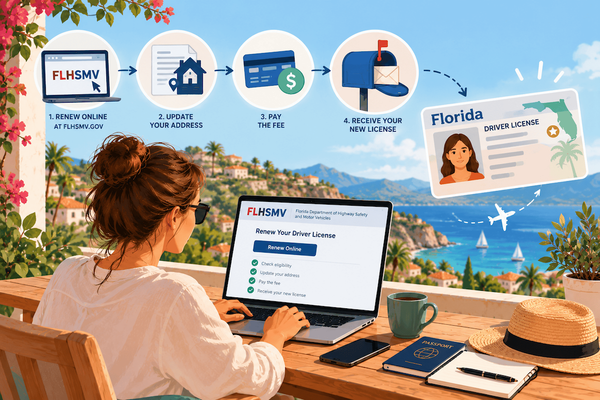
4. Driver's license
Obtain a driver's license in your new domicile state before you leave the US. This is one of the most concrete signals of domicile intent and one of the first things a state tax authority will look for.
If you are eligible, you may update your voter registration based on your current voting residence. Confirm your eligibility and the correct address with the applicable election authority.
5. Update every financial and government institution
Once your new address is in place, update it everywhere: banks, brokerages, 401(k) providers, insurance policies, the IRS (Form 8822), and the Social Security Administration if you receive benefits. Leaving your old state address on file with any of these institutions creates a tie you may not realise is still there.
Local tax obligations abroad
Even if you qualify for the Foreign Earned Income Exclusion (FEIE) or Foreign Tax Credit (FTC), you may still be required to file and pay taxes in your new country of residence.
Each country has different tax rules, which generally fall into three categories:
Territorial tax systems
Countries like Panama, Costa Rica, Thailand, and Malaysia tax only income earned inside their borders. Foreign-sourced income, such as U.S. remote work or Social Security, is not taxable in these countries.
Worldwide taxation
Countries such as the U.S., Germany, Spain, and Australia tax residents on their global income, meaning that even if you earn money in other countries, you may still owe local taxes.
Special tax incentives for expats
Some countries offer expat-friendly tax programs that provide significant reductions on foreign-earned income:
- Portugal’s Non-Habitual Resident (NHR) program: Allows new residents to pay zero tax on certain types of foreign income for 10 years (though this is being phased out in 2024).
- Italy’s Flat Tax Regime: Qualifying expats can pay a flat €100,000 tax on all foreign income, regardless of amount.
- Greece’s 50% Tax Reduction: Expats working in Greece may only have to pay tax on half of their income for up to seven years.
Self-employment and business taxes
If you own a business or work as a freelancer while living abroad, additional tax considerations apply:
Self-employment tax
- If you’re self-employed, the U.S. still requires you to pay self-employment taxes (Social Security and Medicare) of 15.3% on your net earnings, even if you qualify for the FEIE.
- If you live in a country with a totalization agreement (like Canada, the UK, or Germany), you may only have to pay into that country’s system instead of the U.S.
Incorporating a business abroad
- Some expats choose to register their business in a tax-friendly country to avoid high U.S. self-employment taxes. However, the IRS has strict rules for Controlled Foreign Corporations (CFCs), which may still require reporting and taxation under GILTI (Global Intangible Low-Taxed Income) rules.
- Popular destinations for business incorporation among expats include Estonia, the UAE, and Singapore, which offer low corporate tax rates and simple business structures.
Tax treaties and double taxation agreements
The U.S. has tax treaties with over 60 countries, which can help reduce double taxation and clarify how income is taxed between the U.S. and those countries. However, tax treaties do not exempt U.S. citizens from filing a U.S. tax return.
The Foreign Tax Credit (FTC) generally eliminates most double taxation, but consulting a tax professional experienced in expat taxes is crucial to optimizing your tax situation.
Avoiding tax pitfalls
Many new expats unknowingly violate tax laws due to inadequate preparation. Here are common mistakes and how to avoid them:
- ❌ Failing to file a U.S. tax return: Even if you owe no U.S. taxes, failing to file can result in penalties and potential audits.
- ❌ Not filing FBAR or FATCA forms: The IRS and U.S. Treasury require reporting of foreign bank accounts and financial assets if they exceed certain thresholds.
- ❌ Misunderstanding local tax residency laws: Some countries automatically consider you a tax resident after 183 days in a calendar year, requiring full tax compliance.
- ❌ Not factoring in state taxes: Leaving the U.S. doesn’t automatically end your state tax obligations, so you need to establish a clear exit from high-tax states.
Healthcare: insurance and medical expenses
Public healthcare
- Many countries offer low-cost or free public healthcare to legal residents.
- Residency visas often require proof of private insurance before allowing access to public systems.
- Countries like Spain, Portugal, and Canada provide universal healthcare for residents, though wait times for non-urgent procedures can be long.
Private health insurance
For most expats, private international health insurance is not optional — it's the only coverage you'll have. Medicare does not cover medical expenses outside the US. Most ACA marketplace plans and employer-sponsored plans have no international coverage either, and the ones that do typically limit it to emergency care only.
International health insurers with strong expat track records include Cigna Global, Allianz Care, GeoBlue, and SafetyWing. Budget $150–500 per month depending on your age, coverage level, and destination. Younger expats moving to lower-cost healthcare markets like Southeast Asia or Latin America will sit toward the lower end; older expats or those moving to Western Europe where private care is expensive will sit higher.
When comparing plans, pay attention to coverage limits for medical evacuation — getting airlifted to an appropriate facility can cost $25,000–$100,000 without insurance — and whether the plan covers pre-existing conditions, either immediately or after a waiting period.
Medicare and retiring abroad
If you're approaching retirement age or already enrolled in Medicare, the picture is more nuanced than simply cancelling your coverage before you leave.
Medicare does not cover you outside the US, with very limited exceptions for emergencies near the Canadian or Mexican border. That's the bad news. The important nuance is that you should not drop Medicare Part A before moving abroad.
Part A — which covers inpatient hospital care — carries no premium for most people who paid Medicare taxes during their working years. Keeping it costs you nothing and means you're covered immediately if you return to the US for any reason, whether for a medical procedure, a family emergency, or a permanent return.
Reinstating Part A after dropping it is possible but comes with delays and potential gaps in coverage.
Part B is a different calculation. It carries a monthly premium (around $185 in 2026) and covers outpatient care that Medicare won't pay for abroad anyway. Many expats drop Part B to avoid the premium, then re-enrol when they return.
Be aware that re-enrolling after a gap triggers a late enrolment penalty of 10% per 12-month period you were without coverage, which is added to your premium permanently. If you're planning to return to the US within a few years, keeping Part B may be the more cost-effective choice.
Some Medicare Advantage plans offer limited emergency coverage outside the US, but standard Medicare does not. Do not rely on either for routine care abroad.
Preparing for the move
Once you’ve chosen your destination, secured your visa, and planned your finances, it’s time to prepare for the actual move. This includes organizing documents, deciding what to pack, arranging travel logistics, and setting up your new life abroad. Proper planning will make your transition smoother and minimize stress.
Documents you need before leaving
Moving abroad requires handling a lot of paperwork. Make sure to gather, update, and digitally store copies of the following:
- Passport – Ensure it’s valid for at least six months beyond your departure date. Some countries require longer validity.
- Visa and Residency Papers – Print multiple copies of your visa approval letter or residency permit. For Americans, a working holiday visa is an accessible option that allows you to work and travel simultaneously without needing a job offer, though age restrictions apply.
- Birth Certificate and Marriage Certificate – Required for dependent visas, family reunification, or banking. Some countries require them to be apostilled.
- Driver’s License and International Driving Permit (IDP) – Some countries allow you to drive on a U.S. license for a few months, but an IDP is often required.
- Social Security Card and Tax Documents – Needed for tax filing, banking, and Social Security benefits.
- Health Records and Prescriptions – Bring vaccination records and any prescriptions, especially if some medications are restricted in your destination country.
- Financial Documents – Bank statements, proof of income (if required for residency), and investment details.
Scan and store all documents in cloud storage and carry a USB backup in case of internet issues.
What to pack and what to leave behind
Shipping everything overseas is expensive and usually unnecessary. Bring essentials and buy the rest locally.
What to pack:
- Important documents
- Medications (three- to six-month supply with a doctor’s note)
- Electronics and power adapters (many countries use 220V instead of 110V)
- Clothing suited to the climate
- Bank cards and at least $500–$1,000 in local currency for arrival expenses
- Basic toiletries and small essentials that may be hard to find locally
What to leave behind:
- Furniture and large items (renting a furnished place is easier than shipping)
- Appliances (voltage differences may make U.S. appliances unusable)
- Most clothing (buy local styles suited to the climate)
- Heavy books (use Kindle or audiobooks)
- Excess shoes (some countries have different sizing, but bring extras only if needed)
Check airline baggage limits. Many international flights allow two free checked bags for long-haul travel. Overweight baggage fees can be expensive, so pack wisely.
Shipping vs. buying locally
For long-term moves, shipping may seem like a good option, but it is usually costly and slow.
- International shipping can take six to twelve weeks and cost thousands of dollars.
- Customs fees may apply, even for personal items.
- Alternatives, such as checking extra luggage or using services like SendMyBag or DHL Express, can be more affordable.
Best things to ship: important documents, specialty electronics, sentimental items, or anything expensive to replace.
Not worth shipping: furniture, large appliances, clothing, and most everyday household items.
If staying for six months or longer, check local Facebook groups or expat marketplaces for secondhand furniture and home goods.
Housing: where to stay first
Before committing to a long-term lease, rent short-term for the first few weeks or months while you get settled.
Short-term housing options
- Airbnb and Vrbo – Flexible but can be expensive
- Serviced apartments – More space and amenities than hotels
- Hostels and guesthouses – Budget-friendly with monthly rental discounts
- Expat and local rental websites – Useful for finding long-term leases
Signing a lease abroad
- Many long-term rental contracts require six months to one year minimum.
- Some landlords require proof of income, residency status, or a local bank account.
- Security deposits range from one to three months’ rent.
- Furnished rentals can help you avoid buying furniture right away.
In popular expat cities, local Facebook groups often have listings from other expats and locals.
Healthcare: signing up for insurance
Short-term (first few months)
- Travel insurance covers emergency medical care, but usually not routine doctor visits.
- Some countries require proof of private insurance before granting residency.
Long-term (after residency)
- Some residency visas allow access to public healthcare after a waiting period.
- If public healthcare is not available, private insurance is essential.
- Private insurance is usually cheaper than U.S. insurance, but pre-existing conditions may not be covered immediately.
Research which hospitals or clinics in your new country have English-speaking doctors before you move.
Setting up a bank account abroad
Many countries require proof of residency to open a local bank account.
- Check banking requirements – Some banks require a local address, a visa, or proof of employment.
- Bring required documents – Usually includes passport, proof of residency, and a tax ID if applicable.
- Consider an international bank – HSBC, Citibank, and other global banks may allow account setup before moving.
- Use a multi-currency account – Wise (formerly TransferWise) and Revolut allow you to hold multiple currencies and make currency exchange cheaper.
If you can’t open a local account immediately, use a U.S. bank that reimburses foreign ATM fees, like Charles Schwab or Fidelity.
Your move abroad checklist
Most people treat moving abroad as a single event. It's actually three distinct phases, each with its own deadlines and consequences if skipped. The steps below follow that structure — what to do months out, what to handle in the final weeks, and what needs to happen once you're on the ground.
Phase 1: 2–6 months before you leave
These are the steps with the longest lead times. Leave them until the last minute and you may not be able to complete them before your departure date.
- Establish your domicile in a no-income-tax state — Change your legal domicile to Florida, Texas, Nevada, Alaska, South Dakota, Tennessee, or Wyoming before you leave. Get a real residential street address (not a PO Box or CMRA), file a domicile declaration, update your driver's license, and close or transfer bank accounts in your old state. This is the single most consequential financial step you'll take before moving.
- Handle your US property — Decide whether to sell, rent, or keep vacant any US real estate. Keeping a home in a sticky state weakens your domicile exit. If selling, do it before you leave — it's significantly easier to manage from the US.
- Sort out your investments — Confirm your brokerage accepts foreign addresses. Do not buy non-US mutual funds or ETFs — they're classified as PFICs and taxed punitively by the IRS. Keep your 401(k) in place; you can't contribute new money but there's no need to move it.
- Apply for your visa — Processing times run 2–6 months. Some countries require you to apply from the US and won't let you convert a tourist visa after arrival. Start this earlier than feels necessary.
- Gather and apostille your documents — Passport (valid 6+ months beyond your move date), certified copies of your birth certificate, marriage certificate if applicable, Social Security statement, and a police background check if your destination requires it for residency. Digitise everything and store it in encrypted cloud storage.
- Get international health insurance — Medicare does not cover you outside the US. Most ACA and employer plans don't either. Budget $150–500 per month depending on age and coverage level. If you're keeping Medicare, hold onto Part A — it's free and covers you if you return.
- Learn the FBAR rules before you open foreign accounts — Any foreign financial accounts exceeding $10,000 in aggregate at any point during the year must be reported on FinCEN Form 114. Penalties for non-compliance are severe. Understand the rules before you have accounts that trigger them.
- Understand the FEIE — The Foreign Earned Income Exclusion lets you exclude up to $132,900 (2026) of foreign earned income from US federal tax, but you must qualify under either the Physical Presence Test or the Bona Fide Residence Test first. If you're self-employed, the FEIE does not exempt you from self-employment tax (15.3%). Plan your income structure before you leave, not after.
Phase 2: Final 1–2 months in the US
These are the operational steps — accounts, logistics, and paperwork that need to be in place before you board the flight.
- Secure your US residential address — If you haven't already, lock in a real residential street address in your domicile state. Update every financial institution, the IRS (Form 8822), and the Social Security Administration if applicable.
- File IRS Form 8822 — Formally notify the IRS of your new US domicile address. The IRS treats a notice mailed to your last known address as received, even if you never saw it. An unread audit notice or levy notice can compound penalties for months before you find out.
- Set up mail forwarding — A single missed IRS notice can turn a $0 tax bill into a significant penalty. Use a mail forwarding service that scans and forwards physical mail so nothing slips through.
- Set up US banking that works abroad — Keep at least one account with a bank that accepts foreign addresses: Schwab, Fidelity, and SDFCU are the most reliable options. Enable international transactions, download the mobile app, and consider the Schwab debit card, which reimburses ATM fees worldwide.
- Set up a VPN — Install it on all devices before you leave. US banking portals, streaming services, and some government websites flag or block foreign IP addresses. Keep it on whenever you access US financial accounts from abroad.
Phase 3: First 90 days abroad
These steps require you to be in-country. Don't treat arrival as the finish line — there's a short but important list of actions to complete once you're on the ground.
- Register with the US Embassy (STEP) — Enrol in the Smart Traveler Enrollment Program at step.state.gov. STEP allows the embassy to contact you in emergencies — natural disasters, civil unrest, evacuations — and makes consular services like passport renewal and notarisation significantly easier to access. If there's a crisis and you're not registered, nobody knows you're there.
- Open a local bank account — You'll need one to pay rent, utilities, and day-to-day expenses. Some landlords and employers require it. Bring your passport, visa, proof of address, and US tax ID. Note that this local account counts toward your FBAR threshold.
- Understand your local tax obligations — Most countries consider you a tax resident after 183 days. Some — Portugal under IFICI, Panama, Thailand — have favorable regimes for foreigners. Others, including Spain, France, and Germany, tax worldwide income at high rates. The US foreign tax credit prevents double taxation, but you need to understand how it works before your first filing deadline, not after.
- File your first expat tax return — File Form 1040 with either Form 2555 (FEIE) or Form 1116 (Foreign Tax Credit). File FBAR separately if your foreign accounts hit $10,000. Your deadline is April 15, with an automatic two-month extension to June 15 for Americans abroad, extendable to October 15 on request. Use an expat tax professional for at least your first year — the first return is where most costly mistakes happen.
Adjusting to life abroad
Visit before you move
Moving to a new country is a big decision, and it’s important to experience a place firsthand before committing. Visiting before you relocate allows you to get a feel for daily life, explore different neighborhoods, and see if the culture suits you.
Many people choose a country based on what they’ve read online, but reality can be very different. Spending a few weeks or months traveling through potential destinations helps you avoid costly mistakes.
Why visit first?
- You can test whether the climate, food, and lifestyle match your expectations.
- You’ll see if you feel comfortable in the local culture.
- You can explore different cities and neighborhoods to find the best fit.
- You’ll have a chance to talk to locals and expats about real-life experiences.
If you can’t visit before moving, consider a trial stay of three to six months before fully committing to permanent residency or selling all your belongings back home.
Settling in
Once you’ve chosen your destination and made the move, the first few months will be about adjusting to a different culture, language, and way of life. Understanding how to navigate daily life, meet new people, and deal with homesickness will help make the process smoother.
Handling culture shock
Culture shock happens when the differences between your home country and your new country feel overwhelming. This is normal and usually happens in four stages:
- Honeymoon Stage – Everything feels new and exciting. You love exploring, trying new foods, and experiencing a different culture.
- Frustration Stage – Small annoyances begin to accumulate. Language barriers, bureaucracy, and different social norms can feel exhausting.
- Adjustment Stage – You begin to adapt and feel more comfortable in your daily life. You learn how things work and feel less like an outsider.
- Acceptance Stage – You feel at home in your new country, even if some things still feel unfamiliar. You have a routine and a support system.
To ease culture shock:
- Stay open-minded – Accept that things are different, not worse or better—just different.
- Learn the local customs – Understand how people greet each other, what’s considered polite, and what to avoid.
- Give yourself time – Adjusting can take months. Be patient with yourself.
- Find familiar comforts – Whether it’s a favorite meal, TV show, or hobby, having something familiar can help you feel more at ease.
Building a social life
Making friends in a new country takes effort, but it’s essential for feeling at home.
Ways to meet people:
- Expat groups – Join local expat communities on Facebook, Meetup, or Internations. Many cities have regular social events for newcomers.
- Language exchange groups – If you’re learning the language, these can be a great way to meet locals and practice speaking.
- Co-working spaces – If you work remotely, these spaces are excellent for networking and making friends.
- Local hobbies and sports – Whether it’s yoga, hiking, or dance classes, joining a local activity is a natural way to meet people.
- Volunteering – Helping out at a local charity or event can introduce you to people with shared interests.
If social anxiety or shyness is a concern, start with one-on-one meetups or online conversations before attending larger gatherings.
Learning the language
Even if you move to a country where English is widely spoken, learning the local language will make your life easier and help you connect with people.
Best says to learn:
- Take a class – Many cities offer language schools for expats.
- Use language apps – Duolingo, Babbel, and Pimsleur can help with vocabulary and pronunciation.
- Practice daily – Even if you’re not fluent, use simple phrases when shopping or ordering food.
- Hire a tutor – A private tutor can accelerate your learning and address specific challenges.
- Immerse yourself – Watch local TV shows, listen to music, and try reading in the language.
Don’t worry about being perfect—locals appreciate the effort, even if you make mistakes.
Navigating daily life
Public transportation:
- Learn how the buses, trains, or metro system works.
- Get a transit card or app for easier payments.
- Be aware of rush hours and safety tips specific to the city.
Grocery shopping:
- Local markets may offer fresher, cheaper options than supermarkets.
- Some foods from home may be hard to find—look for international stores.
- Learn the names of common ingredients if labels are not in English.
Healthcare:
- Register with a local doctor or healthcare provider.
- Know where the nearest hospital or clinic is in case of an emergency.
- If using private insurance, find out which hospitals accept your plan.
Paying bills and managing money:
- Learn how to pay for utilities, rent, and internet (direct deposit, cash, or online).
- Keep some local currency on hand—some places may not accept credit cards.
- Be aware of local banking hours and any foreign transaction fees.
Long-term life abroad
After settling in, you’ll need to decide if you want to stay long-term or move elsewhere. Some expats love their new country, while others realize it’s not the right fit.
Reasons to stay
- You feel comfortable and have built a stable routine.
- You have financial security or a long-term work permit.
- You’ve built a strong social network.
- You enjoy the culture, safety, and healthcare system.
Reasons to move on
- Visa or financial challenges make it hard to stay.
- You struggle with homesickness or social isolation.
- The job market, lifestyle, or cost of living doesn’t fit your needs.
- You’re ready for a new challenge in another country.
Upgrading your residency
If staying long-term, transitioning from a temporary visa to permanent residency or citizenship is worth considering.
- Permanent Residency: Many countries grant it after 2–5 years of living in the country.
- Citizenship: Some countries offer citizenship after 5–10 years, often requiring a language test.
Countries with easy paths to permanent residency
- Portugal – Permanent residency after 5 years, citizenship after 5 years.
- Panama – Friendly Nations Visa offers permanent residency after 2 years.
- Mexico – Apply for permanent residency after 4 years.
- Spain – Permanent residency after 5 years, citizenship after 10 years.
Financial stability abroad
Living abroad long-term requires financial planning to sustain your lifestyle and prepare for the future.
- Banking: Decide whether to keep most funds in a U.S. account or a local bank.
- Retirement: Check if you can contribute to a U.S. retirement account while abroad.
- Earning Income: Remote work, freelancing, or investing in local property or business can provide stability.
- Currency Exchange: Use Wise, Revolut, or OFX to avoid high fees.
Maintaining ties to the U.S.
Even if you live abroad permanently, some U.S. ties remain important:
- Taxes – U.S. citizens must file a tax return no matter where they live.
- Social Security & Medicare – Check if your benefits can be received abroad.
- Voting – U.S. citizens can vote via absentee ballots.
- Mailing Address – Maintain a reliable U.S. mailing address. For official documents and banking, that usually means a residential street address (through a domicile/ residential address service or a family member). A virtual mailbox can be handy for scanning and forwarding mail, but many banks and state agencies will not accept it as your primary residence address.
Planning your next move
If your first destination isn’t the right fit, it’s okay to relocate again.
- Signs It’s Time to Move: You’re unhappy with the job market, lifestyle, or visa situation.
- How to Move Smoothly: Visit the new country first, update legal documents, and transfer funds efficiently.
- Keep a Flexible Mindset: Many expats move multiple times before finding their ideal home.
Staying abroad vs. returning home
At some point, every expat faces the question: Should I stay abroad forever, or return home? Some settle permanently in their new country, while others move back for family, career, or personal reasons. There’s no right answer—only what works best for you.
Reasons to stay abroad
- You enjoy a lower cost of living and better quality of life.
- You’ve built a strong social network and career.
- The healthcare and safety are better than in your home country.
- You feel more at home abroad than where you grew up.
Reasons to return home
- You miss family and close friends.
- Job opportunities or career growth may be better in your home country.
- You want to retire with familiar healthcare and benefits.
- Cultural differences never fully felt comfortable.
Planning a permanent stay abroad
If you decide to stay long-term, make sure your residency, finances, and legal status are in order.
- Upgrade to Permanent Residency or Citizenship – This provides security and eliminates the need for visa renewals.
- Plan for Retirement – Check if local pension systems, Social Security, or international retirement plans will support you.
- Consider Long-Term Healthcare – Enroll in public or private healthcare to ensure coverage in old age.
- Integrate Fully – Learn the language, establish deep social ties, and embrace the culture.
Planning a return home
Moving back can be as challenging as moving abroad. Prepare for reverse culture shock and financial adjustments.
- Plan Your Finances – Re-establish a U.S. bank account and credit history before returning.
- Find Housing Before Moving – Renting or buying a home takes time, so plan ahead.
- Prepare for Career Changes – Some employers may not value overseas experience, so be ready to explain your skills.
- Expect Cultural Adjustment – Things at home may feel different from how you remember, and it can take time to readjust.
Making the right decision
There’s no universal answer—some expats stay abroad forever, while others return home and feel grateful for the experience. The key is evaluating what makes you happiest, from how a path that aligns with your personal and financial goals.