Establish Florida residency as a couple: joint domicile setup
A complete guide to Florida residency for couples, including domicile rules, taxes, banking, address setup, and common mistakes to avoid.

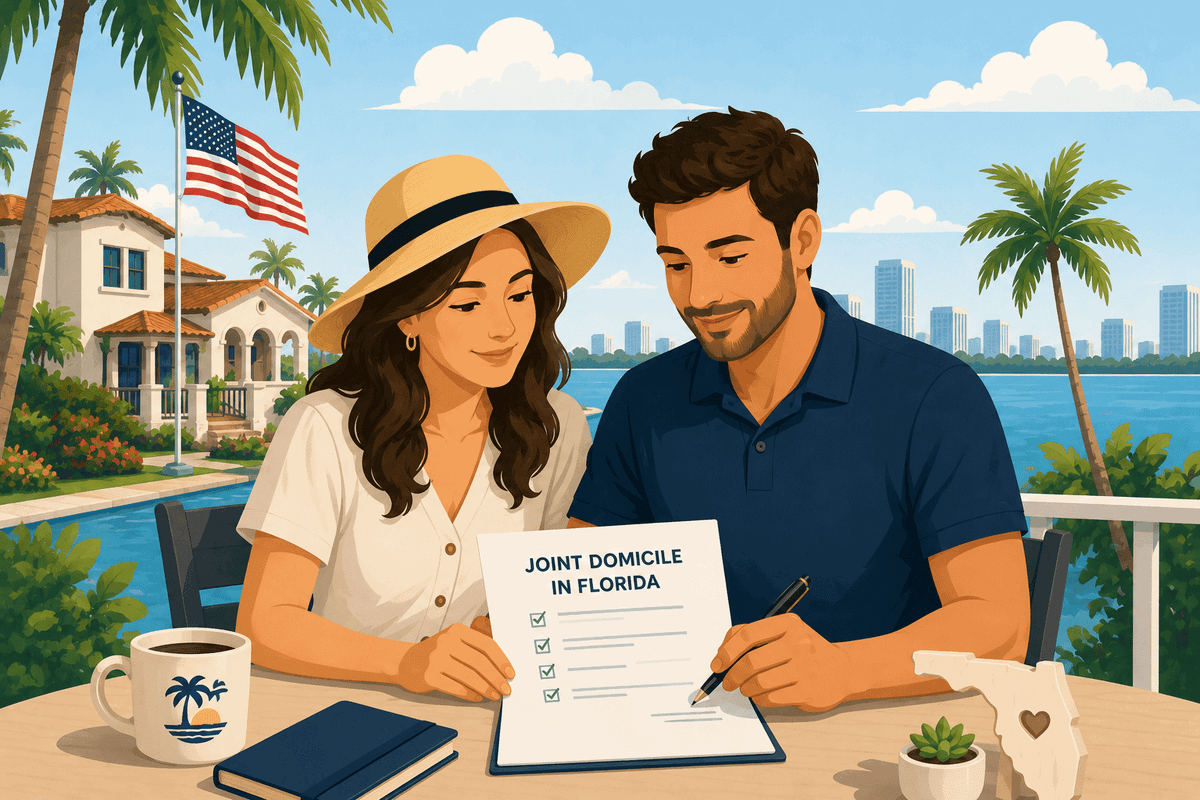
With more retirees, RVers, digital nomads and even Americans living abroad choosing Florida as their domicile state, more and more couples are setting up domicile in the Sunshine State.
Establishing domicile as a couple is easier than setting up solo domicile, and there are many advantages in Florida that the other 49 states cannot offer (for example, no personal income tax). In addition, the state has excellent infrastructure for remote workers, and Florida has made it relatively easy for individuals to establish residency there.
As two people are attempting to establish domicile in a state, things can get complicated as you attempt to sort through various records in order to prove that you and your partner are considered joint domicile, as opposed to the two of you simply sharing an address.
Once one spouse starts changing all of his/her information to reflect the new domicile in Florida, it can sometimes create confusion and/or tax implications if the other spouse has not yet changed his/her information to reflect the new domicile.
This guide covers setting up joint domicile as a couple, why more and more couples are declaring Florida as their domicile state and the way you can structure your joint residency.
Florida is one of the most popular domicile states for couples because it combines no state income tax with a strong infrastructure for expats, retirees, RVers, and remote workers. But establishing joint domicile involves more than sharing an address. Both spouses should keep their licenses, banking records, insurance records, voting records, and other documents aligned with Florida law to reduce the risk of tax or residency disputes.
Many couples choose Florida before moving abroad or traveling full-time because it works well across banking, mail forwarding, healthcare, and long-term estate planning. The key is consistency across systems, especially when leaving high-tax states like California or New York.
Why Florida is popular for couples
Florida has become one of the most popular domicile states for couples because it works well across multiple systems, not just taxes.
The most obvious advantage is the lack of state income tax. For retirees and remote workers leaving high-tax states like California or New York, this can significantly simplify long-term tax planning.
Florida is also considered relatively bank-friendly for people living abroad or traveling full-time. This matters because many expats and nomads struggle with banking compliance when using certain address types or maintaining inconsistent records.
Another reason couples choose Florida is the infrastructure. The state has well-established residential address services, mail forwarding providers, and support systems specifically designed for mobile lifestyles.
Healthcare access is another important factor, especially for retirees. Florida has a strong healthcare infrastructure, large international airports, and insurance availability that tends to work better than some smaller domicile states.
Florida also offers estate-planning advantages because it does not impose a separate state estate tax. For couples thinking long-term about inheritance and retirement planning, this becomes increasingly important.
Can married couples share the same domicile in Florida?
Yes. Married couples commonly establish domicile together in the same state, and Florida is one of the most popular choices.
In practice, couples usually align everything together: the same Florida address, Florida driver’s licenses, voter registration, banking records, insurance policies, and tax documentation. The goal is to create a single, consistent residency setup that works across all systems.
This consistency is important because states look at the overall picture when determining domicile. When both spouses use the same state across licensing, banking, taxes, and official records, the setup is generally much cleaner and easier to maintain long-term.
Technically, domicile is still determined individually for each person, which is why both spouses should keep records aligned rather than assuming marriage alone automatically updates residency status.
How to establish Florida domicile as a couple
Set up a qualifying Florida address
The first step is establishing a qualifying Florida address.
This is where many couples make mistakes because not all addresses work the same way. Some virtual mailbox services use CMRA-classified addresses (Commercial Mail Receiving Agencies, similar to PO boxes). These addresses may work well for mail forwarding, but banks, the DMV, insurance providers, and other institutions often do not accept them as a primary residential address for compliance purposes.
For domicile purposes, the type of address matters. A residential address generally works more smoothly across banking systems, driver’s licenses, insurance records, and tax documentation.
The goal is to create consistency across every system that references your residency.
For domicile purposes, the type of address matters. A residential address generally works more smoothly across banking systems, DMV requirements, insurance records, and tax documentation.
The goal is to create consistency across every system that references your residency.
Update licenses; voter registration (if eligible)
Driver’s licenses are one of the strongest indicators of domicile.
Once you establish your Florida address, both spouses should generally update their driver’s licenses. States often review these documents when evaluating residency.
Each spouse should separately confirm whether any voter-registration update is appropriate based on that individual’s eligibility and voting residence.
The important thing is that both spouses remain aligned. If one spouse updates records while the other continues using another state’s documents, it weakens the overall consistency of the setup.
Align financial and insurance records
This is one of the most overlooked parts of domicile planning.
Your banking relationships, insurance policies, credit cards, tax records, and government accounts should all consistently point to Florida. States often evaluate these records together when determining whether residency has truly changed.
For example, continuing to use a previous state address for primary banking while claiming Florida domicile can create mixed signals.
Insurance is especially important. Auto insurance, RV insurance, and even some health insurance policies are closely connected to your domicile state. Inconsistent insurance records can create compliance or claims issues later.
The more aligned your records are, the stronger your domicile position becomes.
Reduce ties to your previous state
One of the biggest mistakes couples make is assuming that moving abroad or traveling full-time automatically ends state residency.
States like California, New York, Massachusetts, and Connecticut may continue treating you as a resident if strong ties remain in place. This can include maintaining property, continuing to use old addresses, keeping local voter registration, or maintaining primary financial relationships there.
For couples, this issue becomes even more important because states may examine the ties of both spouses together. If you file jointly, some states will treat the household as resident if either spouse maintains strong ties, even if the other spouse fully transitioned to Florida. This is why aligning both spouses’ records matters.
Because of this, many couples establish Florida domicile before moving abroad or beginning long-term travel. Properly transitioning domicile helps reduce the risk of future residency disputes and ongoing state tax exposure.
Florida domicile for couples living abroad
Florida works especially well for couples living overseas.
Many expat couples need a stable U.S. base for banking, taxes, retirement accounts, Social Security, and legal documentation. Florida’s infrastructure makes remote management easier.
A Florida domicile can help support:
- U.S. banking access
- Driver’s license renewals
- Mail forwarding
- Retirement documentation
- Insurance continuity
This becomes particularly valuable for retirees who split time between countries or maintain investments and financial accounts in the United States.
 Jameson Rader
Florida is also commonly used by couples retiring abroad because it simplifies long-term state tax exposure while maintaining a stable U.S. administrative presence.
Florida domicile for RV couples
Florida is one of the most popular domicile states for full-time RV couples.
One reason is vehicle registration. Florida generally allows relatively straightforward remote renewals, which is important for people who rarely remain in one place for long.
The state also has strong infrastructure for mail forwarding and address management, which helps couples maintain consistent records while traveling full-time.
For RVers, domicile affects much more than taxes. It also impacts:
- Vehicle registration
- Insurance pricing
- Driver’s licenses
- Jury duty obligations
- Banking compliance
Because RV couples often move frequently, maintaining a clear legal home state becomes especially important.
Common mistakes couples make
One of the most common mistakes is assuming that marriage automatically synchronizes domicile. In reality, both spouses should actively keep their records aligned with the same state.
Problems often arise when one spouse updates everything to Florida while the other continues to maintain strong ties to a previous state. For example, one spouse may obtain a Florida driver’s license and update banking records, while the other keeps a New York or California driver’s license, voter registration, or primary financial accounts tied to the old state.
This creates a household-level tax risk. States like California and New York may argue that the household never truly left and continue treating the couple as residents for joint-filer state income tax purposes. When different systems point to different states, it weakens the overall domicile position.
Couples also frequently underestimate the importance of address consistency. Using different address types across banking, insurance, tax filings, and government records can create compliance complications later.
The safest approach is usually for both spouses to transition their licenses, addresses, banking relationships, insurance policies, and official records together rather than updating them separately over time.
How domicile affects taxes and estate planning
For couples, domicile affects much more than state income taxes.
It also influences estate planning, inheritance rules, probate, and the treatment of assets after death. Florida’s lack of a state estate tax is one reason many retirees choose to move there before moving abroad.
This becomes especially important for couples with international assets or retirement plans overseas. Some countries, including France, Spain, and Italy, apply forced-heirship rules that may affect how assets are distributed, regardless of what a U.S. will says.
Because of this, domicile and estate planning should be viewed together, particularly for retirees and internationally mobile couples.
Even for younger remote-working couples, aligning on a domicile early can significantly simplify future planning.
How SavvyNomad can help
Domicile is more than just choosing a state.
Your address, banking, taxes, licensing, insurance, and documentation all need to work together consistently. Most problems happen when these systems don’t align.
SavvyNomad helps couples establish Florida domicile with residential address solutions, mail forwarding, and support for maintaining consistent records across systems.
One advantage many competitors don’t offer is couple-friendly pricing. On the Domicile Premium plan, a spouse can be included for free.
On the Basic domicile plan, spouses receive a 50% discount.
For couples establishing a joint domicile, this can simplify logistics and long-term costs.
Conclusion
Florida remains one of the strongest domicile options for couples, especially retirees, expats, RVers, and remote workers.
The biggest factor is consistency. The more both spouses align their records, addresses, licenses, and financial ties with Florida, the stronger and more reliable the domicile setup becomes.
A properly structured Florida domicile can simplify taxes, banking, insurance, and long-term compliance while creating a stable U.S. base for life abroad or on the road.
FAQs
Can married couples share the same domicile?
Yes. Most married couples establish domicile together in the same state.
Can one spouse keep residency in another state?
Technically, yes, but it often creates unnecessary tax and compliance complications.
Does Florida domicile help reduce state taxes?
Florida has no personal state income tax, which is one reason many couples choose the state.
Can couples establish Florida domicile while living abroad?
Yes. Many expat couples maintain Florida domicile while living overseas full-time.