Is establishing a Florida domicile while living abroad legal?
Establishing Florida domicile while living abroad is legal, well-established, and explicitly supported by Florida statute, not a loophole. Learn what the law actually requires, why your former state is the real risk to manage, and how to build a domicile that holds up.

If you're living abroad and researching Florida domicile, there's a good chance the same question stops you before you even start: is this actually allowed? It sounds, at first glance, like a technicality. A loophole. Something that works until it doesn't.
It isn't. Establishing Florida domicile while living outside the US is a well-established legal strategy used by hundreds of thousands of American expats, digital nomads, and remote workers. It's codified in Florida statute, explicitly designed to accommodate people whose lives are based elsewhere, and it's meaningfully different from fraudulent residency claims. Understanding that difference is what this article is about.
Florida domicile while living abroad is legal under Florida Statute §222.17, which is based on intent rather than physical presence. Florida requires no minimum days in-state. The real risk isn't Florida questioning your setup; it's your former state arguing you never truly left. Consistent records across your driver's license, banking and address are what make it defensible. Florida has no state income tax, but this doesn't affect your federal obligations, FEIE and FTC still apply separately.
Yes, and here's the legal basis
Florida Statute §222.17 is the foundation. It allows any person to establish Florida as their legal domicile by filing a Declaration of Domicile: a formal, notarised document declaring intent to make Florida their permanent home. Critically, the statute does not require you to physically reside in Florida for any minimum period. What it requires is intent: that you genuinely intend for Florida to be your permanent legal home.
This intent-over-presence principle is not a grey area. It reflects how domicile has worked in US law for over a century. Courts across the country have consistently held that domicile is the place you consider your permanent home — the place you intend to return to, not necessarily the place where you happen to be living right now. For Americans abroad, that distinction is everything.
This is why Florida domicile is not a loophole. A loophole is a technical workaround that exploits an unintended gap in the law. Florida's domicile framework intentionally accommodates people who travel, live overseas, or have no fixed physical address in the US. The state wrote the rules this way on purpose, and millions of Americans, military personnel, merchant mariners, foreign service officers, and digital nomads have used them legitimately for decades.
What Florida actually requires
There is no minimum number of days you must spend in Florida. There is no physical presence test. What Florida looks at is whether you have taken concrete steps to make Florida your legal home, and whether your records are consistent with that claim.
In practice, establishing Florida domicile typically involves:
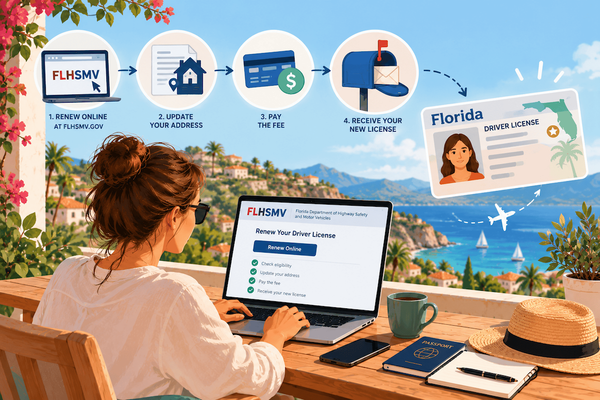
- Filing a Declaration of Domicile with the county clerk (this can often be done via online notary, so you don't need to be in Florida to complete it)
- Obtaining a Florida driver's license does require an in-person visit, but only once
- Registering any US vehicles in Florida
- Updating your address on financial accounts, government records, and insurance policies
- Using a Florida address as your primary US mailing address
The driver's license visit is usually the one physical requirement that brings people to Florida. You don't need to stay. One trip, done correctly, is generally sufficient.
What makes domicile stick over time isn't how many days you spend in Florida — it's how consistently your records, your documents, and your declared intent all point to the same place.
Do you need to own property in Florida?
No. Florida does not require domicile holders to own or rent a physical residence. Many expats establish Florida domicile using a registered mail forwarding address, which provides a valid, real street address for government and financial purposes.
This is a common point of confusion because people associate "home" with property. But in legal terms, domicile and property ownership are separate questions. You can own a house in Italy, rent a flat in Lisbon, and have Florida as your legal domicile, as long as your intent and your records support it.
Could your former state challenge it?
This is the question behind the question. Most people asking "Is this legal?" aren't worried about Florida: they're worried about their former state. California. New York. Illinois. Oregon. States with high income taxes have a financial incentive to argue that someone who has left is still a resident, and some of them pursue that argument aggressively.
The short answer: yes, a former state could challenge your residency status. But the challenge isn't about whether Florida domicile is legal: it's about whether you genuinely abandoned your former state as your permanent home. These are two separate things. See our guide on what to expect in a residency audit for how these challenges typically unfold.
Florida domicile is legally sound. What creates vulnerability is inconsistency — maintaining an Oregon driver's licence three years after claiming to have moved, voting in California elections, keeping a home available for personal use, or having all your financial accounts still pointing to New York. Your former state isn't questioning Florida law; it's questioning whether you ever really left.
The protection isn't in the Florida paperwork alone. It's in the totality of your records — across every state, every institution, and every document that says where you live.
How this interacts with your federal tax obligations
One point worth clarifying: state domicile and federal tax obligations are entirely separate questions.
Establishing Florida domicile does not change the fact that you're a US citizen and still required to file a federal return. The Foreign Earned Income Exclusion (FEIE) and the Foreign Tax Credit (FTC) are federal mechanisms: they operate independently of which state you call home. Florida domicile means Florida does not tax your income (Florida has no state income tax). It does not reduce your federal obligations.
This distinction matters because some people conflate the two, either overclaiming what Florida domicile does or dismissing it, assuming federal taxes swallow everything anyway. For Americans earning income in a high-tax state before moving abroad, the state tax savings can be substantial. As one SavvyNomad client (an IT Chief who had relocated from Utah) put it:
"Coming from Utah, transitioning to a 0% state income tax situation means we anticipate saving close to $10,000 per year. That's not just a small benefit, that's a meaningful difference for our family."
What does doing it correctly look like?
The legal framework is sound. The practical execution is where things go wrong for most people — not because the process is complicated by design, but because managing US state requirements from overseas is genuinely disorienting without a clear system.
One SavvyNomad client who had lived in Croatia for over four years described the experience before getting structured help:
"I haven't been in the US for over four years and Jamson got on the call with me and answered every question I had. He was there answering all my emails along the way over the months until I was ready to actually make it to Florida and get my new residency. Once I got there, everything was set up so that it was as smooth as possible."
What makes Florida domicile legally defensible isn't just filing the Declaration. It's ensuring that your driver's license, vehicle registration, mailing address, banking, and government records all tell the same story, and that story is consistent over time. Done properly, it holds up. Done haphazardly, even the most legally sound framework develops cracks.
The bottom line
Establishing Florida domicile while living abroad is legal, well-established, and explicitly supported by Florida statute. It is not a loophole, a grey area, or something that works until authorities catch on. It is a recognized mechanism of US law that exists precisely because Americans have always moved, traveled, and lived beyond state borders.
What matters is that you do it correctly: file the right documents, update your records consistently, genuinely cut ties with your former state, and maintain a clear paper trail that supports your intent. The legal foundation is solid. What you build on it is up to you.