How to leave Missouri residency
Missouri has a 30-day rule most expats don't know about until it catches them. A domiciled Missouri resident can qualify as a nonresident, but only by maintaining no Missouri abode, keeping an abode elsewhere, and spending 30 or fewer days in the state per year. Here's how to leave cleanly.


Missouri has a residency rule that most people don't know about until it catches up with them. A Missouri-domiciled person can qualify as a nonresident for a given tax year, but only if they maintain no permanent place of abode in Missouri, maintain an abode elsewhere, and spend 30 or fewer days in the state during that year. All three conditions must be met simultaneously.
For expats visiting family in Kansas City or St. Louis, 30 days go quickly. A few weeks over the holidays and a summer trip home can push past the threshold without anyone counting carefully. That is the Missouri trap.
Missouri taxes residents on worldwide income at progressive rates up to 4.7%. Kansas City and St. Louis each add a 1% local earnings tax on income earned within city limits. For people moving abroad or relocating to a no-income-tax state, leaving Missouri residency cleanly requires deliberate steps, not just a change of address.
Missouri uses a domicile-based residency test. A Missouri-domiciled person qualifies as a nonresident only if they simultaneously maintain no Missouri abode, maintain an abode elsewhere, and spend 30 or fewer days in Missouri during the tax year. Spending 31 days in Missouri while still domiciled there generally results in Missouri treating you as a resident for that entire year. The 30-day threshold is the number to track, not 183 days, which applies to non-domiciled people who maintain an abode in Missouri. Missouri's top income tax rate is 4.7% on worldwide-sourced income. Kansas City and St. Louis each impose a 1% local earnings tax on income earned within city limits, which can continue to apply to nonresidents who earn income from those cities. To leave Missouri residency: establish a new domicile elsewhere, remove any Missouri abode, update all records, file a final part-year return, and stay under 30 days in Missouri per year until the domicile change is fully documented.
What does Missouri consider residency?
Missouri uses a two-tier residency system under the Missouri Revised Statutes §143.101.
Tier 1 Domicile: You are a Missouri resident if Missouri is your domicile, so it’s your permanent home, the place you intend to return to when absent. Domicile, once established, continues until you move to a new location with the genuine intention of making that your permanent home. Physical absence from Missouri, even for years, does not, on its own, terminate domicile.
Tier 2 Statutory residency: A person not domiciled in Missouri becomes a statutory Missouri resident if they maintain a permanent place of abode in Missouri and spend more than 183 days there in a tax year. This test applies to someone who was never domiciled in Missouri but has been living there.
The 30-day safe harbor: A Missouri-domiciled individual can be treated as a nonresident for a given tax year if all three conditions apply at the same time: no permanent place of abode maintained in Missouri, a permanent place of abode maintained elsewhere, and no more than 30 days spent in Missouri during the tax year. All three must be satisfied. Meeting two out of three is not enough.
| Scenario | Who It Applies To | Missouri Tax Treatment | Key Threshold |
|---|---|---|---|
| Missouri domicile — standard | Missouri-domiciled person who maintains a Missouri abode or spends more than 30 days in the state. | Resident — taxed on worldwide income. | No day threshold needed; domicile alone is sufficient. |
| Missouri domicile — 30-day safe harbour | Missouri-domiciled person who maintains no Missouri abode, maintains an abode elsewhere, and spends 30 or fewer days in Missouri. | Treated as a nonresident — taxed only on Missouri-source income. | All three conditions must be met simultaneously. |
| Statutory residency (non-domiciled) | Person not domiciled in Missouri who maintains a permanent Missouri abode and spends 183 or more days there. | Resident — taxed on worldwide income. | 183 days plus a permanent abode. |
| Nonresident | Person not domiciled in Missouri and who does not trigger statutory residency. | Taxed only on Missouri-source income. | No Missouri abode, or fewer than 183 days in the state. |
Missouri domicile factors auditors examine include: the location of the primary residence, time spent in Missouri versus other states, the place of employment or business, where the spouse and dependent children live, and the location of vehicles and valuable personal property.
Taxes on American citizens living abroad
How to leave Missouri residency
Leaving Missouri residency is a two-phase process. Phase one is cutting ties with Missouri. Phase two is establishing ties to a new domicile. Both are required.
1. Establish a new domicile outside Missouri
This is the first step. You cannot prove you left Missouri until you can prove you arrived somewhere else. Choose a new domicile state and take the formal steps to establish it there.
For expats and nomads, Florida is the most common choice. Under Florida Statute §222.17, filing a Declaration of Domicile with the county clerk creates a dated, notarised public record of the new domicile. That dated record becomes the evidence of when the Missouri domicile ended.
Declaration of Domicile in Florida
How to select the state of domicile
2. Remove any Missouri abode
This step is more important in Missouri than in most other states. The 30-day safe harbor requires maintaining no permanent place of abode in Missouri. Without satisfying this condition, the safe harbor cannot apply regardless of how few days you spend in the state.
Sell the Missouri property, terminate the lease, or convert it to a rental with an unrelated tenant at market rate. Do not keep a Missouri home available for personal use. Even a guest room at a family member's home that is regularly available for your use can constitute an abode in a close audit.
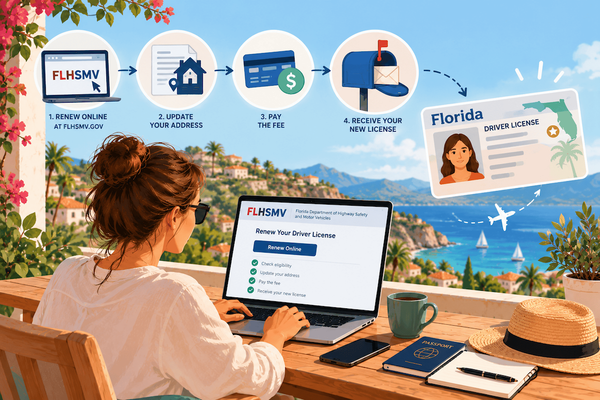
3. Update your driver's license and vehicle registration
Get a driver's license in your new state as soon as possible after establishing domicile. For Florida, Florida Statute §322.031 requires this within 30 days of establishing residency. Register vehicles in the new state. Let Missouri plates lapse.
Florida driver's license without a permanent address
Florida vehicle registration while living abroad
Voter Registration — Separate Eligibility Requirements
If you are eligible, you may update your voter registration based on your current voting residence. Voter registration can be one supporting indicator of domicile, but it is not determinative on its own. You may also need to update or cancel a prior registration, depending on your eligibility and the applicable election-office procedures. We can’t advise on voter eligibility or which address to use — confirm those questions with the appropriate election authority before making a change.
4. Change your mailing address across all institutions
Update your address with every institution simultaneously: banks, investment accounts, brokerage accounts, credit cards, insurance providers, payroll, employer records, and professional licenses. On the government side: IRS Form 8822, Social Security, and passport records. Stop using a Missouri address on any official correspondence.
How to inform the IRS about a new domicile
5. Address Kansas City and St. Louis local earnings tax
If you were earning income within Kansas City or St. Louis, those cities impose a 1% local earnings tax on income earned within city limits. This is separate from state income tax.
After changing domicile, submit updated withholding forms to your Missouri employer to stop local earnings tax withholding.
Note that if you continue to earn income from a business or employer physically located within those city limits, the local earnings tax may continue to apply as a nonresident because it applies to income earned within the city, not to residents alone.
How to stop state tax withholding when you move abroad
6. Update personal and professional ties
Move primary doctors, dentists, attorneys, and accountants to the new state where practical. Update estate planning documents, such as will, trusts, and power of attorney, to reflect the new domicile. Move significant personal property and family heirlooms. Missouri auditors explicitly consider the location of valuable personal property in domicile determinations.
7. File a final part-year resident return in Missouri
File a Missouri part-year resident return (Form MO-1040) for the year of departure. Clearly reflect the departure date on the return. Keep all records that support the move: lease termination dates, moving receipts, closing documents, and utility disconnection confirmations.
Special considerations for people moving abroad
Moving abroad does not automatically end Missouri domicile. Without a new US domicile established, Missouri's claim persists indefinitely. The right sequence: establish a new US domicile first, then move abroad.
The 30-day rule for expats
For expats living primarily outside the US, staying under 30 days in Missouri per year is generally achievable, but requires conscious planning. Track every day spent in Missouri after the claimed departure date. Days accumulate faster than expected across multiple trips to visit family.
The 30-day threshold applies per calendar year, not per rolling 12-month period. The count resets on January 1. A December visit that runs into January counts against two separate years. Document each Missouri visit as a temporary absence from your new domicile, not as Missouri residence.
Using a US mailing address while abroad
The US mailing address used for banking, IRS correspondence, and government records should be in the new domicile state, not Missouri. A Florida mail forwarding address with a real street address, not a PO box, serves this purpose and should appear consistently across every institution from the moment you change domicile.
How to maintain a US address while living abroad
Best mail forwarding services in Florida
Military personnel
Missouri does not tax nonresident military pay. Active-duty members not domiciled in Missouri who have no Missouri-source income can file the No Return Required, Military Online Form with the Missouri Department of Revenue.
Service members stationed at Fort Leonard Wood or Whiteman Air Force Base but domiciled elsewhere retain their home-state domicile under the Servicemembers Civil Relief Act. Missouri cannot tax military pay under the SCRA if the servicemember is domiciled in another state.
What could trigger a Missouri residency audit?
Missouri is moderately sticky. It does not have a dedicated high-volume residency audit program like California or New York, but it reviews departing residents when ties remain. The most common triggers:
- Spending more than 30 days in Missouri in a year while still nominally domiciled there
- Maintaining a Missouri property kept available for personal use
- A Missouri driver's license retained after the claimed departure date
- Financial accounts still pointing to a Missouri address
- Continued ownership or active involvement in a Missouri business
- Kansas City or St. Louis business activity generating continuing local earnings tax exposure
- Spouse or dependent children remaining in Missouri after the claimed departure
Evidence Missouri may review
- Travel records and flight history
- Credit card transactions showing Missouri purchase locations
- Missouri property ownership and usage records
- Bank and investment account statements
- Tax returns filed before and after the claimed departure
- Voter registration history
- Payroll records showing state and local tax withholding
- Location of spouse, children, and dependent family members
- Location of vehicles and valuable personal property
The burden of proof falls on the taxpayer. Missouri does not need to prove you stayed. You need to prove you left.
What to expect in a residency audit
Stickiest states for US citizens ranked
How Missouri residency affects state taxes
Missouri income tax rates
Missouri has a progressive income tax structure with rates from 0% to 4.7% across 8 brackets for tax year 2025 (verify 2026 rate before publishing). Residents are taxed on worldwide income. Nonresidents are taxed only on Missouri-source income.
Missouri-source income that remains taxable after departure:
- Rental income from Missouri property
- Income from a Missouri business or partnership
- Wages earned while physically working in Missouri during visits
- Pass-through income from Missouri entities
The Kansas City and St. Louis local earnings tax
Both cities impose a 1% local earnings tax on income earned within city limits. This applies to nonresidents earning income from within those cities, not just to city residents.
A former Missouri resident who continues to work for a Kansas City employer or earn income from a St. Louis business may still owe the local earnings tax even after leaving Missouri state residency. This is a secondary but real obligation that requires separate attention if your income has city-level exposure.
Social Security and retirement income
Missouri does not tax Social Security benefits for individuals aged 62 or older. Missouri also offers significant exemptions on other retirement income. These benefits apply to Missouri residents. Once nonresident status is established, nonresidents are taxed only on Missouri-source income regardless of retirement status.
The W-2 withholding issue
Employees with W-2 income from a Missouri employer may continue to have Missouri state tax and potentially local earnings tax withheld from each paycheck even after changing domicile. This does not stop automatically. Submit a new Form MO-W4 to the employer reflecting the new domicile state and requesting that Missouri withholding stop.
Do I owe state income tax if I live abroad?
Why do many former Missouri residents choose Florida?
Missouri's top income tax rate of 4.7% is moderate compared to California or New York, but meaningful over time. On $150,000 of income, that is approximately $7,050 per year. For Kansas City and St. Louis residents earning income locally, the combined state-plus-local rate on that income reaches 5.7%.
Florida offers no state income tax, no estate tax, a clear statutory domicile mechanism under Florida Statute §222.17, and a driver's license process that works for people living abroad without a permanent address. There is no minimum day-count required to establish Florida domicile, which matters for the Missouri expat who is also trying to stay under 30 days in Missouri.
The practical sequence for Missouri expats: establish Florida domicile first, remove the Missouri abode, then move abroad. With Florida domicile on record and no Missouri property available for personal use, staying under the 30-day threshold gives the clearest legal footing.
Texas (no income tax), South Dakota (nomad-friendly DMV process), and Nevada (no income tax) are also common alternatives.
- Florida Residency Guide 2026
- Texas residency
- South Dakota domicile for digital nomads
- Best and worst domicile states for nomads and expats
Frequently asked questions
How do I stop being a Missouri resident?
Establish domicile in another state, remove any Missouri abode, update all records to the new state, stay under 30 days in Missouri per year, and file a final part-year return for the year of departure.
What is the Missouri 30-day rule?
A Missouri-domiciled person can qualify as a nonresident if they simultaneously maintain no Missouri abode, maintain an abode elsewhere, and spend 30 or fewer days in Missouri during the tax year. All three conditions must be met at the same time.
Does moving abroad automatically end Missouri residency?
No. Establish a new US domicile first. International residence alone does not end Missouri domicile.
Can I keep a Missouri property after changing domicile?
Keeping any property available for personal use counts as maintaining a Missouri abode and disqualifies the 30-day safe harbor. Convert it to a rental with an unrelated tenant or sell it.
Does Missouri tax me if I live overseas?
Missouri may continue to tax you if you remain domiciled there. If you establish domicile elsewhere and meet the safe harbor conditions, Missouri taxes only Missouri-source income.
What about the Kansas City or St. Louis local earnings tax?
The 1% local earnings tax applies to income earned within those cities, including for nonresidents. If you continue to earn income from a business or employer in those cities after leaving Missouri, the local tax may still apply on that income.
What is the Missouri income tax rate?
Progressive rates from 0% to 4.7% for tax year 2025. Verify the 2026 rate with the Missouri Department of Revenue before publishing.
Conclusion
Leaving Missouri residency requires more than physically moving. It requires removing your Missouri abode, establishing a new domicile with documented steps, and tracking days in Missouri carefully against the 30-day threshold. The local earnings tax in Kansas City and St. Louis introduces a secondary consideration that applies even to nonresidents earning income from those cities.
Missouri's moderate enforcement posture makes it a manageable exit compared to California or New York, but the documentation requirements are real, and the 30-day safe harbor is tighter than most people expect.
Learn how SavvyNomad handles the Florida domicile setup end to end