How to leave Colorado residency
Colorado taxes residents on worldwide income at 4.40%, and moving away doesn't automatically end that obligation. Here's how to leave Colorado residency cleanly, what triggers an audit, and why most former Colorado residents choose Florida.


Colorado taxes residents on worldwide income at a flat 4.40% rate. Simply moving away does not end that obligation. As long as Colorado remains your domicile, your legal permanent home, the state can continue to tax your income regardless of where you physically live or how long you have been gone.
For expats, digital nomads, and people relocating to a no-income-tax state, leaving Colorado residency requires deliberate action. It means establishing a new domicile elsewhere, updating every record that points to Colorado as your home, and creating a paper trail that makes the departure date clear and defensible.
This guide covers what Colorado considers residency, the steps to leave it cleanly, what triggers a Colorado audit, and why most former Colorado residents choose Florida as their new domicile state.
Colorado taxes residents on worldwide income at a flat 4.40% rate (verify 2026 figure, Colorado's TABOR mechanism can cause annual adjustments). Leaving Colorado residency requires establishing a new domicile in another state and updating your driver's license, vehicle registration, and all financial and government records to reflect it. Colorado applies a 183-day safe harbor: spending more than 182 days in Colorado in a calendar year can trigger statutory residency even if your claimed domicile is elsewhere. For expats, the domicile test is the real risk, not the day count. Moving abroad does not automatically end Colorado domicile. A new US domicile must be established first. Colorado can still tax Colorado-source income: rental income, business income, and wages earned while physically in Colorado, even after you change domicile. Florida is the most common destination for former Colorado residents because it has no state income tax, a clear statutory domicile mechanism, and infrastructure that works for people living abroad.
What does Colorado consider residency?
Colorado uses two residency concepts that can apply independently.
Domicile is your permanent home: the place you intend to return to when you are done being wherever else you are. If Colorado is your domicile, Colorado taxes your worldwide income. Physical absence does not matter. You can be living in Portugal for three years and still be Colorado-domiciled if your records, intent, and connections all still point there.
Statutory residency applies when you spend more than 182 days in Colorado during a calendar year. In that case, Colorado may treat you as a resident for tax purposes even if your domicile is genuinely elsewhere. This is a second, independent way to trigger Colorado tax residency.
The 183-day threshold works in both directions. Staying under 183 days in Colorado after changing domicile is a meaningful and documentable data point in your favor. For most expats who are living primarily outside the US, the statutory residency test rarely applies. The domicile question is where the real risk sits.
Colorado's Department of Revenue evaluates domicile through a facts-and-circumstances analysis. It looks at where your permanent home is, where your business and financial interests are centered, and where your personal records consistently point. No single factor is automatically decisive, but the accumulation of records matters. A Colorado driver's license, Colorado voter registration, and Colorado bank accounts all held years after a claimed departure create a picture that is hard to argue against.
Taxes on American citizens living abroad
How to leave Colorado residency
Leaving Colorado residency is a two-phase process. Phase one is cutting ties with Colorado. Phase two is building ties to a new domicile. Both phases are required. Doing only one of them leaves the other state's claim open.
Establish a new domicile outside Colorado
This is the first step and the most important. Before you can prove you left Colorado, you need to prove you arrived somewhere else. Choose a new domicile state and take the formal steps to establish it there.
For expats and nomads, Florida is the most common choice. Under Florida Statute §222.17, filing a Declaration of Domicile with the county clerk creates a dated, notarised public record of when you established Florida as your permanent home. That dated record becomes your evidence of when the Colorado domicile ended.
The new domicile must be genuine. A forwarding address without supporting documentation is not sufficient. The declaration, the driver's license, and the updated records all need to be in place.
Declaration of Domicile in Florida
How to select the state of domicile
Update your driver's license and vehicle registration
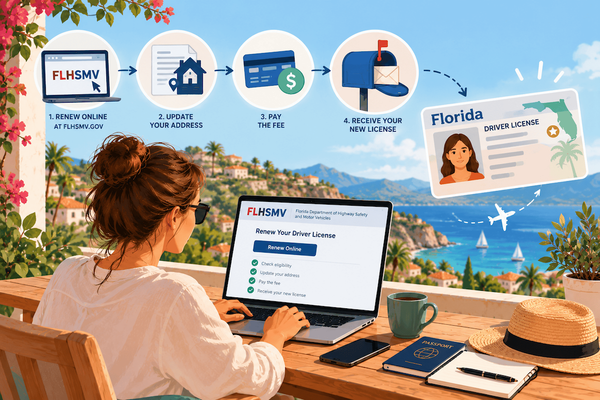
Get a driver's license in your new state as soon as possible after establishing domicile. For Florida, Florida Statute §322.031 requires this within 30 days of establishing residency. That deadline is a legal requirement, not a suggestion. A gap between your declared move date and your new license issuance date is an inconsistency an auditor will notice.
Register vehicles in the new state. Surrender or let the Colorado plates lapse. A car still registered in Colorado years after a claimed move is a direct audit signal.
Florida driver's licence without a permanent address
Florida vehicle registration while living abroad
Voter registration (if eligible)
If you are eligible, you may update your voter registration based on your current voting residence. Voter registration can be one supporting indicator of domicile, but it is not determinative on its own. You may also need to update or cancel a prior registration, depending on your eligibility and the applicable election-office procedures. We can’t advise on voter eligibility or which address to use — confirm those questions with the appropriate election authority before making a change.
Change your mailing address across all institutions
Update your address with every institution simultaneously: banks, investment accounts, brokerage accounts, credit cards, insurance providers, payroll, employer records, and professional licenses. On the government side: IRS Form 8822, Social Security, and passport records.
Stop using a Colorado address permanently on any official correspondence. A single account still listed under a Colorado address two years after your claimed departure date is the kind of detail that raises audit questions.
How to inform the IRS about a new domicile
Update personal and professional ties
Move your primary doctors, dentists, attorneys, and accountants to providers in the new state where practical. Move family, pets, and significant personal property. Update estate planning documents: will, trusts, and power of attorney to reflect the new domicile.
One Colorado-specific point worth noting: Colorado has a strong outdoor recreation culture, and many residents hold ski resort season passes, private club memberships, and subscriptions to outdoor recreation programs. These are minor individually, but they can add up as evidence of ongoing Colorado ties during a close audit. Cancel or transfer them when you change domicile.
File a final part-year resident return in Colorado
File a Colorado part-year resident return (DR 0104) for the year of departure. The return should clearly reflect the departure date. An abrupt jump from resident to non-resident filing without a documented transition year raises questions.
Keep all records that support the move: lease termination dates, moving receipts, closing documents, utility disconnection confirmations. The departure date you document is the one Colorado will use if they ever question the timeline.
Special considerations for people moving abroad
Living abroad does not automatically end Colorado residency. Colorado may still consider you domiciled in the state if you fail to establish a new permanent home elsewhere. The same rule that applies to physical relocation within the US applies to international moves.
The right sequence for expats: establish a new US domicile, typically Florida, first, then move abroad. Not the other way around. Many Americans move abroad, stop filing Colorado returns, and assume the old-state residency has quietly lapsed. Without a new US domicile on record, Colorado's claim persists.
The 183-day safe harbor for expats
Because expats spend most of their time outside the US, they rarely exceed 183 days in Colorado in a calendar year. The statutory residency test is generally not the risk for this audience. The domicile test is.
That said, track days spent in Colorado after your claimed departure date. Family visits, medical appointments, and holiday trips all count. Document them as temporary absences from your new domicile, not as periods of Colorado residence.
Using a US mailing address while living abroad
Expats living abroad need a US address for banking, IRS correspondence, and government documents. That address should be in your new domicile state, not Colorado.
A Florida mail forwarding address with a real street address, not a PO box, serves this purpose and should appear consistently across every institution from the moment you change domicile.
How to maintain a US address while living abroad
Best mail forwarding services in Florida
Military personnel
Colorado has a significant military population: Fort Carson, Peterson Space Force Base, Buckley Space Force Base, and the Air Force Academy all bring service members to the state who are domiciled elsewhere.
Under the Servicemembers Civil Relief Act, military personnel stationed in Colorado but domiciled in another state retain their home-state domicile. Colorado cannot tax military pay if the servicemember is domiciled elsewhere under the SCRA. For military personnel who have established Colorado as their domicile by choice and wish to change it, the same steps above apply.
What factors could trigger a Colorado residency audit?
Colorado sits in the moderately sticky category. It is not as aggressive as California or New York and lacks a dedicated high-volume residency audit unit with the same enforcement intensity. But it does review residency changes, particularly when Colorado business or property ties remain after the claimed departure.
The most common audit triggers for departing Colorado residents:
- Continued ownership of Colorado real estate kept available for personal use
- Ownership or active involvement in a Colorado LLC or business entity
- A Colorado driver's license retained after the claimed move date
- Financial accounts still pointing to a Colorado address
- Significant time spent in Colorado after the claimed departure — especially if close to the 183-day threshold
- Ski resort season passes, private club memberships, or outdoor recreation subscriptions used regularly after departure
Colorado auditors evaluate the totality of facts. The burden of proof falls on the taxpayer. Colorado does not need to prove you stayed. You need to prove you left.
What kind of evidence may Colorado review?
If Colorado questions your residency status, auditors may examine:
- Travel records and flight history
- Credit card transactions showing purchase locations
- Utility records
- Colorado property ownership and usage records
- Ski resort access logs and season pass usage history
- Bank and investment account statements
- Tax returns filed before and after the claimed departure
- Insurance policies and their listed address
- Employer records and payroll filings
- Voter registration history
Consistency across all of these is what makes a departure defensible. One document pointing back to Colorado does not automatically lose the case, but a pattern of inconsistency does.
What to expect in a residency audit
Stickiest states for US citizens ranked
How Colorado residency affects state taxes
Colorado residents are taxed on worldwide income at a flat 4.40% rate (verify 2026 figure before publishing). The flat structure means no marginal rate complexity — the same rate applies to every dollar of taxable income above deductions. Nonresidents are taxed only on Colorado-source income.
What Colorado can still tax after you leave
Ending Colorado residency narrows your Colorado tax obligation but does not eliminate it entirely. Colorado can continue to tax:
- Rental income from Colorado property
- Income from a Colorado business or partnership
- Wages earned while physically working in Colorado during visits
- Certain pass-through income from Colorado entities
Changing domicile removes Colorado's claim on your worldwide income. It does not remove Colorado's claim to income sourced within the state.
The W-2 withholding issue
Employees with W-2 income from a Colorado employer may continue to have Colorado state tax withheld from each paycheck even after changing domicile. This does not stop automatically. It requires formally submitting a new state withholding form to the employer, reflecting the new domicile state and requesting that Colorado withholding stop.
Do I owe state income tax if I live abroad?
How to stop state tax withholding when you move abroad
Why do many former Colorado residents choose Florida?
Colorado has no estate or inheritance tax, and its flat income tax rate is lower than many states in the leave-state cluster; Oregon tops out at 9.9%, California at 13.3%. But for a digital nomad or expat earning income for years or decades, even 4.40% on worldwide income is a meaningful ongoing cost. On $150,000 of income, that is $6,600 per year. On $200,000, it is $8,800.
Florida offers:
- No state income tax
- No estate or inheritance tax
- A clear statutory domicile mechanism under Florida Statute §222.17
- A driver's license process accessible to people without a permanent Florida address
- Established mail forwarding infrastructure for people living abroad
- No minimum day-count requirement to establish domicile
For people leaving Colorado and moving abroad, Florida's remote-friendly setup is a practical advantage. The Declaration of Domicile can be completed via Remote Online Notarisation before arriving in Florida. The driver's license requires one in-person DMV visit. Both can be done in a single focused trip.
Texas (no income tax, large expat community), South Dakota (nomad-friendly DMV process, popular with full-time travelers), and Nevada (no income tax, straightforward domicile) are also common alternatives.
South Dakota domicile for digital nomads
Best and worst domicile states for nomads and expats
Frequently asked questions
How do I stop being a Colorado resident?
Establish domicile in another state, update your driver's licence and all financial and government records to the new state, file a final part-year return in Colorado for the year of departure, and stop spending more than 182 days in Colorado per year.
Does moving abroad automatically end Colorado residency?
No. Colorado considers you domiciled there until you establish a clear new permanent home elsewhere. International residence alone does not end Colorado domicile. The right sequence is to establish a new US domicile first, then move abroad.
Can I keep a Colorado driver's licence after moving?
You can hold it, but retaining it years after a claimed domicile change weakens your position. Get a licence in your new state as soon as possible. For Florida, the law requires it within 30 days of establishing residency.
Can I own property in Colorado and still leave residency?
Yes. Property ownership alone does not establish domicile. The key question is whether the property remains available for your personal use. Rental property raises fewer concerns than a home you can access whenever you visit.
Does Colorado tax me if I live overseas?
Colorado may continue to tax you if you remain domiciled in Colorado. If you establish domicile elsewhere, Colorado taxes only Colorado-source income, rental income, business income, and wages earned while physically present in Colorado.
What is the Colorado income tax rate? A flat 4.40% for 2024 and 2025. Colorado's TABOR mechanism can cause annual rate adjustments; verify the current 2026 rate before publishing.
What if I left years ago but never formally changed my domicile?
Formalize the change now. Your clean departure date is today, not when you physically left. Documented steps from this point forward are preferable to continued exposure. Haven't filed taxes in 3+ years?
Conclusion
Leaving Colorado residency requires more than physically moving. It requires establishing a new domicile that Colorado cannot dispute, with a driver's license, up-to-date records, and a consistent paper trail pointing to the new state.
Colorado's flat tax rate and moderate enforcement posture make it a more manageable exit than California or New York. But the steps are the same, and the documentation matters equally. Cut ties systematically, build ties to the new state with the same thoroughness, and ensure the departure date is cleanly documented.
Learn how SavvyNomad handles the Florida domicile setup end to end