Texas vs. South Dakota domicile for RVers and nomads
Texas and South Dakota are both zero-income-tax RV domicile states, but they work very differently. Eligibility, licensing, vehicle taxes and inspections, insurance and costs for full-time RVers and nomads all differ.

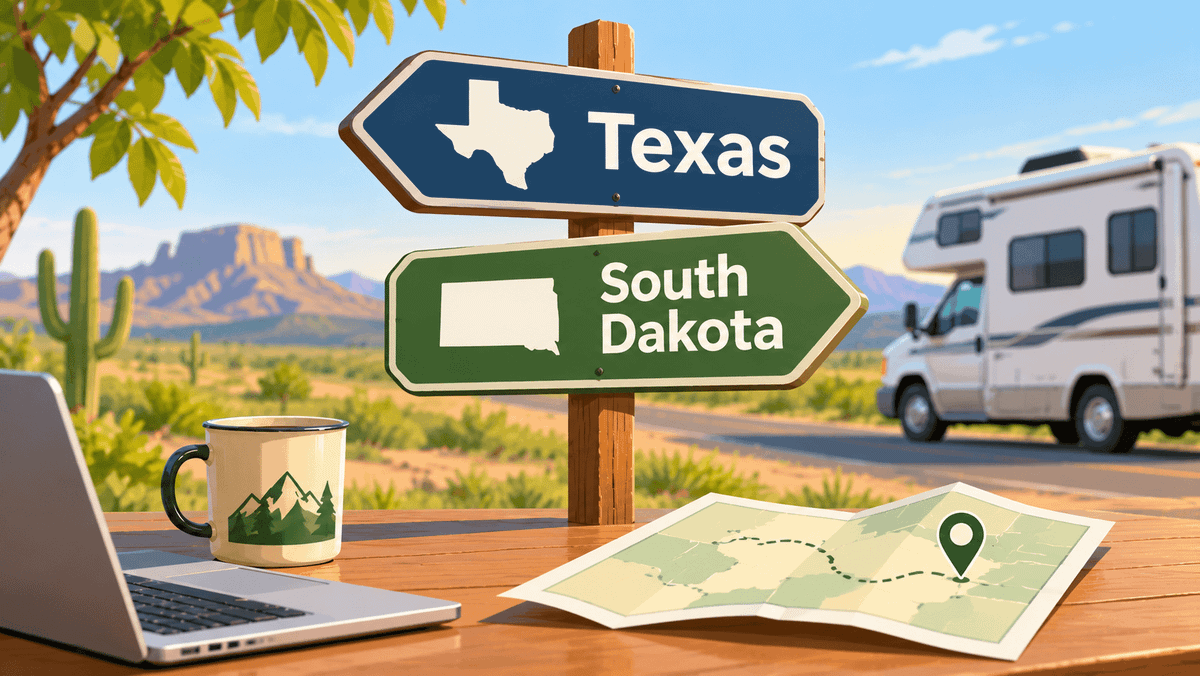
Texas and South Dakota are the two states with no income tax that the full-time RV'er would most likely consider for a legal home base. They're not the same, though. South Dakota has a straightforward route: the full-time traveler exception, subject to an eligibility test and a sworn affidavit. Texas has no such category. You need a residential address and two proofs.
This guide looks at the RV domicile states in terms of who qualifies, the driver's license, vehicle registration and tax, insurance, jury duty, voting and health insurance. It's general information only and is not legal or tax advice. No agency or body is in any way obliged to accept any address. For the basic legalities, see the How to establish permanent residence in an RV guide.
Texas or South Dakota: which is better for full-time RVers?
Neither is simply easier. The gates are different.
- Texas is for those who can produce a Texas residential address and just want the standard license process (i.e., no affidavit required).
- South Dakota suits people who live full time in an RV, a camper or a hotel (or who travel full time for work) and don't have a residence elsewhere.
| Profile | Likely Better Fit | Why |
|---|---|---|
| RVer with a Big Rig | Compare vehicle tax first | Texas charges a $90 new resident tax on a vehicle already registered in your name elsewhere. South Dakota credits tax you paid to another state but collects the difference if that state charged less than 4%, so a rig bought where sales tax was low can cost more there. |
| Nomad Abroad (American Living Outside the US) | Texas | South Dakota's exception is for people living in an RV or hotel or traveling full time for work, not for a rented home abroad. SavvyNomad serves Americans abroad in Texas. |
| Van-Lifer | Either | A van counts as a camper under South Dakota's affidavit. The vehicle-tax gap is smaller on a cheaper vehicle. |
| Retiree on Medicare | Check plans for each address | Original Medicare works nationwide, but Medicare Advantage and Part D plans are tied to where you permanently live. Compare plans for the address you'd use. |
How to establish domicile in Texas as a full-time RVer (address, vehicle, DPS visit, voting)
The Texas domicile requirements are pretty straightforward, really: a residential address, registered and insured vehicles and an in-person visit to the DPS. Our Texas residency guide has all the details.
A Texas residential address. DPS will not accept a business address (37 TAC § 15.25). SavvyNomad's Texas residential address is Quilly's Big Fish RV Park in Rockport. All of the customers' mailing addresses are in Brandon, FL, and Basic Domicile has no mailing address. The Texas declaration is a private notarised statement that you keep. SavvyNomad won't file it, as Texas has neither a state form nor a county recording process for it.
Vehicle registration and insurance first. New residents have 30 days from the move date to register their vehicles (Form 130-U). When you surrender your out-of-state license, DPS's checklist also asks for Texas registration and insurance on each vehicle you own. So it's important to get the insurance and registration sorted first, then the DPS visit.
The DPS visit. You go in person by appointment and provide two proofs of residency. DPS requires proof that you've lived in Texas for at least 30 days (this is waived if you're surrendering a valid, unexpired license from another state). You still need two proofs in either case. New residents have 90 days to get a Texas license. SavvyNomad's Texas customers provide their own two proofs, and the help center explains how. The DPS affidavit option requires a signer who lives at the same address, which of course doesn't work for most RVers.
Voting. If you're eligible, you can complete your voter registration as part of your DPS application, and DPS will accept a printout of your votetexas.gov as one of its acceptable residency documents.
You only need to go to Texas if you want its license or ID.
The South Dakota route for full-time travelers (short version)
You achieve South Dakota domicile via the full-time traveler exception, not simply by overnighting. You need to have a physical residential address in South Dakota, live full time in an RV or camper or travel full time for work (e.g. a traveling nurse or truck driver). The route needs to be:
- A Residency Affidavit, notarized or signed before a DPS examiner, if you use a mail forwarding service
- A receipt for one night's stay at an SD hotel, motel, campground or RV park in the past year with your name on it.
- One document proving your mailbox address, under a year old
The affidavit states that you live in an RV, camper or hotel and that you are traveling full time for work, that South Dakota is where you will return to, that you do not maintain a residence in any other state and that your mailbox is a mail forwarding service (not a virtual-only one). It's signed under penalty of perjury.
South Dakota's HB 1208 also defines an applicant who provides only a mail forwarding address as a federal-only voter. See the South Dakota residency for tax purposes guide and the South Dakota driver's license requirements article. SavvyNomad doesn't set up a South Dakota domicile, so this is for informational purposes only.
Driver's license and vehicle registration: Texas vs South Dakota
| Feature | Texas | South Dakota |
|---|---|---|
| State Income Tax | None | None |
| Who the Route Fits | Anyone with a Texas residential address and two proofs | People who live full time in an RV, camper or hotel or travel full time for work, with no residence elsewhere |
| In-Person Requirement | DPS visit by appointment; 30-day requirement waived if you surrender a valid out-of-state license; two proofs still required | Licensing visit with the affidavit, one-night receipt and mailbox document |
| License Validity and Renewal | Up to 8 years; online, phone or mail renewal if DPS says you're eligible | 5 years; online or mail renewal if eligible; full-time travelers add the affidavit and mailbox document |
| Vehicle Inspection | No safety inspection for non-commercial vehicles since Jan 1, 2025 ($7.50 replacement fee); emissions tests in certain urban counties | No state safety or emissions inspection for passenger vehicles |
| Vehicle Tax and Registration | $90 new resident tax if previously registered in your name elsewhere (no credit for tax paid elsewhere); otherwise use tax on the purchase | 4% excise tax, with credit for tax paid to another state (difference collected if that state charged less); $10 title fee; county wheel tax; $100 fee if you hold no SD license or ID |
| Insurance Cost Tendency | Higher on average: about $2,461 a year for full coverage (Insurify, June 2026) | Lower: about $1,834. State car averages, not RV quotes |
| Jury Duty | Voter list plus DPS license and ID holders | Voter list supplemented by driver license and ID lists |
Renewing from the road. Texas licenses are valid for up to 8 years. Many can renew online or by phone, and DPS offers mail renewal to Texas residents living outside the state (generally ages 18 to 78, US citizens with an SSN on file). DPS will determine your eligibility. South Dakota licenses last five years and can be renewed online or by mail if you didn't do either in the last renewal cycle (so about every other cycle). Full-time travelers must provide a notarized affidavit and a mailbox document.
Inspections: Texas dropped safety inspections for non-commercial vehicles as of 1/1/2025 (HB 3297) but has retained the $7.50 registration fee as a replacement for the inspection. Emissions testing still applies in certain urban counties so the county you register in is important. South Dakota has no state safety or emissions inspection program for passenger vehicles.
What does each state cost?
- The Domicile service. SavvyNomad's Texas plans are listed at $ 60/mo billed annually ($ 720) for the Basic plan and $90 ($ 1,080) for the SavvyNomad plan. The South Dakota mail services are considerably cheaper: Americas Mailbox starts at $169.99/year plus a start-up fee, and Escapees Mail Service in Texas starts at $110/year plus club membership. See SavvyNomad vs Americas Mailbox and SavvyNomad vs Escapees.
- State fees. SD application fee is $28, and its vehicle fees are in the table above. Texas license fees are on the DPS fee page.
- Insurance. State averages will vary, but RV insurers will price the rig and how you use it, so get quotes for the address you'd actually be using.
- An example of the vehicle tax gap. Take a $150k rig that. The new resident tax in Texas would be $90. In South Dakota, the excise tax could be as much as 4% of the rig's value (i.e., $6,000). If you'd paid 6% in your prior state and can show that, South Dakota would collect no further excise tax, whereas Texas would still charge the $90. These are just illustrations, not quotes. The rules are based on the vehicle's history, and your vehicle registration should follow your actual domicile. This is not tax advice.
Jury duty, voting and health insurance
- Jury duty. Both states draw their jury lists from voter registration plus licence/ID records (Texas Government Code §62.001, SDCL 16-13-4.1), so a license in either state can result in a jury summons.
- Voting. South Dakota HB 1208 classification (above) versus Texas registration at DPS.
- Health insurance. Original Medicare is available nationwide, but Medicare Advantage and Part D plans are area-specific (i.e. they're only available in the area where you live). If you move out of that area, you get a special enrollment period. State Health Insurance Assistance Program (SHIP) counselors quoted by PBS say many full-time RVers use Original Medicare with a stand-alone Part D plan and Medigap. ACA marketplace plans are sold state by state, so you need to check how the plan covers non-emergency care when you're away from the state. SavvyNomad doesn't offer health insurance, so you'll need to compare plans for the address you'll be using.
Frequently asked questions
Is Texas or South Dakota better for full-time RVers?
It depends on whether you meet South Dakota's full-time traveler test and your rig's vehicle tax history. South Dakota is for people who live full time in an RV or travel for work and have no other residence. Texas is for people who have a documentable Texas residential address. See the fit table above.
Do you have to visit Texas to establish domicile?
To get a Texas license, you do indeed need to go in person and provide two proofs of residency. The 30-day requirement is waived if you're surrendering a valid, unexpired license from another state. Domicile is where you intend to make your home.
Can you switch domicile from South Dakota to Texas?
In principle, yes: get a Texas license (surrender your SD one), register your vehicles and update your voter registration and records. Your SD affidavit said SD was your state, so you'd need to talk to a CPA or attorney about the timing.
Conclusion
Texas and South Dakota are very different in this respect. South Dakota is the full-time traveler exception. Texas requires a residential address, and the vehicle tax gap is the most important factor for big rigs. For a more in-depth comparison with Florida, see Florida vs Texas and Florida vs South Dakota.