Roth conversion ladder: how it works and why your state matters
A Roth conversion ladder moves IRA money to a Roth a slice at a time, so each slice can be withdrawn without the 10% penalty after five years. See the steps, a worked example, and how your state changes the cost.

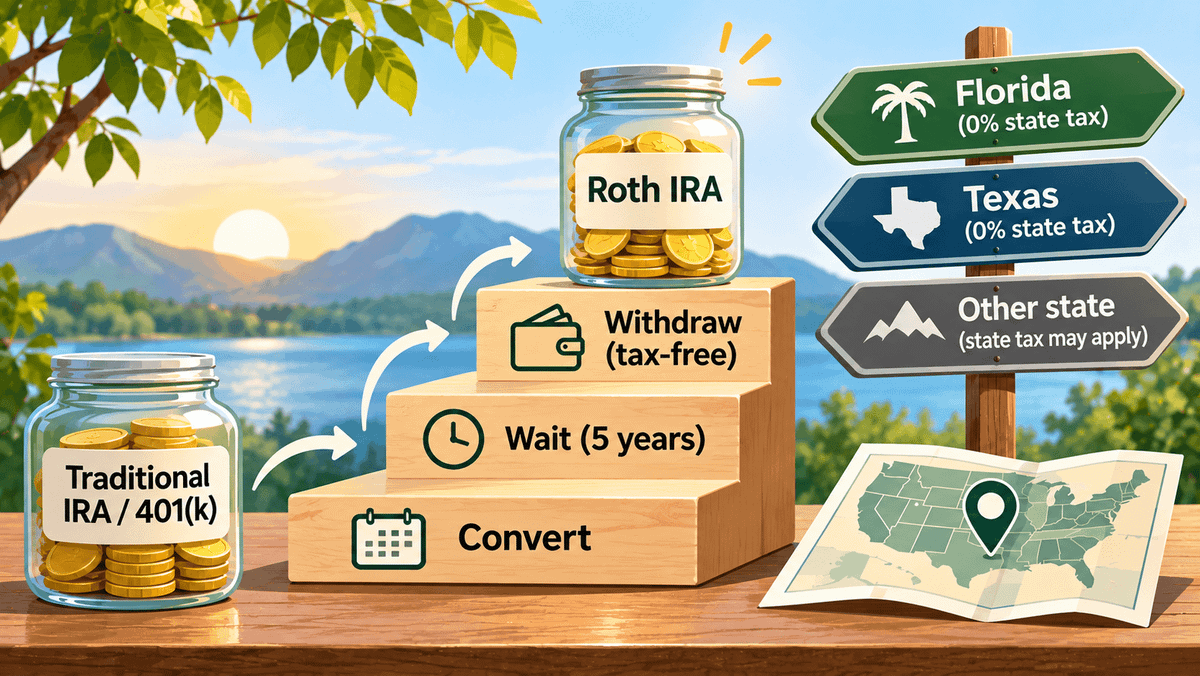
A Roth conversion ladder moves pre-tax money into a Roth IRA a slice at a time. You pay income tax on each slice when you convert it, and each converted slice can be withdrawn without the 10% additional tax about five years later. People use it to reach retirement money before 59½.
This guide explains the Roth conversion ladder step by step, with a worked example. It covers the five-year rule, how much to convert, how the ladder compares with the Rule of 55 and 72(t), what your state does, and what changes if you live abroad.
What is a Roth conversion ladder?
A Roth conversion ladder (often called a Roth ladder) is a series of yearly conversions. Each year you convert some traditional IRA money to a Roth IRA and pay income tax on the converted amount. Each conversion starts its own five-year clock. When a slice's clock ends, you can withdraw that slice without the 10% additional tax. The "ladder" is the staggered set of conversions, with a new rung each year.
A Roth ladder for early retirement turns pre-tax savings into accessible money before 59½ without relying on an exception such as the Rule of 55 or 72(t).
Two things it doesn't do:
- It doesn't avoid tax on the conversion. The conversion is taxed as ordinary income in the year you do it. Only the 10% additional tax on later withdrawals is avoided.
- It doesn't give you money right away. You need other money to live on for the first five years.
For the bigger early-retirement picture, see our guide to the FIRE movement.
How does the 5-year rule work for conversions?
Each conversion has its own five-year period, and it starts on January 1 of the year of the conversion, no matter what month you actually convert. IRS Publication 590 gives the example of a February 2016 conversion whose five-year period began January 1, 2016. So a conversion in November 2026 covers 2026 through 2030, and you can withdraw it from January 1, 2031.
What the clock protects: the 10% additional tax on withdrawing converted amounts before 59½. The tax applies to the portion of the conversion you included in income, and it applies in the year of the withdrawal, even if you paid income tax on the conversion years earlier. At 59½ and older, the 10% additional tax no longer applies.
There's a second five-year rule, and people mix them up. It decides when Roth earnings come out tax-free, and it runs from January 1 of the tax year of your first Roth IRA contribution or conversion. Publication 590-B says the two periods are determined separately.
When you withdraw from a Roth IRA, the IRS ordering rules treat the money as coming out in this order:
- Regular contributions
- Conversions, oldest first
- Earnings
Earnings come out last, so they're the last thing a ladder touches.
How to build a Roth conversion ladder, step by step
- Get the money into a traditional IRA. After you leave an employer, a direct rollover from a 401(k) to a traditional IRA isn't taxed. Rolling into an IRA ends the Rule of 55 for those dollars, so decide which route you want first. Our Rule of 55 guide explains the trade-off.
- Check the pro-rata rule. If you have after-tax money in any traditional, SEP or SIMPLE IRA, part of each conversion is tax-free, worked out from the combined December 31 balance of all those IRAs (IRC § 408(d)(2), Form 8606). 401(k) and 403(b) balances aren't counted.
- Convert a slice each year. Planning to pay the tax from money outside the account keeps the full amount working in the Roth. The IRS doesn't allow conversions made after 2017 to be undone.
- Cover the first five years elsewhere. That can be taxable savings, cash, Roth contributions you made earlier (contributions can come out first), or a bridge such as the Rule of 55 or 72(t).
- From year six, withdraw each slice as its clock ends, oldest first.
| Conversion Year | Amount Converted | Federal Tax | First Year the Converted Amount Can Be Withdrawn Without the 10% Tax |
|---|---|---|---|
| 2026 | $40,000 | $2,620 | 2031 |
| 2027 | $40,000 | $2,620 | 2032 |
| 2028 | $40,000 | $2,620 | 2033 |
| 2029 | $40,000 | $2,620 | 2034 |
| 2030 | $40,000 | $2,620 | 2035 |
Assumptions: single filer, no other taxable income in the conversion years, 2026 brackets and the $16,100 standard deduction held constant, no investment growth, no state tax. Taxable income is $23,900, taxed at $1,240 (10%) plus $1,380 (12%). Brackets change each year, so real results differ. This is an illustration, not advice.
How much should you convert each year?
A common Roth conversion ladder strategy is to convert up to the top of a low bracket. With no other income in 2026, a single filer sees this:
- The first $16,100 converts at 0% federal tax, because the standard deduction covers it. This is the "0% bracket" people talk about.
- Up to $28,500 in total, the rate is 10%.
- Up to $66,500 in total, the rate is 12%.
- Above $66,500, the rate rises to 22%.
(IRS Rev. Proc. 2025-32 sets the 2026 standard deduction and brackets. The totals are my arithmetic.)
Other taxable income, such as interest or dividends, uses up some of that room, so the amount that fits is smaller. Don't convert more than you can pay the tax on from outside the account.
A larger conversion also raises your adjusted gross income, which can affect Marketplace health subsidies and, two years later, Medicare premiums. Check both before you convert.
This is a way of thinking about the numbers, not a recommendation for your situation.
Roth conversion ladder vs 72(t) vs Rule of 55
The three routes solve the same problem in different ways. The Rule of 55 depends on leaving a job at 55 or later and has no fixed schedule. A 72(t) plan works at any age but locks you into payments. A Roth ladder works at any age and lets you choose each year's amount, but the first slice takes about five years to become available. Our guides cover the others: Rule of 55 and 72(t) SEPP.
| Feature | Roth Conversion Ladder | 72(t) SEPP | Rule of 55 |
|---|---|---|---|
| Earliest Access | Any age, but each slice becomes available about five years after conversion | Any age | Separate in or after the year you turn 55 (50 for public safety) |
| Accounts | Traditional IRA or 401(k) money converted to a Roth IRA | IRAs, 401(k)s and 403(b)s | The 401(k), 403(b) or TSP of the employer you left |
| Flexibility | Choose each year's amount | Fixed schedule | Take what you need, subject to plan rules |
| Lock-in | Five years before the first slice is available | The longer of five years or age 59½ | None |
| Income Tax | Yes, in each conversion year | Yes | Yes |
| Best For | Someone who can fund five years elsewhere | Someone who needs steady income now | Someone leaving a job at 55 or later |
Why your state of residence matters
A conversion is income in the year you do it, and the state you're resident in that year generally taxes it. Florida and Texas have no state income tax. Does Florida tax retirement income guide explains the Florida side.
| State | Approx. State Tax on a $40,000 Conversion |
|---|---|
| California | About $740 |
| New York | About $1,560 |
| New Jersey | About $680 |
| Florida | $0 |
| Texas | $0 |
Illustration for a single filer whose only income is the conversion, with no credits or local tax. California uses the 2025 schedule and the $5,706 standard deduction. New York uses its 2026 rates and the $8,000 deduction. New Jersey uses its schedule and the $1,000 exemption, and has a separate retirement income exclusion for older filers, so check nj.gov/treasury/taxation. Rates change, and a new address alone doesn't change your domicile.
Can you run a Roth ladder while living abroad?
A US citizen abroad still owes US tax on the conversion, and two features of the expat tax system matter.
The foreign earned income exclusion doesn't cover it. The exclusion applies to earned income. The IRS lists pension and annuity payments among amounts that aren't foreign earned income, and a conversion is retirement income, not wages.
Stacking can raise the rate. If you exclude wages in the same year, the IRS requires you to figure tax on your remaining income at the rates that would have applied without the exclusion. A conversion stacks on top of the excluded wages and can land in a higher bracket.
The foreign tax credit usually can't help. It only reduces US tax on foreign-source income (IRS Publication 514), and a distribution from a US IRA is generally US-source. Some treaties let you treat certain US-source income as foreign-source, or give an additional credit for tax imposed by the treaty partner, but that depends on your country. Ask a cross-border CPA.
Other points: your country of residence may tax a conversion or a Roth account differently, and whether a US custodian will serve a foreign address is a question for your custodian. How to use a 401(k) and IRA as an American expat guide covers the wider picture.
Frequently asked questions
Is a Roth conversion ladder worth it?
It depends on your tax rate now versus later, your other savings and how you value early access. It trades tax now for flexibility later, and it can't be undone. A professional can run your numbers.
When can I withdraw converted Roth money penalty-free?
After the five-year period for that conversion, or at 59½, whichever comes first, as far as the 10% additional tax goes. Earnings follow a separate rule.
Do I pay state tax on a Roth conversion?
Most states with an income tax treat a conversion as income in the year you convert. Florida and Texas have no state income tax. Check your state's rules.
Can I do a Roth conversion ladder as a US expat?
Yes, in principle, but you still owe US tax on the conversion. The foreign earned income exclusion doesn't cover it, and the foreign tax credit may not help.
Conclusion
A Roth conversion ladder swaps tax now for access later. Each conversion has its own five-year clock, so you need a way to cover the first five years. If you qualify for the Rule of 55 or want a fixed schedule instead, read the 72(t) SEPP guide. For the abroad angle, read How to use a 401(k) and IRA as an American expat.