How to establish permanent residence in an RV (the legal way)
Living full-time in an RV? Learn how to establish a legal residence, choose the right state, and stay compliant with taxes and documentation.

Living full-time in an RV offers freedom that traditional lifestyles can’t match. You can move whenever you want, change scenery on a whim, and avoid being tied to one place.
But there’s one thing you can’t avoid: having a legal residence.
Many RVers assume that because they’re always on the move, they don’t need a permanent address or domicile. In reality, the opposite is true. Even if you never stay in one place for long, governments, banks, and insurers still need to know where you are legally based.
Without a clear domicile, tasks such as filing taxes, registering a vehicle, banking, and even basic identity verification can quickly become complicated.
This guide explains how to establish permanent residence in an RV the right way, so you can enjoy the lifestyle without running into compliance issues later.
Living full-time in an RV doesn’t exempt you from the need for a legal residence. You still need a domicile for tax, vehicle registration, banking, and compliance purposes.
To set it up properly, choose an RV-friendly state (like Florida, Texas, or South Dakota), get a compliant residential address, update your driver’s license and vehicle registration, and align all your records.
Mail forwarding alone is usually not enough. You also need to cut ties with your previous state and keep consistent documentation.
The key is showing a clear, well-organized connection to one state, even if you’re always on the move.
What does “permanent residence” mean for RVers?
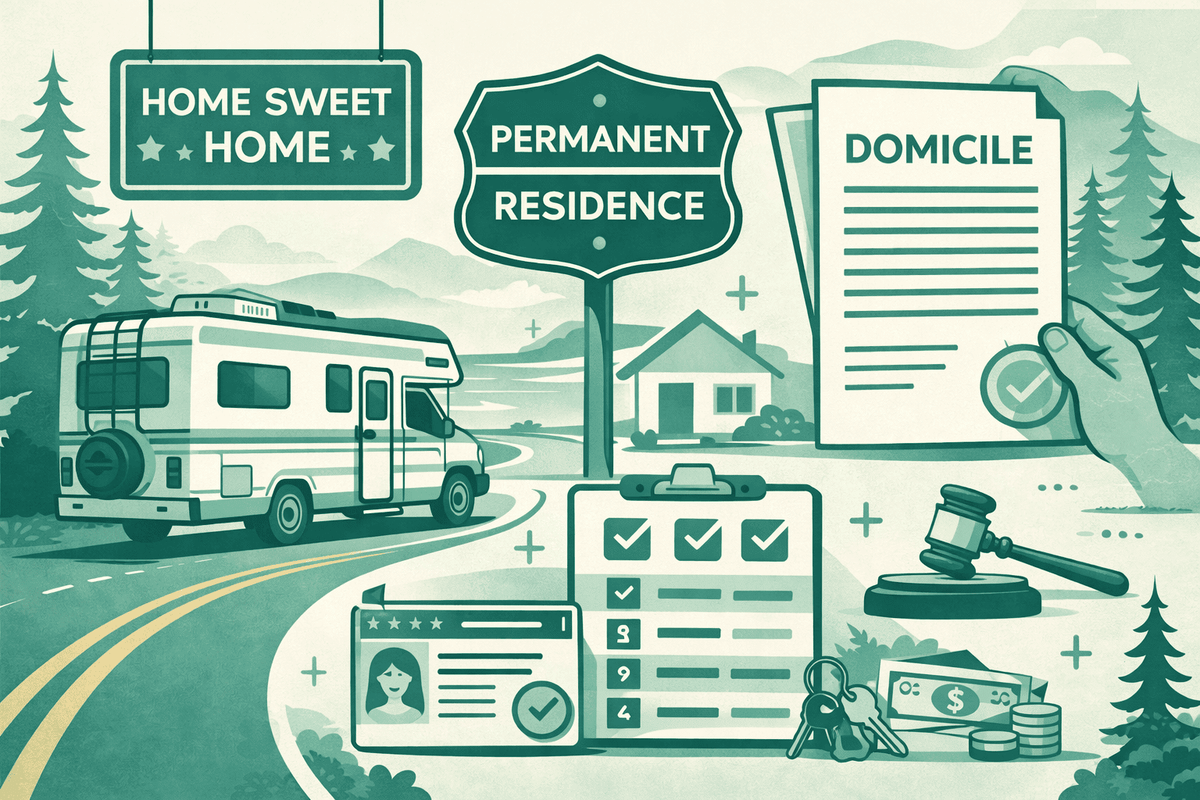
Many RVers get permanent residence confused with settling down permanently in one place, yet your permanent residence is your domicile, which is legally recognized as your home.
Your residence is typically the place you intend to return to, even when traveling. Your residence is also the state in which you pay most of your taxes, and where you obtain a driver's license, register your vehicles, and fulfill other obligations required by law.
It is different from residency, which is where a person physically lives day to day and is typically measured in months or years. While a person can be traveling across the country, potentially even different states, their domicile would remain the same unless they specifically change it.
It is essential to understand the concept that underlies the vast majority of compliance failures. Most people mistakenly assume that their lifestyles are location-free, only to be brought back to reality by legal systems that do not share that perception.
Why do you need a legal domicile as an RVer?
Establishing residency as a full-time RVer is not as simple as it seems. Even though you are living in an RV full-time, your residence affects your life in many financial and legal ways.
Taxes can play a major role, mostly having to do with your State of Residence and whether or not you pay income tax to that state, as well as how that state handles filing requirements.
Your RV and any other vehicles must be registered in your state of domicile. You will need to research which state they need to be registered in and learn the rules and processes for inspections, registration renewals, and state fees.
You will also need to provide an address for a driver's license, car insurance, and bank information. Most companies require addresses to be compliant with the post office.
However, living on a road can make it difficult to register a car, open a bank account, get insurance, and prove your identity.
Check out this conversation on Reddit about permanent residency:
New to RV living (soon to be)
by u/haveuseenmymindd in RVLiving
Best states for RV domicile (quick overview)
While you can technically establish domicile in many states, a few stand out as particularly RV-friendly.
Florida, Texas, and South Dakota are the most popular choices. These states offer no personal income tax, relatively simple residency requirements, and infrastructure that supports mobile lifestyles.
They also have established systems for mail forwarding and address services, which makes it easier to maintain a consistent legal setup.
Other states like Nevada and Wyoming can also work, but they often come with different trade-offs, such as higher registration costs or stricter residency requirements.
Step-by-step: how to establish RV residency legally
Establishing a legal domicile as an RVer involves more than just picking a state. It requires a series of coordinated steps that demonstrate your intent to make that state your home.
1. Choose your domicile state
Start by selecting a state that fits your lifestyle.
Consider factors such as taxes, vehicle registration costs, and how often you’ll realistically return. A state that looks attractive on paper may not work if its requirements don’t align with how you travel.
2. Get a compliant residential address
A valid address is one of the most important parts of establishing domicile.
This isn’t just about receiving mail. It’s about meeting the requirements of banks, government agencies, and other institutions.
Some RVers use domicile services that provide a residential-style address. Others rely on trusted family members. Mail forwarding services can help manage mail, but on their own, they may not always meet compliance standards.
3. Spend time in your chosen state
Many states require some level of physical presence to establish residency.
This could be a short stay at a campground, a hotel, or a rented property. The goal is to create a record that shows you were physically present when establishing your domicile.
4. Get a driver’s license in your new state
Updating your driver’s license is a key step in demonstrating your new domicile.
This process usually requires proof of address and identity. Once completed, it becomes one of the strongest indicators of your residency status.
5. Register your RV and vehicles
Your vehicles must be registered in your state of domicile.
This may involve obtaining insurance, paying registration fees, and meeting any inspection requirements. These rules vary by state, so it’s important to understand them before making your choice.
6. Voter registration (if eligible)
If eligible, you may update your voter registration based on your actual voting residence. Confirm your eligibility and appropriate residence address with the applicable election authority.
7. Update your address everywhere
Consistency is critical.
You should update your address with your banks, credit card issuers, insurance providers, and the IRS. This ensures that all your records align with your new domicile.
8. Cut ties with your previous state
To fully establish a new domicile, you need to sever or reduce your connections to your previous state.
This may involve selling property, closing local accounts, and updating any remaining records that still point to your old address.
The goal is to create a clear break and avoid situations where two states could claim you as a resident.
What counts as proof of residency in an RV
Proving residency as an RVer can be more complex than for someone with a traditional home.
Authorities may look for evidence such as campground stay receipts, lease agreements, or other records showing physical presence. Financial documents and official correspondence can also support your case.
The key is consistency. Your documents should all point to the same state and support your claim of domicile.
Common mistakes RVers make
It seems that for many RVers, trouble doesn’t come from not knowing the rule; rather, it’s that they misunderstand the seriousness of complying with it.
A common mistake is relying solely on a mail forwarding address that doesn’t meet official requirements. Another is failing to update records across all institutions, which creates inconsistencies.
Some people also keep strong ties to their previous state, such as property or frequent visits, which can weaken their claim of a new domicile.
Choosing a state based only on tax benefits is another issue. If the state’s practical requirements don’t match your lifestyle, it can create complications later.
Mail forwarding vs real address: what’s the difference
Mail forwarding is useful for many packages and communications, but does not serve as a legitimate residential address.
Many of these services are Commercial Mail Receiving Agencies (CMRAs), and many banks and DMVs do not accept CMRAs as proof of a street address for registering vehicles, obtaining licenses, or opening bank accounts.
A compliant residential address is essential for identity verification and document verification.
Most RVers have a residential street address for critical matters (e.g., voter registration, property ownership, receiving important packages by error) and a mail-forwarding service for mail related to their RVing lifestyle.
Can you live in an RV full-time legally?
Yes, living full-time in an RV is legal, but it comes with certain conditions.
Local zoning laws may affect where you can park and stay, but these are separate from your domicile. You can travel freely as long as you maintain a legal residence somewhere.
The key is understanding that mobility does not replace the need for a legal base.
How long does it take to establish a domicile?
There’s no single timeline for establishing domicile.
While some elements take mere weeks or months to accomplish, getting a driver’s license or registering your vehicle, others, like proving long-term residency, require years of steady habit.
Consistency in your approach is a key factor in demonstrating your residency. There should be a trail of evidence over time to support your self-declared domicile.
How SavvyNomad can help
Setting up a compliant domicile while traveling in an RV can be confusing and time-consuming, especially when dealing with multiple systems.
SavvyNomad helps Americans living abroad, and RV travelers choose a residence, then sets up your new address, organizes paperwork, notifies all relevant parties and changes your state affiliation.
Conclusion
Living in an RV gives you freedom, but it doesn’t remove the need for structure.
Choosing a formal legal residence (or domicile) is a crucial step in organizing your finances, handling your taxes, and ensuring compliance with various laws and regulations.
In addition to choosing the optimal state for living on the road, registering your RV mailing address and establishing appropriate records are key to building a solid foundation for your life on the move.
When setting up your RV for seasonal residence, you can maintain total flexibility while avoiding cumbersome limitations.
FAQs
Can I use a PO box as my legal address?
In most cases, no. A PO box alone usually doesn’t meet requirements for official residency.
What is the easiest state for RV residency?
South Dakota is often considered the simplest, but with newest updates, you need to be careful. Florida and Texas offer more infrastructure.
Do I need to stay in the state to maintain residency?
Requirements vary, but most states expect some level of physical presence.
Can I change domicile while traveling?
Yes, but you need to follow the proper steps and document the transition.
What happens if I don’t establish residency?
You may face issues with taxes, banking, and compliance, and risk being claimed by a previous state.