Remote work visa tax implications: what US citizens need to know (2026)
A remote work visa solves the immigration problem. It doesn't solve the tax problem. Here's what US citizens on digital nomad and remote work visas actually owe, in the US, in their visa country, and at the state level.

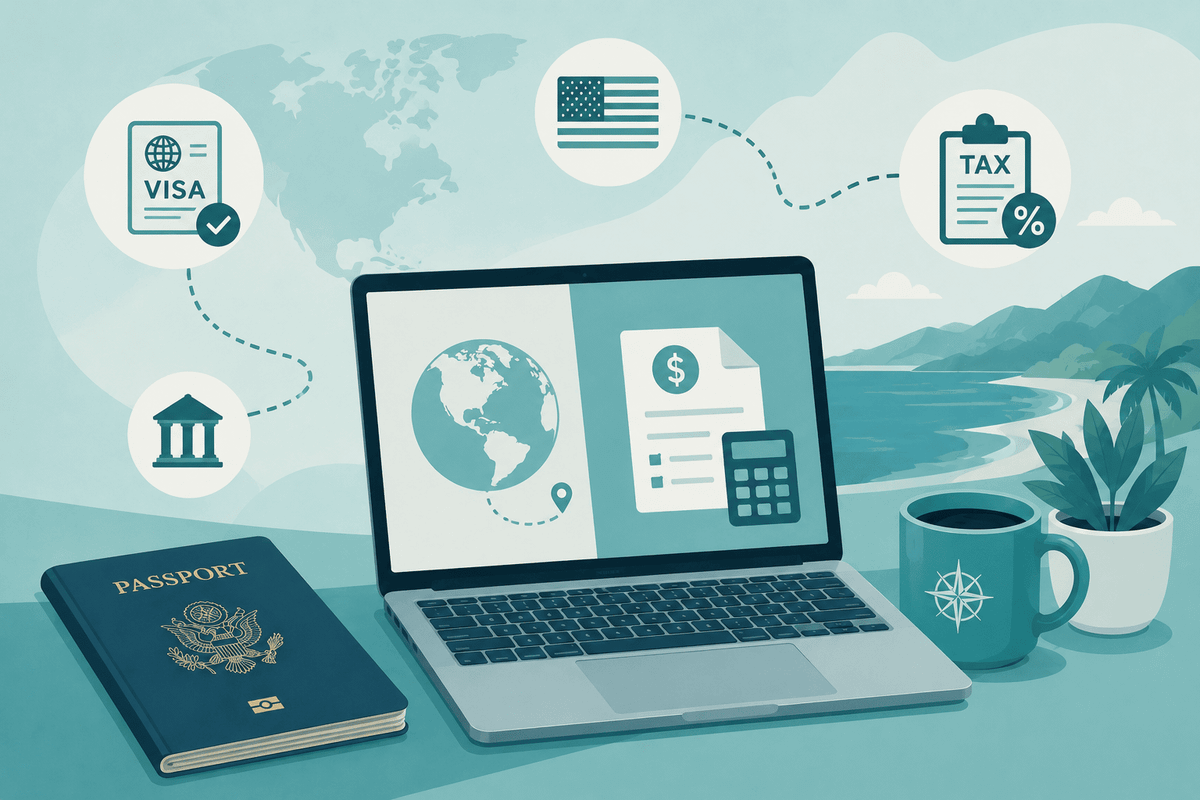
A remote work visa grants you the legal right to stay in another country while earning income from outside it. What it does not do is resolve your tax situation in either direction. It does not exempt you from US taxes. It does not automatically create local tax breaks. It does not end your US state tax obligations.
Most tax complications for digital nomads on remote work visas come from confusing three separate questions: what does your visa country tax, what does the US tax, and how do the two interact? This guide answers all three for 2026, with specific treatment of the most common destinations for remote work visas.
A remote work visa grants immigration status. It does not remove the US filing obligation. US citizens file taxes on worldwide income regardless of visa or location. The Foreign Earned Income Exclusion ($132,900 per person for 2026, $265,800 for qualifying couples) and the Foreign Tax Credit are the primary tools for reducing US tax on foreign-earned income. Self-employment tax of 15.3% applies even when all income is excluded under FEIE: the most commonly missed cost for freelancers on nomad visas. On the host country side, three categories apply: territorial systems that do not tax foreign-source remote income at all, countries with special nomad regimes at reduced rates, and countries that apply standard worldwide tax rates after 183 days. US state taxes do not stop automatically when you leave the country. A formal domicile change is required.
What a remote work visa does and doesn't do for your taxes?
Over 65 countries offer some form of digital nomad or remote-work visa as of 2026. These permits solve one specific problem: they give you the legal right to live in a country while working for clients or employers outside it. That is where the visa's tax relevance begins and ends.
A remote work visa does three things with tax implications. It authorizes your legal presence, which can help establish Bona Fide Residence for FEIE eligibility. It may make you a formal tax resident of the host country after a threshold period, usually 183 days. And it can trigger local tax obligations depending on how that country treats foreign-source remote income.
A remote work visa does not remove your US filing obligation. It does not automatically exempt you from local taxes. It does not guarantee any specific tax treatment in the host country.
Every remote work visa holder needs to answer three separate questions:
- Does my visa country tax my remote income?
- How does this affect my US tax bill?
- Do I still owe US state taxes?
Is being a digital nomad legal?
Taxes on American citizens living abroad
The US side: your filing obligation doesn't change
US citizens file federal taxes on worldwide income regardless of where they live or which visa they hold. The filing requirement kicks in once income exceeds the standard deduction. Living abroad and holding a foreign visa is irrelevant to the IRS. You file Form 1040 annually and report everything.
The standard filing deadline is April 15. Americans living outside the US receive an automatic extension until June 15, with no form required. A further extension to October 15 is available via Form 4868. Extensions apply only to filing; any tax owed accrues interest from April 15, regardless of when you file.
The Foreign Earned Income Exclusion
The FEIE excludes up to $132,900 of foreign earned income from US taxable income for 2026. Married couples where both spouses qualify can exclude up to $265,800 combined. The foreign housing exclusion amounts to $39,870 for qualifying housing costs, including rent and utilities.
To claim the FEIE, you must meet one of two tests. The Physical Presence Test requires 330 full days outside the US in any 12-month period. The Bona Fide Residence Test requires legal residency in a foreign country for a full calendar year. A remote work visa actively helps with the Bona Fide Residence Test. It is documented evidence of legal residency intent in a foreign country.
The FEIE does not apply to passive income, dividends, interest, or capital gains. It applies only to income earned through work.
The Foreign Tax Credit
The Foreign Tax Credit credits foreign taxes paid against US tax liability on the same income, dollar for dollar. It works best in high-tax countries where local rates equal or exceed US rates. When that is the case, the credit wipes out US liability entirely. The FTC can be used alongside the FEIE on different income streams.
How to file taxes as a US citizen living abroad
The self-employment tax trap
This is the cost most freelancers and remote contractors on nomad visas do not see coming.
The FEIE excludes foreign earned income from federal income tax. It does not eliminate self-employment tax. SE tax runs at 15.3% on net earnings. It applies even when every dollar of income is excluded under FEIE. A freelancer earning $100,000 abroad who claims the full FEIE pays $0 in federal income tax and approximately $14,130 in SE tax.
One source of relief: Totalization Agreements between the US and 30+ countries prevent dual Social Security contributions. If you are self-employed in the UK, Germany, France, Australia, Canada, Japan, South Korea, or another Totalization Agreement country, you generally contribute to only one country's system. Check SSA.gov for the current list. Nomads in the UAE, Thailand, and most Southeast Asian countries are not covered by Totalization Agreements. Full US SE tax applies.
US state tax still applies without a domicile change
A remote work visa does not end US state tax obligations. A nomad on a Portugal visa who was previously domiciled in California still owes California income tax unless domicile was formally changed before leaving.
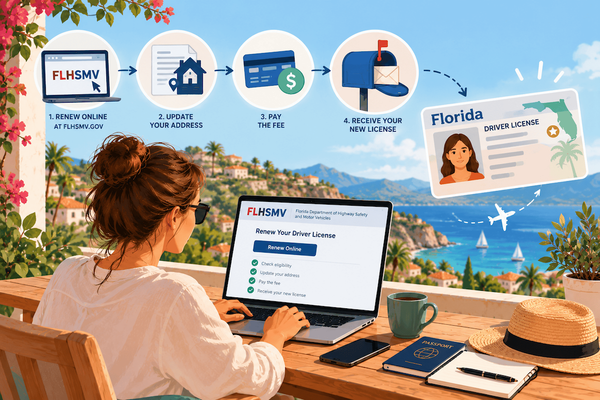
The fix: establish Florida, Texas, South Dakota, or Nevada domicile before or immediately after moving abroad. These states have no income tax and no estate tax. Filing a Declaration of Domicile, obtaining a driver's license, and updating all records to the new state address ends the old state's claim.
Do digital nomads pay state taxes?
Florida residency requirements for tax purposes
The host country side: 3 tax situations your visa might create
Which of these three categories your visa country falls into determines your entire local tax exposure.
Category 1: Territorial systems, no local tax on foreign remote income
These countries only tax income earned locally. Foreign remote work income paid by overseas clients or employers is not taxed locally regardless of how long you stay.
- Georgia: 20% flat tax on Georgian-source income. Foreign remote income is exempt under the territorial system. Low cost of living. Popular with US nomads in part because the FTC does not apply here and the FEIE does the full job.
- Panama and Costa Rica: both operate territorial systems. Foreign-source remote income is not taxed locally. No minimum-stay visa requirements make these accessible options.
- Croatia: explicitly offers a 0% tax exemption for digital nomad visa holders on foreign-source income. One of the clearest nomad-specific tax exemptions in Europe.
- UAE: 0% personal income tax with no territorial restriction. One-year remote work visa available. No Totalization Agreement with the US means full SE tax applies for self-employed nomads. No US tax treaty, which matters for investment income.
- Barbados Welcome Stamp: 0% on foreign-source income for visa holders. One-year permit aimed directly at remote workers.
Practical result for US nomads in territorial countries: no local income tax on remote work. FEIE eliminates most or all US federal income tax. SE tax still applies if self-employed.
Category 2: Worldwide tax systems with special nomad regimes
These countries normally tax worldwide income. They offer reduced rates for qualifying nomads who meet specific criteria.
- Spain (Beckham Law): flat 24% on income up to €600,000 for qualifying applicants on the digital nomad visa. Work must be primarily for non-Spanish clients or employers. Applies from the first year of Spanish residency. Duration: up to 6 tax years. Significantly better than Spain's standard 47% marginal rate for higher earners.
- Greece: 50% income tax discount for new tax residents who transfer their tax residency to Greece. Apply within 2 years of establishing Greek residency. Duration: 7 years.
- Portugal (IFICI regime): The Non-Habitual Resident regime closed to new applicants. The successor IFICI regime offers a 20% flat rate for qualifying high-value activities. Foreign-source income is broadly exempt for first-time Portuguese tax residents. The D8 digital nomad visa provides residency rights. IFICI must be applied for separately. Administrative guidance is still developing in 2026 — get specialist Portuguese tax advice before assuming eligibility.
- Estonia: 12-month digital nomad visa with a €4,500/month income requirement. Foreign-source income is not locally taxable if not earned in Estonia.
Practical result: local tax applies at a preferential rate. The FTC may reduce remaining US liability. Both tax systems need to be coordinated — this is where a cross-border CPA earns the fee.
Category 3: Standard worldwide tax systems
These countries apply normal progressive rates to residents on worldwide income after 183 days. Germany, France, and most European countries without special regimes fall here.
Rates can reach 30 to 50% on income above moderate thresholds. These countries generally have US tax treaties. The FTC typically eliminates US liability entirely when local rates exceed US rates — so double payment is avoided, but the total effective rate is the higher of the two countries' rates.
Practical result: local tax at full rates applies. No double payment to the US, but the total bill is the foreign rate. For high earners moving from a low-tax US state, this can be significantly more expensive than they expected.
| Country | Visa type | Local tax on remote income | Special regime | Notes |
|---|---|---|---|---|
| UAE | Remote Work Visa (1 year) | 0% | None needed | No U.S. tax treaty; self-employment tax applies in full |
| Croatia | Digital Nomad Visa | 0% | Explicit exemption for visa holders | Clean territorial exemption |
| Barbados | Welcome Stamp (1 year) | 0% on foreign income | None needed | Foreign-source income is not taxed |
| Georgia | Remote Work Visa | 0% on foreign income | Territorial system | 20% on local-source income only |
| Panama | Various | 0% on foreign income | Territorial system | No local tax on income from remote clients |
| Costa Rica | Digital Nomad Visa | 0% on foreign income | Territorial system | Foreign-source remote income is generally outside the local tax base |
| Spain | Digital Nomad Visa | 24% flat rate up to €600,000 | Beckham Law | Available for up to 6 years; standard top rate can reach 47% |
| Portugal | D8 Digital Nomad Visa | 20% flat rate for qualifying income | IFICI regime | NHR is closed to most new applicants; verify 2026 eligibility |
| Greece | Digital Nomad Visa | 50% discount on the standard rate | Special regime | Available for up to 7 years |
| Estonia | Digital Nomad Visa | 0% on foreign income | Specific to visa | €4,500 monthly income requirement |
| Germany | Freelancer Visa | Standard rates of 14%–45% | None | Tax residency may arise after 183 days |
| Thailand | DTV Visa | Evolving — see note | None | Rules changed in 2024; verify the current tax treatment |
The 183-day rule: what it actually triggers
Most countries consider you a tax resident after spending 183 days there in a calendar year. That triggers tax residency and with it, the local tax obligations described above.
Spending fewer than 183 days does not automatically mean you are not a tax resident. Some countries use additional tie-breaker tests: where is your permanent home, where are your closest family ties, where is the center of your economic life. Germany and France can claim tax residency even if you spend less than 183 days there if you maintain a permanent home there.
The 183-day rule is a floor, not a ceiling. Many countries can claim you as a resident on other grounds before you hit it.
The digital nomad visa itself changes this calculation in some countries. Several visa programmes establish tax residency from day one of the visa not, after 183 days. Check the specific rules for your visa programme, not the general country rule.
For FEIE purposes, the Physical Presence Test counts days in any combination of foreign countries. You do not need to spend 330 days in one place. Track every day with a travel log reconciled to flight records, hotel receipts, and credit card statements. If the IRS questions your Physical Presence Test, you must be able to account for every day.
Dual tax residency for US citizens abroad
Thailand: a rule change every nomad needs to know
Thailand deserves a standalone note because its rules changed in 2024 and many nomad guides have not caught up.
Thailand traditionally taxed only foreign income remitted into the country in the same year it was earned. Many nomads built their financial setup around keeping income in offshore accounts and not remitting it to Thailand. That planning approach was legitimate under the old rules.
Since 2024, new Thai tax regulations allow the taxation of global income by residents, including income not remitted to Thailand. The rules are still evolving, and transitional guidance has been under discussion for 2025 and 2026. Do not rely on guides written before 2024 or on advice that references the old remittance rule without acknowledging the change. Consult a Thai tax advisor for your current situation before assuming any exemption applies.
FBAR and reporting obligations don't disappear abroad
Opening a bank account in your visa country, which almost every nomad does, almost certainly triggers FBAR reporting.
FBAR (FinCEN 114) is required if aggregate foreign financial account balances exceed $10,000 at any point during the year. This applies regardless of visa status, income level, or whether any US tax is owed. Form 8938 (FATCA) applies if foreign financial assets exceed $200,000 at year-end or $300,000 at any point for expats living abroad.
Both requirements are separate from your tax return. FBAR is filed electronically with FinCEN, not the IRS. The penalty for non-wilful failure to file is up to $16,536 per annual report for 2026.
Frequently asked questions
Do I owe taxes in the country where I have a digital nomad visa?
It depends on which of the three categories your visa country falls into. Territorial countries do not tax foreign remote income. Countries with special regimes tax it at reduced rates. Standard worldwide tax countries apply normal rates after 183 days. Check which category applies before assuming anything.
Does a digital nomad visa help me qualify for the FEIE?
Yes. A visa demonstrating legal foreign residency helps meet the Bona Fide Residence Test. The Physical Presence Test (330 days outside the US) also qualifies and does not require any specific visa type. Foreign Earned Income Exclusion
What if I move between countries during the year?
You may avoid triggering tax residency in any single country if you stay under 183 days in each. But a permanent home or significant family or business ties in any country can create residency even below that threshold. The Physical Presence Test for FEIE counts days in any combination of foreign countries. Dual tax residency for US citizens abroad
Do I still owe US state taxes while on a remote work visa?
Yes, unless you formally changed your US domicile before leaving. The state where you were last domiciled can continue to tax you until you establish domicile elsewhere. Do digital nomads pay state taxes?
I'm self-employed. Does the FEIE eliminate all my US tax?
No. The FEIE excludes income from federal income tax but does not reduce self-employment tax. SE tax applies at 15.3% to net earnings and is regardless of FEIE. Totalization Agreements with some countries reduce this exposure for self-employed nomads.
Does FBAR apply even if I owe no US tax?
Yes. FBAR is a reporting requirement independent of tax liability. If your foreign account balances exceeded $10,000 at any point during the year, the filing is required. FBAR for American expats
Conclusion
A remote work visa and your tax situation are two separate problems. The visa solves the immigration question. Your taxes require a separate answer on two fronts: what the host country claims based on its tax system category, and what the US claims regardless of where you live or which visa you hold.
Most US nomads resolve the US side through FEIE and FTC and owe little or no additional federal income tax. The self-employment tax and the state tax are the two obligations most commonly underestimated. The host country side depends on which of the three tax categories your visa country falls into, and for the most popular destinations, the rules are more specific and more favorable than a generic "you might owe local taxes" warning suggests.