How to become a resident in another state: what you actually need to do
Becoming a resident of another state means more than getting a new address. Your old state keeps taxing you until four specific steps are done: address, driver's license, voter registration, and updated records.


Most people assume that moving to a new state automatically makes them a resident there. For legal, tax, and financial purposes, it does not.
The state that considers you a resident determines where you pay income tax, where you vote, and what your bank, employer, and government records show. Getting this wrong means paying taxes in the wrong state for years, sometimes without realizing it.
One SavvyNomad customer put the stakes plainly: "We moved to Panama, but still needed to have residency in the US to maintain our bank accounts and investments, receive US mail, and vote!"
This guide covers what it actually means to become a resident in another state, the four steps that make it official, and the mistakes that leave people exposed to a state they thought they had left behind.
Becoming a resident of another state means changing your legal domicile: the state that considers you a permanent resident for tax, voting, driver's license, and financial purposes. Moving to a new state and renting an apartment there does not automatically end your old state's claim on your income. Three steps can help make the change official: establish a physical address in the new state, get a driver's license or state ID there, and update all financial and government records. In the year of the move, you typically file part-year tax returns in both states. If you are moving to a no-income-tax state like Florida or Texas, you must complete and document the change. An old driver's license or continued voter registration in the old state can give that state grounds to keep taxing you.
What it means to become a resident in another state
State residency for tax, voting, and legal purposes is determined by domicile. Your domicile is your permanent home, the place you intend to return to when you are away from it.
Domicile is not the same as physical presence. You can live in Texas for six months and still be legally domiciled in California if all your records still point there. The state your driver's license comes from, where you vote, where your bank accounts point, where your professional licenses are registered; all of these form the picture of your domicile.
Why does it matter? Your domicile state determines your state income tax obligations. States like California, New York, and Illinois tax residents on their worldwide income and continue doing so until the domicile change is complete and properly documented. Simply leaving does not end that obligation.
Every state has its own rules for determining residency. Some use day counts; if you spend more than 183 days in a state and maintain a home there, that state may treat you as a resident regardless of your domicile. Others use intent-based tests focused on where you have established your permanent home. Most use a combination of both.
For a detailed breakdown of how the mechanics work in practice, How to change your state of residency guide is the step-by-step companion to this article. And if you want to understand which states are hardest to leave, Stickiest states for US citizens article ranks them by enforcement posture and audit risk.
Why people change state residency
- Tax savings is the most common reason. California tops out at 13.3%, New York reaches 10.9%, Illinois sits at 4.95%, Oregon at 9.9%. All of them tax residents on worldwide income. Moving domicile to Florida or Texas, both with 0% state income tax, can save thousands of dollars per year. On $150,000 of income, the annual saving from leaving California for Florida is approximately $8,891. That saving applies for every year the new domicile holds.
- Going nomadic or moving abroad is the second most common reason for the SavvyNomad audience. Expats and digital nomads who leave the United States still have a legal domicile state unless they actively change it. Many people leave their old state's claim active by accident simply by not taking the formal steps. The right approach is to establish domicile in a no-income-tax state before going abroad, so the new state is the legal home base from day one. "We moved to Panama, but still needed to have residency in the US to maintain our bank accounts and investments, receive US mail, and vote!" is a situation many expats share, the key is having that US residency in the right state.
- Lifestyle or work relocation is the most straightforward scenario. Retiring somewhere warmer, following a new job, joining family, or choosing a lower cost of living. For people physically moving, the residency change follows naturally from getting settled in the new location.
- Simplifying financial and legal life drives many nomads to consolidate everything into a single clean state of record. One state for the driver's license, voter registration (if eligible), bank addresses, and professional licenses. Fewer complications, fewer loose ends.
Best and worst domicile states for nomads and expats guide covers the full picture of which states work best for each situation. Do digital nomads pay state taxes article explains how the state tax obligation follows the domicile, not the physical location.
How to establish residency in a new state: the four steps
These four steps change your legal residency. Doing them together, consistently, in the new state is what ends the old state's claim and establishes the new one.
| Step | What to Do | Why It Matters | Common Mistake |
|---|---|---|---|
| 1. Physical Address | Establish a genuine non-CMRA street address in the new state. | Foundation of the domicile claim. All other steps reference back to this address. | Using a PO box or CMRA-flagged forwarding address that banks and DMVs may reject. |
| 2. Driver's License | Get a new state driver's license or ID as soon as possible. | An important document supporting your domicile claim and evidence that auditors may examine. | Keeping the old state license for months or years after the claimed move. |
| 3. Voter Registration | If eligible, you may update your voter registration based on your current voting residence; confirm with the appropriate election authority whether a prior registration should be updated or cancelled. | Creates a public record supporting your declared state of residence. | Assuming a prior registration is handled automatically without confirming with the election authority. |
| 4. Update All Records | Update banks, IRS (Form 8822), Social Security, employer payroll, and professional licenses, as applicable. | Consistent records support your domicile claim. Outdated records may raise questions during a state tax audit. | Updating the obvious accounts while missing subscriptions, insurance, and professional licenses. |
Step 1: Establish a physical address in the new state
A genuine physical street address in the new state is the foundation of the residency change. Not a PO box. Not a CMRA-flagged mail forwarding address. A real street address.
For people physically moving, this is their new home. For nomads and expats who will not live there full-time, a domicile service that provides a non-CMRA residential address in the new state serves this purpose. The address must be in the state you are claiming as your new domicile, and you must use it consistently across all records going forward.
Step 2: Get a driver's license or state ID in the new state
The driver's license is the single most important document in a residency change. It is government-issued, state-specific, and the anchor of the domicile claim. Banks rely on it. Government agencies rely on it. Auditors look at it first.
Get the new state license as quickly as possible after establishing the new address. Keeping the old state license for months or years after a claimed move is the most common audit trigger and the hardest to explain.
Step 3: Voter registration in the new state (if eligible)
If you are eligible, you may update your voter registration based on your current voting residence. Voter registration can be one supporting indicator of domicile, but it is not determinative on its own. You may also need to update or cancel a prior registration, depending on your eligibility and the applicable election-office procedures. We can’t advise on voter eligibility or which address to use — confirm those questions with the appropriate election authority before making a change.
Step 4: Update all financial and government records
Bank accounts, investment accounts, credit cards, insurance providers, payroll, the IRS (Form 8822), Social Security, and professional licenses all need to reflect the new state address. One account or record still pointing to the old state is a data point an auditor will note. Update everything at the same time where possible.
One SavvyNomad customer who moved from Illinois to Florida described the process simply:
"Using this service is pretty painless to establish residency in FL (formerly IL). Not cheap, but works."
For the full mechanics of each step including what documents specific states require, How to change your state of residency guide covers every detail. Florida residency requirements for tax purposes and Texas Residency: Benefits and Requirements articles cover the two most popular destination states in full.
The best states to become a resident in
For people physically relocating, the best state is wherever they are actually moving. For nomads and expats who are choosing a legal home base strategically, the primary consideration is state income tax.
Nine states have no income tax: Florida, Texas, Nevada, South Dakota, Wyoming, Alaska, Washington, Tennessee, and New Hampshire. Washington and New Hampshire have narrow exceptions on certain investment income, but for most earned income they are effectively zero.
Florida is the most popular choice for expats and nomads. A Declaration of Domicile filed with the county clerk creates a single, dated, notarized public record of domicile that anchors the claim to a specific date. The driver's license process accommodates mail forwarding addresses with supporting documentation. There is no estate tax. The expat and nomad infrastructure is the most developed of any state.
One remote worker living abroad described the experience:
"They provided a legitimate residential Florida address, handled the Declaration of Domicile filing, and guided me through driver's license and vehicle registration steps. Mail forwarding and digital scanning worked perfectly. A clean, reliable path to Florida residency."
Texas has no income tax, and that status is constitutionally protected. It is the strongest choice for people with Texas employers or family connections. A Declaration of Domicile is filed with the county clerk, and establishing residency requires an in-person visit to a Texas DPS office.
South Dakota has the fastest setup. An overnight stay in certain counties satisfies the physical presence requirement. No income tax, no minimum day count to maintain residency once established. Popular with full-time RVers and domestic travelers. House Bill 1208 (2026) adds some complexity for people using private mailbox addresses.
Nevada and Wyoming both have no income tax and stronger LLC privacy protections than Florida or Texas. Setup is more complex for nomads without existing connections in either state.
What happens to taxes when you change states
In the year of the move, you typically file a part-year resident return in each state. The old state gets a return covering the period you lived there. The new state gets a return covering the period after the move. Your federal Form 1040 covers the full year as normal and does not change.
What income each state can tax: generally, each state taxes income earned while you were a resident there. Some states also claim source income, such as rental income from a property located in the state, wages from work physically performed there, even after you have left as a resident.
The old state's claim ends when the residency change is complete. California, New York, and other aggressive states will continue to claim you as a resident if any of the four steps in the previous section are missing or inconsistent. The documentation must be clean and consistent across every record.
If both states tax the same income in the year of the move, most states provide a credit to prevent true double taxation. The credit is typically claimed on the new state's return.
A physician assistant who established Florida residency put it directly:
"They make moving overseas and establishing residency in Florida so easy. Well worth the price; I feel I got every penny's worth."
Do I have to file taxes in two states if I moved article covers the part-year return mechanics in full. Stickiest states for US citizens guide ranks which states are most likely to challenge the change.
Common mistakes when changing state residency
- Not severing ties with the old state. Keeping a driver's license, bank accounts, or property available for personal use in the old state can possibly give that state grounds to keep treating you as a resident. California and New York specifically look for these tie factors during audits.
- Assuming physical absence ends residency. Moving out of a state, even for years, does not automatically end a domicile. Domicile continues until a new one is formally established elsewhere. An expat who lived in Germany for five years without changing their California domicile may still owe California income tax on five years of worldwide income.
- Keeping the old state driver's license. A driver's license from the old state, held long after a claimed move, is the single most common audit trigger. It signals to auditors that the move was not genuine. Get the new state license as soon as the new address is established.
- Not updating IRS records. The IRS uses the address on your last-filed return. File Form 8822 to update the IRS with the new state address. Consistent records across the IRS, Social Security, banks, and voter rolls make the domicile change hard to dispute.
- Moving the body but not the records. Physically moving to Florida while keeping bank accounts, professional licenses, and subscriptions pointing to the old state creates a split record. Each inconsistency is a data point the old state can use. Update everything, not just the obvious items.
Frequently asked questions
How long does it take to become a resident of another state?The driver's license and voter registration can be completed in a single visit to the new state's DMV and election office. A focused one-week trip covers the full residency change for most states, such as address setup, license, and updated records. South Dakota can be done faster with an overnight stay; Nevada requires a 30-day continuous stay.
Do I need to live in the new state to establish residency there? You need a genuine physical address in the new state and you need to complete the formal steps. Some nomad-friendly states accommodate people who will not live there full-time through domicile services that provide a residential address. You do not need to own property or maintain a physical home in the traditional sense.
Can I be a resident of two states at once? Legally, you have one domicile state. You cannot be fully domiciled in two states simultaneously. However, some states can claim you as a statutory resident based on day counts and a permanent place of abode, even if your legal domicile is elsewhere. This is the source of most double-taxation situations in the year of a move.
What documents do I need to establish residency in a new state? The core documents are proof of physical address in the new state (utility bill, lease, or bank statement at the new address), a Social Security number, and proof of identity (existing state ID or passport). Specific requirements vary by state. Check the DMV of the specific state before your visit.
What is the easiest state to establish residency in? South Dakota has the most accessible physical presence requirement. Florida and Texas are the most popular for expats and nomads because of their no-income-tax status and established infrastructure.
Does changing state residency affect my federal taxes? No. Federal tax obligations are based on citizenship and income, not state residency. Changing state residency affects only state income tax obligations. Your federal Form 1040 covers full-year income regardless of which state you live in.
Conclusion
Becoming a resident of another state means changing your legal domicile through four documented steps, not just moving. The old state's claim persists until you complete those steps and make them consistent across every record.
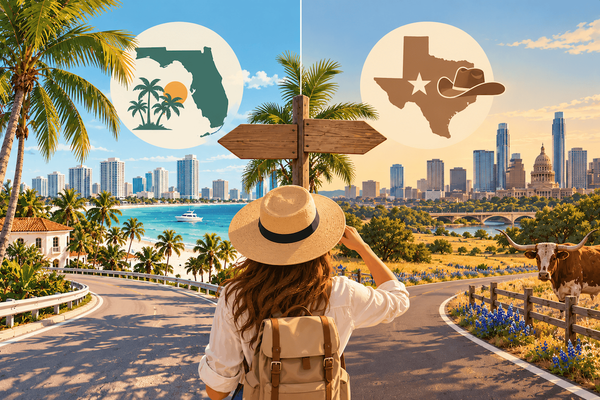
For nomads and expats choosing a new state strategically, Florida and Texas are the two most accessible no-income-tax options with established infrastructure for people who are not physically present full-time. Both offer a clear, documented path to a new legal home base.
SavvyNomad handles the domicile setup for both states: the residential address, the Declaration of Domicile, driver's license guidance, and mail forwarding that keeps your US home base running while you live anywhere.