
Dual tax residency for US citizens abroad: what it actually means
US citizens living abroad are always in dual tax residency. But treaty tiebreakers rarely help; the savings clause preserves US taxing rights regardless. Here's what actually eliminates double taxation, and when treaties genuinely apply.

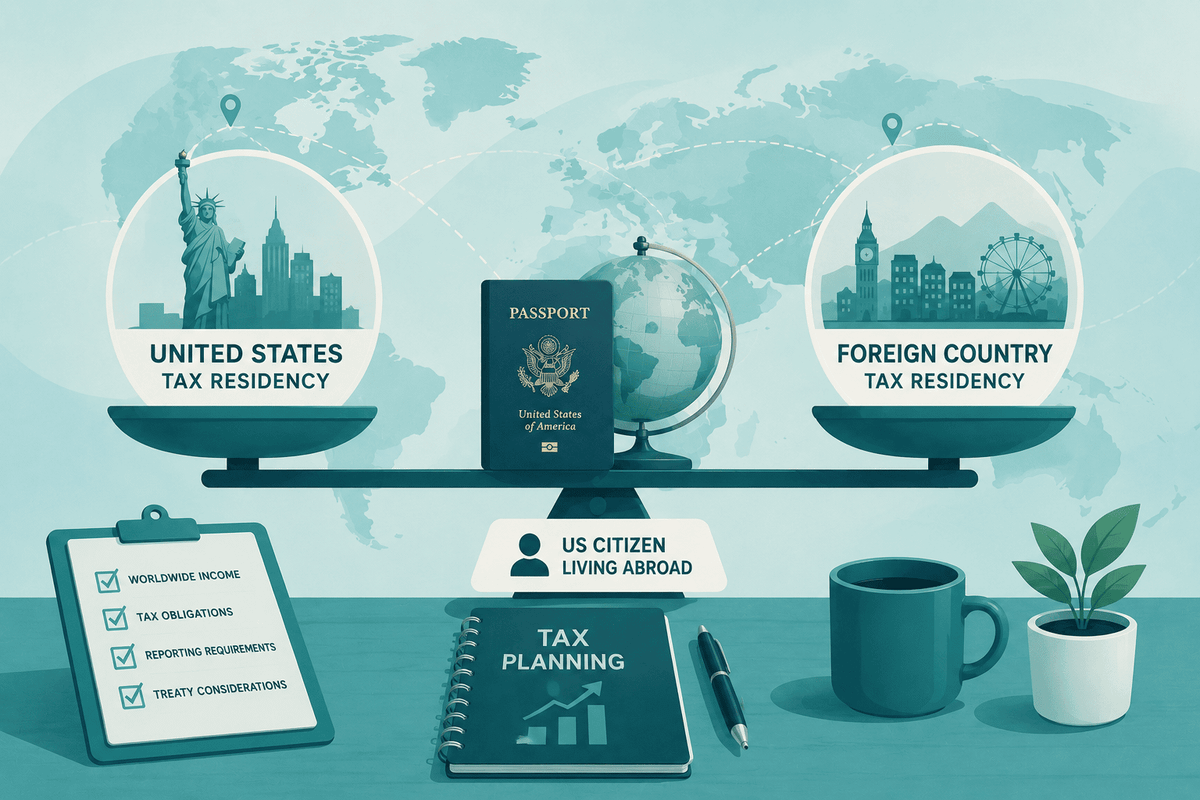
If you live abroad and pay income tax in your host country, you are likely being taxed by two countries on the same income. Both have a legal claim on your earnings. The question is what you can do about it.
The answer is not to invoke a tax treaty tiebreaker and declare yourself a resident of only one country. For US citizens, that generally does not work. Understanding why is the starting point for actually solving the problem.
This guide explains what dual tax residency means for US citizens specifically, why treaties are more limited than most people expect, and which tools actually prevent double taxation in practice.
US citizens are US tax residents by definition. Moving abroad adds a second country's tax residency on top. The primary tools for eliminating double taxation are the Foreign Earned Income Exclusion (up to $132,900 per person for 2026) and the Foreign Tax Credit. Most expats owe zero additional US tax after applying these. Tax treaties can help in specific situations, such as social security allocation and pension treatment, but the savings clause in virtually every US tax treaty preserves the US right to tax its citizens on worldwide income. Treaty tiebreaker rules generally cannot be used by US citizens to avoid worldwide US taxation. Green Card holders face an additional risk: invoking a treaty tiebreaker may trigger the exit tax under IRC Section 877A. Use FEIE and FTC first. Then look at specific treaty articles for income types they do not fully cover.
What dual tax residency means for US citizens
Most countries determine tax residency by physical presence or domicile. Spend enough time in Germany or Spain, establish your life there, and those countries claim the right to tax your income as a resident.
The United States does not work this way. The US uses citizenship-based taxation. Every US citizen is a US tax resident regardless of where they live. No physical presence in the US is required. No domicile test applies. Moving to Portugal does not end US tax residency. It adds Portuguese tax residency on top.
This means virtually every US citizen who lives abroad long enough to become a tax resident in their host country is in dual tax residency. Two countries have overlapping legal claims on the same income. This is the default situation for most expats, not an edge case.
Being a tax resident of two countries does not automatically mean paying full tax in both. The mechanisms that prevent double payment are the focus of the rest of this article.
The savings clause: why tax treaties are more limited than most people think
This is the concept most expat tax guides get wrong by omission. Understanding it prevents a costly mistake.
What the savings clause is
Almost every US income tax treaty contains a savings clause. This provision allows the US to tax its citizens and residents as if the treaty had never entered into force.
In plain terms: the US reserves the right to tax your worldwide income even if you live in a treaty country, even if that country also taxes you as a resident, and even if the treaty would otherwise reduce or eliminate US tax on specific income.
This is why dual residency for a US citizen differs from that of a foreign national who moved to the US. A German national who became a US tax resident can use the treaty tiebreaker to establish residency in one country for tax purposes. A US citizen living in Germany generally cannot do the same thing in reverse.
What this means in practice
A US citizen living in France, the UK, Japan, or Germany cannot invoke the treaty tiebreaker to declare themselves only a foreign tax resident and thereby escape US worldwide taxation. The IRS still requires a full Form 1040 reporting worldwide income. The treaty tiebreaker does not change that obligation for citizens.
What is excepted from the savings clause
Specific treaty articles are carved out from the savings clause. These vary by treaty but commonly include:
- Social security and government pension allocation
- Certain pension and retirement income articles
- Teacher and student provisions
- Government employee income
These carve-outs are treaty-specific. The same article may exist in one treaty and not another. Always check the actual treaty text rather than a summary.
The tools that actually prevent double taxation
After understanding what treaties cannot do for US citizens, the solution becomes clearer. Two tools do most of the work.
Foreign Earned Income Exclusion
The FEIE excludes up to $132,900 of foreign earned income from US taxable income for 2026. Married couples where both spouses qualify can exclude up to $265,800 combined.
The FEIE does not prevent the host country from taxing your income. It prevents the US from taxing the same income again. The result is that you pay tax in your host country and owe nothing additional to the US on that portion of income.
The foreign housing exclusion adds further relief. For 2026, it allows expats to exclude qualifying housing costs above a base amount, up to $39,870. This covers rent, utilities excluding telephone, and renter's insurance. It is claimed on Form 2555 Part VI and requires meeting the same qualifying test as the FEIE.
Two important limitations apply. First, you must meet either the Bona Fide Residence Test or the Physical Presence Test to qualify. Second, self-employment tax still applies even when income is excluded. Many freelancers and remote workers are surprised by this.
The FEIE works best in low-tax or no-tax countries, where foreign taxes are low and the exclusion eliminates most US liability without needing a credit.
Foreign Tax Credit
The Foreign Tax Credit credits foreign taxes paid against US tax liability on the same income, dollar for dollar.
If you pay $15,000 in income tax to Germany and owe $12,000 to the US on the same income, the credit eliminates the US liability entirely. The remaining $3,000 in excess credits can be carried back one year or forward ten years.
The FTC works best in high-tax countries. When foreign taxes equal or exceed US rates, the credit wipes out the US bill.
The FTC also covers income types the FEIE does not. Investment income, rental income, and other passive income cannot be excluded under FEIE. The FTC can offset US tax on those income types.
The practical result
According to IRS data from 2016 to 2021, 62% of Americans filing from abroad owe zero federal taxes after applying FEIE and FTC. Most double taxation is resolved at this level. Treaties become relevant for specific income types that FEIE and FTC do not fully address.
When US tax treaties do help US citizens
Treaties are not useless for US citizens. They add value in specific situations.
Reduced withholding on passive income
Many treaties reduce withholding rates on dividends, interest, and royalties paid from foreign sources to US recipients.
Under the US-UK treaty, dividends are withheld at 15% rather than the 30% statutory rate. Interest may be withheld at 0%. These reductions are claimed at the source level and typically do not require Form 8833.
Social security allocation
Several treaties specify which country has exclusive taxing rights on social security payments. Under the US-Germany treaty,
US Social Security received by a German resident is taxed only in Germany. This is a genuine savings clause carve-out that reduces US tax for qualifying US citizens abroad.
Pension and retirement account treatment
Some treaties protect the tax treatment of home-country retirement accounts or specify favourable treatment for pension distributions.
The US-UK treaty's treatment of certain pension lump sums under specific conditions is one example. Without treaty protection, foreign retirement accounts can trigger complex PFIC or grantor trust rules.
How to identify what your treaty offers
IRS Publication 901 summarises US tax treaty benefits by country. The treaty text itself, available on the IRS and Treasury websites, is the authoritative source.
The key question for each article is whether it is explicitly excepted from the savings clause. If it is not, it likely does not apply to you as a US citizen.
How to claim treaty benefits: Form 8833
When you take a treaty-based return position that modifies how US tax law otherwise applies, Form 8833 must be attached to your return.
Common situations requiring Form 8833 include claiming that a specific pension or social security payment is taxed exclusively in the foreign country under a treaty carve-out, or claiming a modification to how specific income is sourced or taxed under a treaty article.
Form 8833 is not required for the Foreign Tax Credit. It is not required for reduced withholding claimed at the source level. It is specifically for return positions that change how the Internal Revenue Code would otherwise apply.
The penalty for failing to file Form 8833 when required is $1,000 per unreported position for individuals. Attach the form to Form 1040 by the return deadline, including extensions. The form requires the treaty country, the specific treaty article number, the income amount, and a factual explanation of why the treaty position applies.
Warning for Green Card holders: the tiebreaker trap
Green Card holders are taxed on worldwide income the same way US citizens are. Unlike US citizens, they can technically invoke treaty tiebreaker rules. But there is a serious and often unrecognised risk.
A Green Card holder who has held the card for at least 8 of the last 15 years is a long-term resident under US tax law. If such a person invokes a treaty tiebreaker to claim foreign residency, the IRS may treat this as voluntary termination of US residency. That triggers the exit tax under IRC Section 877A.
The exit tax treats all worldwide assets as sold at fair market value on the day before residency terminates. Gains above the annual exclusion are taxed at capital gains rates. The result can be a significant and unexpected tax bill, arising from a filing decision the person did not realize had that consequence.
This is one of the most dangerous unintended consequences in cross-border tax planning. Green Card holders approaching 8 years of residency, or who are already long-term residents, should get specific professional advice before invoking any treaty tiebreaker position.
Countries without US tax treaties
The US has income tax treaties with approximately 70 countries. Several popular expat destinations have no treaty: Brazil, Singapore, Hong Kong, the UAE, Thailand, Vietnam, and Indonesia.
For expats in non-treaty countries, FEIE and FTC are the only available double-taxation relief mechanisms. There are no reduced withholding rates, no social security allocation provisions, and no pension carve-outs.
This does not make double taxation unavoidable. FEIE and FTC resolve most situations for most income types. But for income that neither tool covers, there is no treaty-based backstop. That gap is worth knowing before choosing a destination country or structuring income streams.
Frequently asked questions
Am I being taxed twice as a US citizen living abroad?
Both countries have the legal right to tax you. In practice, FEIE and FTC eliminate most or all US tax on foreign-earned income for most expats. The legal claim exists. The actual double payment usually does not. FEIE vs Foreign Tax Credit
Can I use a tax treaty to avoid US taxes?
Generally no. The savings clause preserves the US right to tax its citizens on worldwide income regardless of where they live. Specific articles are exempt from the savings clause, including social security allocations and some pension provisions, but the general income exclusion is not available to US citizens under treaties.
What is Form 8833 and when do I need it?
Form 8833 is the IRS disclosure form for treaty-based return positions. It is required when you claim a treaty benefit that modifies how US tax law otherwise applies. It is not required for FEIE or FTC claims.
Does a tax treaty mean I don't have to file a US return?
No. Living in a treaty country does not remove the US filing obligation. US citizens file Form 1040 annually and report worldwide income regardless of treaty position.
Does FBAR still apply if I claim treaty benefits?
Yes. FBAR and FATCA reporting obligations apply to US citizens regardless of any treaty position. Treaty positions affect tax liability. They do not affect information reporting requirements.
What if my country has no tax treaty with the US?
You rely on FEIE and FTC for double-taxation relief. These tools resolve most situations. For income types they do not fully cover, there is no treaty-based alternative.
Conclusion
Dual tax residency is the default situation for US citizens living abroad. Both countries have legal claims on your income. The tools that resolve this in practice are FEIE and the Foreign Tax Credit.
Together, they eliminate US tax for the majority of expats. Treaties add value in specific situations, primarily social security allocation, certain pension articles, and reduced withholding on passive income. They do not offer a general escape from US worldwide taxation. The savings clause prevents that.
Start with FEIE and FTC. Then assess whether a specific treaty article applies to income types it does not cover. For anything beyond the standard tools, professional guidance makes the difference.