How to prove US residency without utility bills
Learn how to prove US residency without utility bills. Discover alternative proof of address documents banks and institutions may accept.

Want to open a bank account, apply for some government benefits or prove who you are? An address is required for all of these things. And what has an address and your name? A utility bill!
Not everyone has their name on the utility bills. This might include: digital nomads, people living in short-term rentals or shared accommodation, students living with their families or flatmates. Luckily, there are loads of other documents that prove your name and address.
Each institution has its own regulations regarding proof of address for a resident. In this guide, we will explain how to prove your address without a utility bill and which alternative documents you can use.
TL;DR
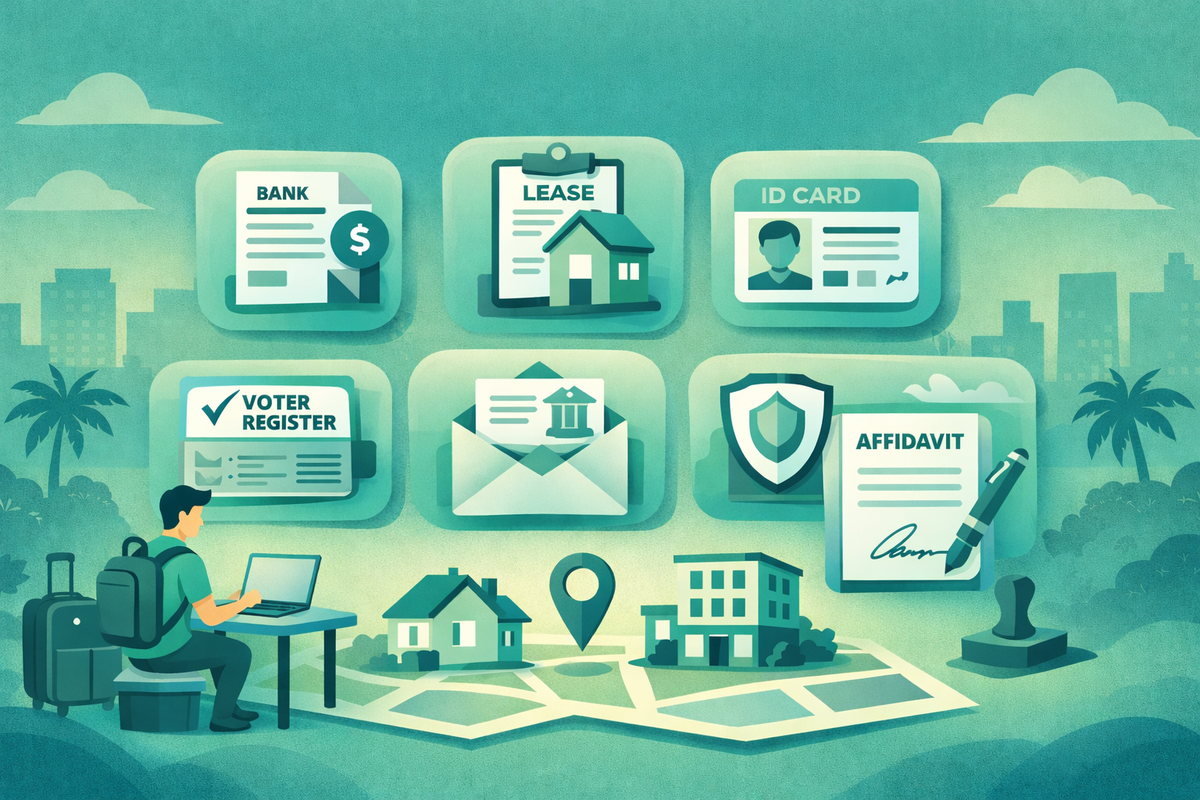
Common alternatives are: Bank Statement with your Name and Address, Tenancy Agreement or Rental Contract, Government ID with your Address, Official letters from any Government department (for example, tax letters, Social Security letters, vehicle registration), Insurance Statement, or Financial Statement, and Notarized Residency Affidavit.
Banks and other institutions request documentation to verify your address when undertaking KYC/CIP checks. Please note that each state and institution is different and may request different forms of proof of address.
Having your recent documents in order, matching your name and address, and having multiple proofs of ID can help when being verified.
What institutions usually mean by “proof of US residency”
Before you collect your documents, it helps to know what organizations mean when they ask for proof of US residency.
These terms are sometimes used as if they mean the same thing, but there are some differences between them.
Proof of address
Proof of address is a document that shows your name linked to a specific address. You often need this when opening a bank account or signing up for services.
Examples of proof-of-address documents are bank statements, government letters, and insurance documents.
Proof of US residency
Proof of residency usually means showing that you actually live at a specific place. Organizations use this to verify your identity or determine whether you qualify for certain services.
Proof of domicile
Proof of domicile shows where your permanent legal home is, often for legal or tax reasons. This can involve more than just giving an address.
Banks, financial companies, and government offices may use these terms differently, depending on their own rules.
KYC (Know Your Customer) and CIP (Customer Identification Program) are procedures your bank may complete to verify your street address. Banks have to confirm your identity to verify you and complete anti-fraud processes. Banks primarily seek your street address, rather than your mailing address.
Since each organization sets its own rules, the documents it accepts as proof of US residency can vary.
Why some people don’t have utility bills
Utility bills are often used to check addresses because they are official and linked to a specific property. But many people don’t get these bills in their own name.
This often happens if you live with family or roommates, rent short-term, stay in shared housing as a student, or travel a lot as a digital nomad.
People who have just moved or expats living abroad may not have utility bills either. In these cases, organizations may accept other documents that link your name to your address.
7 common alternatives to utility bills for proof of US residency
If you don’t have a utility bill, other documents can help prove where you live. The documents accepted depend on the institution reviewing them.
Here are some types of documents organizations may accept as proof of US residency.
1. Bank statements
A bank statement in your name with your current address on it may verify your address.
Most places want a statement from the last 30 to 90 days. It should usually include:
- your full name
- your residential address
- the issuing bank or financial institution
- the statement date
To reduce the risk of delays, ensure the address on the statement corresponds to the one you provided during the application process.
Under many financial compliance rules, banks must collect a residential address rather than a mailing address. Since rules can vary, each place decides whether your bank statement is sufficient for their checks.
2. Lease agreements or rental contracts
A signed lease can prove that a particular address is the location of your primary residence or principal place of business.
Lease documents usually include:
- the tenant’s name
- the property address
- the rental start date
- signatures from both tenant and landlord
Some landlords and letting agents may request some extra documentation in addition to the agreement that you will be renting the property. This may include copies of your passport and or proof of 6 months bank statements along with evidence of your 6 months’ rental payments.
3. Government-issued ID with address
Some government IDs show the address listed on file and can be used as proof of US residency as long as the ID is current.
Examples include:
- driver’s licenses
- state identification cards
- national ID cards
If your current address does not match the address listed on your ID, they may require additional documentation.
4. Voter registration records
In some areas the voter registration records may reflect your connection to an address.
You have voter registration but what makes it valid? The voter registration card is basically a supporting document to prove eligibility to vote, and the requirements are different for every voting precinct or location.
5. Official government correspondence
Letters or documents from government offices can sometimes be used to prove your address.
Examples include:
- tax authority correspondence
- Social Security letters
- immigration documentation
- vehicle registration records
These papers show that a government office has your name linked to a specific address.
6. Insurance or financial statements
Some places may accept financial or insurance documents as proof of your address.
Examples may include:
- health insurance statements
- car insurance policy documents
- pension account correspondence
- investment account statements
As with other documents, it depends on the organization whether these are accepted.
7. Affidavit or proof of residency letter
In some cases, organizations may accept a notarized letter confirming your address.
An affidavit is usually a written statement confirming that a person lives at a particular address. It may include:
- confirmation from the property owner or primary tenant
- identification documents from both parties
- additional supporting documents
Whether these letters are accepted depends on the organization and your location.
Proof of US residency for banks and financial institutions
Banks and financial institutions are required to follow regulations created to reduce fraud and financial crime.
Two common compliance models include Know Your Customer (KYC) procedures and Customer Identification Program (CIP) requirements we mentioned earlier.
These steps usually involve checking who you are and getting your residential street address.
As part of these checks, banks may ask for documents that show your name and address together. The exact documents they accept can vary by bank or platform.
It is not unusual for policies to change and institutions revise their policies on a regular basis. We always suggest that clients check the institution’s policy before submitting official documents.
How digital nomads and expats usually handle proof of address
Digital nomads and expats, can face extra problems when trying to prove their residency and address. Being considered resident by your country of choice means you have certain rights and obligations to that state and taxes included. So you really want to understand how a country or state considers you a resident or has deemed you to be at an address.
Common approaches may include:
- Maintaining a residential address: some expats keep a residential address in their home country, sometimes tied to family real estate or a permanent residence.
- Using family property addresses: living with family or using a family address will help you keep documents that show you live at that address.
- Long-term rental agreements: long-term rental contract may become an official document which confirms an address where you reside.
- Address documentation for financial or administrative purposes: some people keep records such as bank statements, insurance letters or government letters which show their address.
Each organization has a slightly different way of reviewing documents and may request additional information at any time.
Tips for preparing residency documents
Get your documents in order to confirm your address. We've got some top tips to help make this as simple as possible.
Keep documents recent
Most organizations request documents from the past 30 to 90 days. The more recent the documents, the less likely you will be asked for additional documentation.
Ensure names and addresses match
Name and address on identification documents must match the name and address given on any application, request or verification.
Maintain multiple supporting documents
Multiple records verifying the name and address listed on the application may be helpful.
Update your address on official records
Letting banks, government offices or insurance companies know that you have moved can help you on a future occasion when they ask to verify the address at your former location.
These steps won't guarantee success, but they should help document your residency for good measure.
When proof of residency may be required
Sometimes, the people and places we interact with want to confirm our residency (also known as your address). They do this in order to confirm our identity and to determine whether a particular program or service is available to people living at your address.
So how do they figure all this out? They often ask for proof of residency in the form of a document that shows our address on it.
Common examples include:
- opening a bank account
- creating a brokerage or investment account
- applying for a driver’s license or state ID
- completing tax residency documentation
- registering for government services
- immigration or visa processes
Each organization sets its own record requirements and verification procedures.
Summary
Institutions often ask for utility bills to check your address. But many people don’t have utility accounts in their name because of their living, travel, or rental situations.
In these cases, you can use other documents to prove where you live. Bank statements, leases, government letters, insurance documents, and other official papers can link your name to your address.
Because verification policies vary between organizations, documents accepted in one situation may not be accepted in another. Check the institution’s requirements for proof of residency to find out which records are suitable. Some digital nomads choose to establish domicile in states with favorable tax rules.
Having recent documents that clearly show your name and address can help with the verification process.