Is being a digital nomad legal? The honest answer
Is the digital nomad lifestyle actually legal? This guide explains visa rules, tax obligations, and common risks so you can work abroad with more clarity.

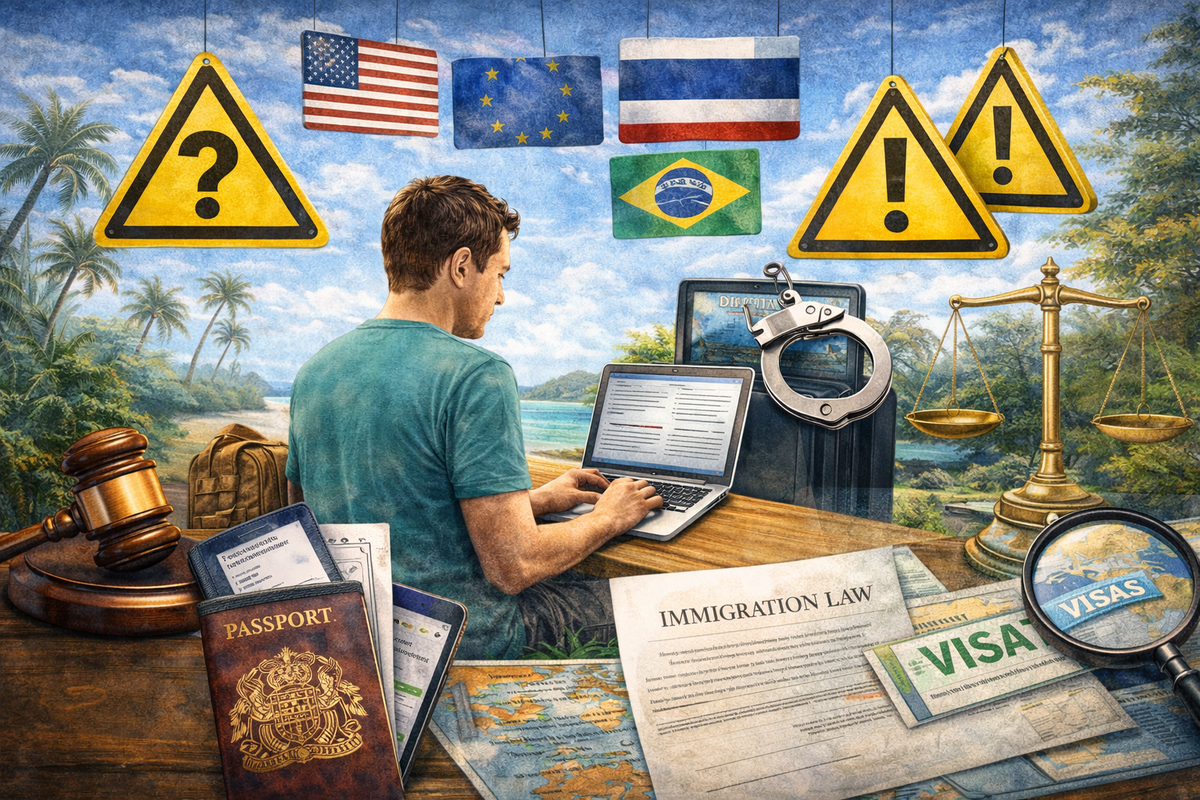
The idea of working from anywhere sounds simple. You open your laptop, connect to Wi-Fi, and earn a living while moving between countries. For many people, that’s the appeal of the digital nomad lifestyle.
But once you start looking deeper, a question comes up quickly: is it actually legal?
The honest answer is not as straightforward as yes or no. Being a digital nomad is not inherently illegal, but it often exists in a grey area shaped by visa rules, tax laws, and how your income is structured.
Some people travel for years without issues. Others run into problems with visas, taxes, or banking. The difference usually comes down to how well they understand the rules behind the lifestyle.
This guide breaks down what “legal” really means in this context, where the risks are, and how to approach digital nomad life more responsibly.
Digital nomadism is legal and not inherently incriminating, yet, with its many appeals and temptations, it can exist in an almost illicit state. At the core of that are three words: visa, taxes, and income.
Most nomads choose to enter a country on a tourist visa and start working remotely immediately. It’s becoming more common over time, but it's still not officially allowed for those visiting on a tourist visa. Some countries now offer digital nomad visas, which make it easier to enter and are specifically designed for remote workers with certain income requirements and some paperwork involved.
So, you’ve moved abroad. Don’t imagine you’ve left taxes behind, because if you are a U.S. citizen, you are required to file an annual tax return whether you’re at home or abroad. You may also have tax obligations in the country where you live.
Now that we’ve successfully navigated the Australian visa applications, it’s worth remembering that there are additional rules to be respected. It is recommended to understand the guidelines properly, select the most relevant visa whenever possible, and meet all tax and compliance obligations.
What does being a digital nomad actually mean?
So what is a digital nomad? They are travelers around the world who work in some form of digital work and can be based almost anywhere. There are many different types of work that digital nomads do.
Some are paid by the hour as freelancers, providing services to clients worldwide. Others are full-time employees who can work remotely from anywhere in the world. And finally, there are people who work building websites or apps for profit, or starting up their own businesses while traveling abroad.
There is a common thread across all these posts: income is not location-specific. You can live in Spain for a month, then Thailand, and still work with your clients or get a wage from your employer.
Immigration and tax laws were generally written with the assumption that a person lives and works in one country at a time, but with the growing trend of the digital nomad or Location Independent Worker, this doesn’t always have to be the case. Most legal systems are not prepared for people who regularly move between locations.
Is being a digital nomad legal?
Is it legal to be a digital nomad? Short answer: yes. Longer answer: yes. There is no law against working online while traveling.
Again, legality depends on how one chooses to split time between countries and compliance with relevant immigration, tax, and work rules in each country.
Now we are entering a grey area. In many cases, what people are doing is neither explicitly allowed nor actively enforced. That does not mean it is risk-free, but many aspects of life today the system has not yet addressed.
Acknowledging the difference between something and permission to do it is important. Something can be common and familiar and feel ‘normal’ without necessarily being allowed.
The visa problem: where things get complicated
For digital nomads, one question usually stands out above the rest when it comes to legal issues: how do you obtain the necessary visas to keep working remotely in different countries?
Tourists with a smartphone often sidestep immigration rules by continuing to work online. As long as you’re not taking Canadians out of work and earning your online wages from abroad, what’s the harm? Turns out, there is some harm.
The problem is that most “tourist” visas aren’t set up to allow for any kind of work, including remote work. Just because the world is moving forward with how we do work doesn’t mean the rules governing visitor permits have caught up.
Please note that, in practice, it varies greatly from country to country. Some countries may never even question you, while others become increasingly strict as they realise that you are living there on a long-term basis and possibly working under an improper visa.
One problem with the immigration system is that, at times, officials may think you are working in a way that violates your visa conditions. In many cases, this can result in serious fines, the cancellation of a visa, or even the refusal of a future visa application.
Where it’s easiest to be a digital nomad
While many digital nomad visas come with high income requirements and complex paperwork, some countries are making things much easier.
Places like Thailand and Colombia offer relatively simple application processes with lower barriers, often focusing on proof of remote work rather than strict income thresholds. In Latin America, Uruguay stands out as one of the most accessible options, with minimal requirements and low fees.
Island destinations such as Mauritius and St. Lucia also keep things simple, requiring only basic documents like a passport, proof of remote income, and health insurance. Meanwhile, countries like Georgia provide a balance of low costs, straightforward applications, and growing nomad communities.
Even in Europe, where requirements are typically stricter, options like Malta offer a more structured and transparent path.
The key takeaway is that while some countries make it difficult, others are actively simplifying the process. With the right research, it’s possible to find destinations where living and working legally as a digital nomad is far more straightforward.
Digital nomad visas: a more formal solution
The growth of remote work has spurred many countries to create “digital nomad visas.” A digital nomad visa is for people who wish to reside in a country and work remotely for employers and/or clients based outside of that country.
Visas specifically designated for digital nomads provide a clearer legal pathway to entering a country and specify how long one can remain there, in contrast to typical tourist visas, which stipulate that any work must be conducted outside the country. In some cases, remote work is explicitly allowed.
In order to issue a Long Stay visa, the Embassy and VISA application centres need to know that you will be able to financially support yourself while in the Schengen country, that you have ties to your home country, that you meet specific requirements set by the country (such as having a minimum income, being currently employed/running a business etc.) and that you won’t overstay your allowed stay in the Schengen country.
Each Schengen country sets its own rules for this type of visa, so please check with the specific country (or countries) you plan to visit to see their requirements in full.
These options offer more stability and fewer immigration issues than a college dorm, but they won’t be available everywhere and don’t solve the tax issue.
Taxes: the part most people misunderstand
Of all the things about the digital nomad lifestyle that are easy and wonderful, taxes are probably the biggest pain point.
For U.S. citizens, being resident overseas does not necessarily mean that you are relieved of your tax obligations. Most U.S. citizens are required to file an annual tax return, whether they live at home or abroad.
You may also have tax obligations in your country of residence while you are abroad, as well as additional tax implications due to your length of stay and residence status.
In some countries, more than one tax is levied at the same time, and measures exist to avoid double taxation, provided the relevant rules and regulations are reported and correctly complied with.
Many digital nomads are unaware that someone might be monitoring their situation. While this may be true, financial reporting entities and international agreements are doing their jobs better than ever before.
Working for a foreign vs U.S. company
Your work structure can also influence how your situation is viewed.
If you are an employee of a company based in your home country and simply working remotely while traveling abroad, your situation from an employment perspective is straightforward. However, your immigration and tax situation is a different story.
For those who are freelancing or operating as a small business, things may have become more complicated due to operating outside the traditional company structure. This means you need to think about whether you are operating through a properly established business (including where it is registered), how books are kept, how tax and VAT returns are submitted and how annual income tax is paid.
But remember, even if you do all your work online, there could still be local issues with your legal status or the way you interact with your clients, depending on the nature of the company you work for.
Banking, residency, and compliance challenges
Even if a digital nomad is happy with their visa and tax situation, there are other aspects of banking and residency that can be quite pesky.
A common problem when opening a foreign bank account is that you are required to provide proof of address (POA). For a digital nomad, this can be quite a challenge. Additionally, some online foreign bank accounts require a US address to activate.
So why do all these issues exist in the first place? These problems are important because they relate to compliance and other institutions, such as banks and financial systems. These other government systems require accurate information about your address and other financial details to process transactions.
Without this essential information, even basic activities such as processing a payment or verifying your identity may become problematic.
What actually happens in real life?
If you talk to digital nomads, you’ll hear a wide range of experiences.
Some people travel for years using tourist visas and never encounter problems. Others face unexpected issues at borders or when dealing with banks and tax authorities.
The reality is that enforcement is inconsistent. Just because something works for one person does not mean it will work for everyone.
Relying on others can create a false sense of security. What matters is how your specific situation aligns with the rules of the countries you’re interacting with.
How to stay on the safer side
Living as a digital nomad doesn’t require perfection, but it does require awareness.
Choosing visa options that align with your activities can reduce uncertainty. Staying informed about your tax obligations, especially as a U.S. citizen, helps avoid problems later.
Keeping your financial records organised and maintaining a clear structure for your work and income also makes a difference. These steps don’t eliminate all complexity, but they help you stay closer to compliance rather than drift further away.
Common mistakes digital nomads make
Many people mistakenly believe they can obtain a tourist visa for a longer stay than is currently allowed under local regulations, or that working in a foreign country exempts them from reporting their income to the U.S. government.
But even with the best of intentions, people may not understand their residency options and inadvertently become liable for taxes in multiple countries.
It's rarely done on purpose. More often, it's because you don't know the facts or because you have been misdirected on advice that, whilst generally correct, isn't in every case.
How SavvyNomad can help
Life can be complicated, especially with so many systems interacting across borders.
SavvyNomad helps Americans living abroad to understand and comply with their U.S. tax obligations. SavvyNomad demystifies the process, explains what is required, and helps its clients organise the necessary information and documents so they can seek assistance from a tax professional or even complete and file their own returns.
Conclusion
So, is being a digital nomad illegal? Not necessarily, but it’s not quite as simple as that.
From a legal standpoint, your options are only as legal as the visas, taxes, and compliance you choose to practice. Often, this way of life exists in a regulatory limbo, with laws and agreements that are not yet adapted to the new realities.
That doesn’t mean you need to avoid it. It means you need to understand it.
You can enjoy the flexibility of remote work while still complying with the rules by having the right knowledge and structure.
FAQs
Is it illegal to work remotely on a tourist visa?
In many countries, tourist visas do not officially allow work, even if the income comes from abroad. Enforcement varies, but it can still carry risks.
Do digital nomads have to pay taxes?
Yes. Most U.S. citizens are required to file a tax return, regardless of where they reside, and there are specific rules for those considered to be residents of foreign countries.
What is a digital nomad visa?
These visas allow you to live in a foreign country while working for clients or an employer located outside the country.
Can I live abroad and not pay U.S. taxes?
For many of you living abroad, there may be a temptation to believe that you are relieved of the obligation to file U.S. taxes each year. But that’s not the case, and in fact, there are some exclusions and special credits available to U.S. taxpayers living abroad.
What happens if I ignore visa or tax rules?
It can cause you a lot of problems, such as getting fined, having any existing or future visas revoked, or having problems getting credit in the future.