
California exit tax explained: what nomads and expats need to know
Confused about the California exit tax? Learn how residency rules work, why leaving isn’t always enough, and how to avoid ongoing tax obligations.

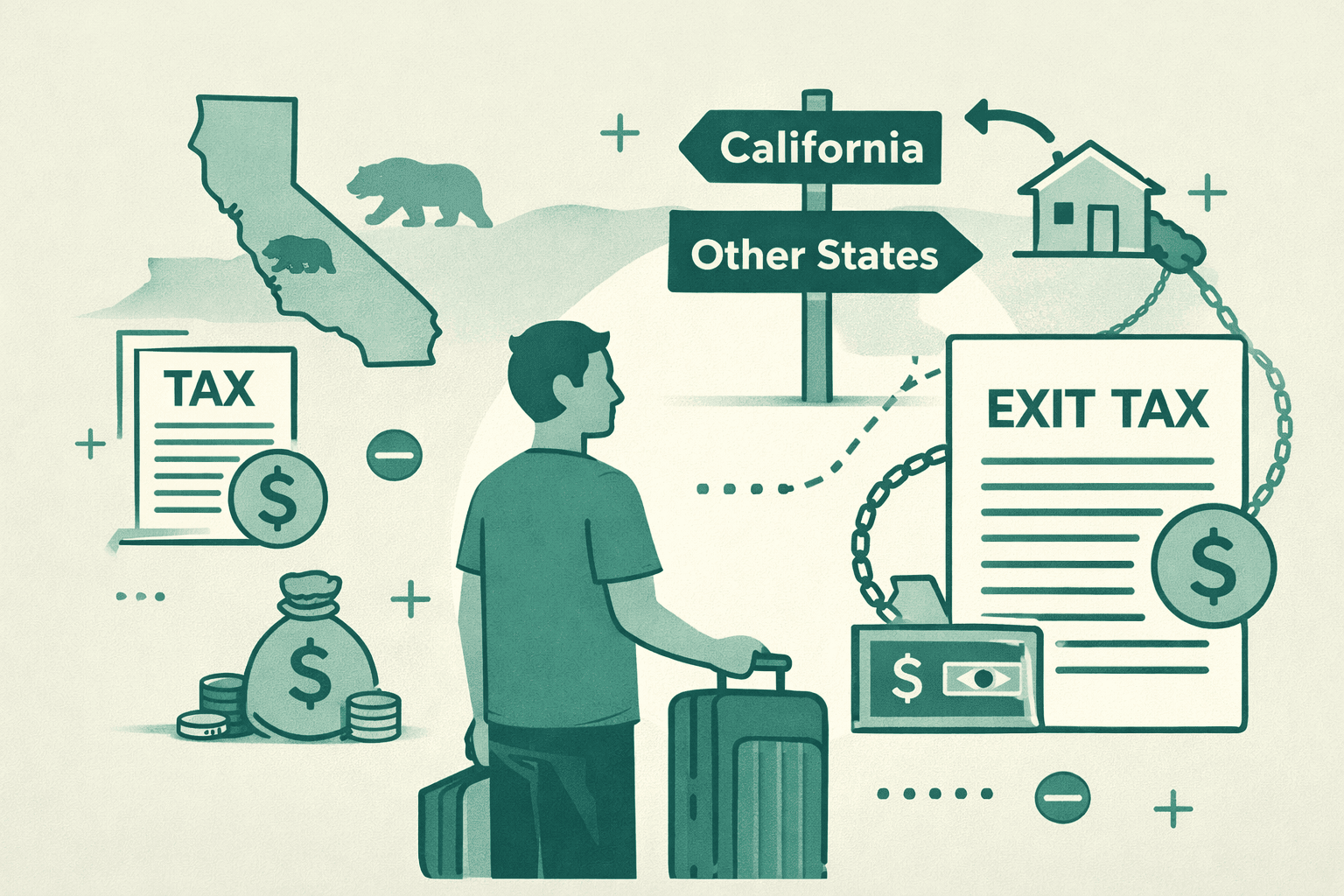
Thinking about leaving California to save on state taxes? You may be surprised by how deep your ties to the state go.
Here, we’ll examine how California's tax laws impact residents considering relocation to clarify financial expectations.
In reality, it’s not always that simple.
Many digital nomads and expats find California difficult to leave for tax reasons. Even after relocating, some may still need to handle California tax filings or audits.
The term “California exit tax” reflects a real concern. California may keep taxing your income if you don’t clearly establish that you’ve left.
Understanding how this works can help you avoid costly mistakes and make a cleaner transition. Take action now to review your ties and position yourself for a smooth departure.
There’s no official California exit tax, but California may continue to tax you if it still considers you a resident after you leave.
Simply moving isn’t enough. The state examines your domicile, time spent, and ties such as address, license, and finances.
To avoid issues, you need to clearly cut ties with California and establish a new domicile, often in a no-income-tax state like Florida, Texas, or Nevada.
If California challenges your status, the burden of proof is on you. Start gathering proper documentation now and make your transition consistent to avoid audits and ongoing tax obligations.
What is the California exit tax?
There is no formal “California exit tax” in law.
The term describes situations in which California continues to tax you after you’ve left, often when your residency hasn’t officially ended.
If you’ve ever heard the line “you can check out anytime you like, but you can never leave,” it might sound like a joke. But when it comes to California taxes, it can feel surprisingly accurate.
Leaving the state isn’t always simple. The state may still consider you a resident if your ties haven’t clearly changed, even after you relocate.
This matters because California has one of the highest personal income tax rates in the country, reaching up to 13.3%. That creates a strong incentive for the state to scrutinize people who claim they’ve moved away, especially high earners, remote workers, and expats.
California defines residency by domicile and overall connection, not just location. Financial, personal, or social ties may mean you remain a resident even after you move.
The idea of a “California exit tax” exists because leaving requires more than a move; it requires clear documentation showing your life has shifted elsewhere.
Why leaving California can still lead to problems
One of the main reasons the idea of a California exit tax feels so real is how actively the California Franchise Tax Board (FTB) enforces residency rules.
The FTB is responsible for determining whether you still qualify as a California resident for tax purposes. And in practice, they don’t rely on a single factor. Instead, they take a detailed look at your entire situation, including where you live, how often you return, and what ties you’ve kept.
If something doesn’t add up, you may receive a notice or be selected for review. In some cases, this can turn into a full audit. At that point, you may be asked to provide documentation showing where you actually live, how much time you spend in each location, and whether your financial and personal connections have truly shifted away from California.
This process can feel invasive. The FTB may examine travel records, bank activity, property ownership, and even day-to-day lifestyle indicators. The burden of proof is on you, which means you need to demonstrate that you’ve clearly established a new domicile.
People often run into trouble when they assume that moving is enough. In reality, keeping a California address, spending significant time in the state, or maintaining strong financial ties can all be used as evidence that you never fully left.
This is why planning your move matters. A well-documented transition, with consistent actions that support your new residency, can make a significant difference if your status is ever questioned.
Why is California so aggressive about residency?
With California having some of the highest taxes in the country, it has a strong vested interest in ensuring that its taxpayers aren’t chased off to other states with more lenient tax regimes. How far will it go to keep them from fleeing the failing California economy?
Where do I live? At first, this may seem like a simple question, but it is not for the California taxpayer. To determine whether they are still a California resident, California looks beyond a person's physical address and applies a closest-connection standard to determine where a person’s life maintains the most significant connections.
Note that simply leaving California is not enough; the Court will also look to whether there is a growing connection with another state.
Who is most at risk?
The concept of a California exit tax typically affects individuals who maintain significant ties to the state after relocating. Generally, this risk group includes digital nomads, expats, remote workers, and anyone who continues to have family, property, or financial interests in California, even after moving away.
Even digital nomads who visit California, whether for family, recreation, or brief stays, may still be classified as residents for tax purposes.
Expats can still be considered residents and taxed, even if they don’t have new housing: keeping a residence, driver’s license, or bank accounts may maintain residency.
For those who work from home, remote employees may also be subject to California law, especially if they work for a California-based employer, in addition to any other connections they have to the state.
The more ties you maintain, the harder it is to prove you’ve established a new domicile.
How California determines residency
California does not rely on a simple rule like the number of days you spend in the state. Instead, it evaluates your situation based on multiple factors.
Time spent in California is still important, but it’s only part of the picture. The state also looks at whether you own or rent property there, where your family lives, and where your daily life is centred.
Things like your driver’s license, voter registration, and mailing address also matter. Financial connections, such as bank accounts or business activity, can further strengthen California’s case.
No single factor determines residency. Instead, the state builds an overall narrative based on your actions and circumstances.
4 common mistakes when leaving California
A major misconception is that moving automatically ends California tax obligations. Many leave without fully cutting ties, creating later issues.
Here are the most common mistakes to avoid:
- Keeping a California mailing address
- Even using a family member’s address can signal that California is still your base.
- Not updating official records
- Holding onto a California driver’s license or voter registration weakens your claim of leaving.
- Spending too much time in California
- Extended or frequent stays may suggest the state is still your primary residence.
- Maintaining strong personal or financial ties
- Things like local bank accounts, subscriptions, or services can reinforce California connections.
Individually, these may seem minor. But together, they can make it much harder to prove that you’ve truly left California. Act now to review and update your records to strengthen your case.
You can actually read people’s real stories on Reddit about the California exit tax:
Comment
by u/maybefoolmetwice from discussion
in TaxQuestions
Removing CA tax residency when moving abroad
by u/cni23456 in ExpatFinance

What income can California still tax?
Even after you leave California, you may still be required to pay tax on certain income.
California may tax income earned while present in the state or from property or businesses there, regardless of location.
For remote workers, the story can be even more complicated. If an employee works 100% outside California, the pay may not be considered California-source income. But even then, the employee may be subject to a California review of their circumstances.
In addition to being concerned about any federal limitations on the foreign earned income exclusion, taxpayers departing from California should also understand which types of income are considered California-source income.
How to properly cut ties with California
To avoid California exit tax issues, show a clear, marked departure from the state.
1. First, you must establish a new physical domicile (residence) in a state or even a foreign country and demonstrate that you truly live there. Many individuals choose states such as Florida, Texas or Nevada (no state income tax) to establish their new home.
2. Take plenty of photos and commemorate your transition! But don’t forget the other important steps to leave the past behind.
3. Update your records with the relevant authorities by applying for a new driver’s license, registering your new vehicle, and notifying your state or local election office to update your voter registration information.
4. Remember that, in addition to finding a place to live, your new house and neighborhood should also serve as the base for your new financial and administrative setup. Make it a priority to update your bank details, contact information with all insurance providers, and basic account details today to ensure a complete transition.
5. In addition to updating your address with Amazon and displaying packages with appropriate California foreign packaging, you should also limit your time in California to avoid any suspicion of residency. Occasional trips are fine, but if you're spending too much time there, Amazon may think you actually live there.
The aim is to tell a consistent story of a new dwelling.
Moving abroad vs moving to another state
Contrary to what you may read, moving abroad is NOT necessarily the solution to your California exit tax issue.
Did you know that even though you may have left California, the state could still consider you a resident if you have sufficient ties to the state?
Unlike many countries, almost every level of taxation in the U.S. centers on the concept of States and Provinces. If you are outside the country, your home state can assert that you are a California domiciliary if you haven’t affirmatively established an alternative domicile.
Moving to a different state can make the whole thing easier if you take the necessary steps to show your residency to the state you are moving to.
What happens if California challenges your status
California may conduct a review or audit if they believe you are a resident.
When voting outside your state of residence, proof of departure from the state and the assumption of a new domicile may be required.
Share your new address, add travel plans, and provide updated bank and credit card account information to help demonstrate you are not avoiding service of process. Documentation, such as proof of residence and change-of-address forms, is crucial.
However, we lack evidence to confirm this assertion.
How long does it take to break California residency?
There is no set time period for this to occur.
We are not looking for a specific timeframe for your transformation. We are looking for a consistent demonstration of lasting change.
As you develop a deeper root system in your new place and relationships with that location become more meaningful than those in California, you find yourself becoming more established and secure in your position.
Unlike prior RFCs, which allowed a generous window for implementing changes, this RFC seeks a faster implementation. Consistency and a clear process throughout the documentation are more important than the specific number of months it takes to reach said implementation.
How SavvyNomad can help
The process of leaving California or living abroad can be complicated. But managing your domicile and the tax implications can be less complicated with some careful planning.
SavvyNomad helps Americans abroad understand their obligations and organize the steps needed to establish residency in more tax-friendly states, such as Florida.
SavvyNomad provides guidance on documentation, address setup and more importantly, what you need to demonstrate compliance.
Conclusion
If you've heard of a "California exit tax," you might wonder what that could possibly mean - but what it really means is that you've got to prove you moved somewhere else.
It is very important to establish that you are not a resident of any state, or you could run the risk of that state taxing you on your income.
But that’s not all bad. With a little planning, organization and focus, making the split as smooth as possible is entirely within your grasp.
Many people move from California every year. Let me help make your move as smooth as possible.
FAQs
Is there really a California exit tax?
You may hear this term referred to as “exit tax”, but there is no actual tax levied on the departure of a taxpayer from the state. The term simply refers to California’s continuing treatment of one who is a California resident for tax purposes.
Can California tax me if I live abroad?
Yes, if California determines that you remain a California resident based on your contacts and ties to the state.
Typically, a sworn statement is required to prove a change of residence. Some entities also require a copy of your new driver’s license.
Reside in a new state and establish business relationships and other substantial connections there.
How many days can I spend in California?
There is no firm, evidence-based rule that can establish your residency status; however, being present in California for an extended period can support your residency claim.
What state is best to move to after California?
While many choose to reside in states with no income tax (such as Florida, Texas, or Nevada), whether this is truly advantageous depends on individual circumstances.