How to change your state of residency (without making a costly mistake)
Changing your state of residency can affect taxes, voting rights, and official records. This guide explains how residency and domicile rules work, what steps may be involved, and what to consider before making a move.


One of the most common conversations Americans have with each other when they move to a different state, start a job in another state or become digital nomads is when they should officially change their state of residency. This conversation is becoming more common in today’s remote world.
Your state of residency will affect many aspects of your life, including state income tax, vehicle tags, voting and state services.
But a change of residency is not always a matter of going to a new address. States differ on the factors they consider when determining whether a person has established new residency.
Know the laws in your new state and avoid big misconceptions by understanding state residency laws. This article discusses state residency and related law, steps to obtain new state residency and common mistakes that are made during a move.
Changing your state of residency is more than just moving. States look at factors such as where you live, how much time you spend there, and official records, such as your driver’s license, voter registration, and vehicle registration. To establish residency, you usually need to update your address, ID, and financial records. Since rules differ by state, reviewing the requirements can help you avoid problems when changing your domicile.
Understanding state residency vs domicile
When discussing changing the state of residency, two terms often appear: residency and domicile. While these terms are sometimes used wrong, they have different meanings in many legal contexts.
State residency
A state can consider someone a resident for a number of reasons, including the amount of time the person is in the state, whether the person has a home in the state, and any personal or economic ties to the state.
Some states have statutory residency tests that base residency determinations on factors other than the amount of time an individual is physically present in the state during a year. An example is where a state provides that an individual is a resident if he or she has maintained a home in the state for more than a certain number of days in a year.
Domicile
Domicile refers to the state which an individual regards as his or her home. An individual may have multiple residences throughout the United States, but is only legally considered to have one domicile at any given time.
So when we talk about domicile, the formula we use to determine it is based on several key components, including intent to remain and any ties you have to a home, whether that be real or personal property, as well as any driver’s licenses or voter registrations that may have been issued in a given state.
A person may reside in several places, but the place they live with the intention of making it their permanent home is considered their domicile. There are numerous variations in tax laws and legal regulations across the US, and understanding the distinction between residency and domicile can make navigating these changes easier.
When do you have to change your state residency?
Why would someone change their tax residency? Sometimes people will simply choose to change their way of life. At other times, it will be for tax benefits, ease and other advantages.
Common reasons include:
1. Moving for work
Many people have to move to a different state for work. If you are planning to live in a new state permanently, you will have to become a resident of your current state.
2. Retirement relocation
While many residents choose to age in place, some choose to move from their lifelong homes. Some prefer warmer weather in what are commonly referred to as the Sun states, while others opt for lower cost-of-living regions.
3. Remote work or digital nomad lifestyles
Remote work allows many people to pick up and live where ever they choose - whether that's across the country or outside the normal commute zone for an office. Some people move to a state to match their desired way of life.
4. Lower state income taxes
A couple of factors that people usually consider when thinking about moving to a different state include weather and taxes. Specifically, people sometimes move to states without a state income tax.
5. Access to financial or business services
A common reason for people to relocate is to improve their financial position, gain a legal advantage or to further their business.
While taxes can be a factor in deciding to become a resident, other lifestyle and personal considerations are generally more significant.
States commonly chosen for residency changes
Everyone is interested in learning about moving to another state and becoming a resident there. While there are various opinions and ideas about which states might be a good fit for relocation, some states are mentioned more frequently.
These states include:
- Florida
- Texas
- South Dakota
- Nevada
- Tennessee
These states get attention partly because they don’t have a state income tax.
When considering a move, people often ponder which state they should call home. Different states apply different tax policies and residency rules, which is why many people research the best and worst domicile states for digital nomads before making a decision.
The choice can be based on many things, from cost of living and taxes to climate and even professional sports teams. But moving to a new state is about so much more than taxes. It means dealing with different residency requirements, paperwork and bureaucracy.
Get a local driver’s license, register a car, or deal with other local administrative issues that relate to the fact that you have moved there.
No matter the benefits of a state's tax regime, a resident must always abide by the state's laws and regulations regarding residency.
How to establish residency in a new state?
Laws and requirements for state-to-state moves for residency vary by state and by your specific circumstances. The following is a general overview of common steps taken when establishing residency in a new state.
Establish a physical address
Most states require you to have a residential address in the state.
Renting, buying, or leasing can all be part of this life-changing decision. Having a documented residential address is often a first step in proving residency.
Obtain a driver’s license or state ID
States may have different requirements for residents who move there from another state, including how quickly new residents must obtain a driver’s license or state ID. Your driver’s license is often used as proof of residency.
Register to vote
Registering to vote can help show that you plan to make a state your home.
But voter registration by itself usually isn’t enough to prove residency.
Register vehicles
You may need to get a new vehicle registration and purchase new insurance when you move to a new state.
Most states require you to register your vehicle locally after you move.
Update financial records
When you become a resident you will need to obtain or update a variety of records:
- bank accounts
- insurance policies
- employer records
- tax documents
Making these changes will ensure that your records are up to date so that any of your personal documents can be automatically updated with your new address.
Cut ties with the previous state
If you are moving to a new state, it is important to cut back or remove ties to your old state. Just getting a new address might not be enough if you still have strong connections to where you lived before. Many states, like California, may still see you as a resident if they find signs that most of your life is still based there.
This includes things like keeping a home in your old state, using your old address for important records, or spending a lot of time there. For example, if your driver’s license, voter registration, bank accounts, or tax returns still show your old state, it could make people question if you really moved.
States usually look at your whole situation, not just one document. If your records have mixed or conflicting information, it can be harder to prove you have a new home state. Sometimes, people think they have moved, but their money, legal matters, and personal ties still connect them to their old state.
To help show you have changed your residency, update important documents and accounts to match your new state. This can mean getting a new driver’s license, registering to vote, changing your address with banks and insurance companies, and filing taxes as a resident of your new state if needed.
Since every state has its own rules, cutting ties with your old state and making steady connections in your new one is important for how your residency will be judged.
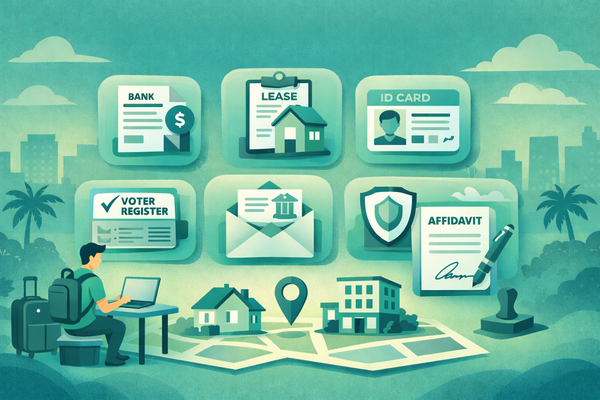
Documentation that may support residency
Each state has its own criteria in determining whether you are considered a resident or nonresident. These factors are used when reviewing applications, and may include some of the documents below.
Examples of documents that may support residency include:
- lease agreements or property ownership records
- driver’s license or state identification
- voter registration records
- vehicle registration
- utility bills showing the local address
- financial statements listing the residence
No one document will confirm residency. Every state has different requirements that consider both documents and individual circumstances.
You will need to provide different documents to each agency or office that has jurisdiction over your case, depending on their particular requirements.
Time requirements and statutory residency rules
Some states use time-based tests to determine whether someone is considered a resident.
Tests that take into account factors such as whether a person has established a domicile in a particular state and the amount of time the person spends in that state during the year.
Example of a physical presence test for residency: the state would consider a person a resident if they maintain a residence in the state and is physically present in the state for 183 days of the taxable year.
Taxes can vary significantly from state to state. Understanding the tax laws for the state where you plan to live is important to your decision to relocate. Tax laws regarding residency can vary widely from state to state. Therefore, it is essential that you understand the rules in your new location.
Common mistakes when changing state residency
Some individuals who are attempting to change their address may find that their efforts are in vain due to misconceptions about the classification of a given place as resident or non-resident.
Several common issues may arise.
Keeping strong ties to the previous state
If you keep strong ties to your old state, it can make it harder to prove you’ve established residency somewhere else.
Examples of such ties may include:
- owning property in the former state
- maintaining official records with the old address
- spending significant time there
States sometimes review these connections when determining residency.
Inconsistent documentation
If your official records, such as your driver’s license, voter registration, or state ID, show addresses that are different than the one you actually live at, you may raise a red flag.
Keeping your ID, financial records, and registrations consistent can help avoid confusion.
Misunderstanding statutory residency rules
One common myth is that moving to another state terminates an individual’s tax residency. While leaving a state may qualify an individual as non-resident for some purposes, each state has its own criteria for establishing residency and non-residency, so it’s possible that another state could still classify an individual as a resident.
For instance, owning a home in a given state and being there for a certain number of days per year may be enough to meet state residency requirements.
Understanding these rules can help people avoid unexpected complications.
Considerations for digital nomads
Although this article is not exclusively directed towards digital nomads and remote workers, there are several additional considerations that such individuals need to think about in terms of state residency for taxation purposes.
World travelers as they are sometimes called, typically maintain a legal residence in some country because of the administrative needs and because of the laws and tax obligations that have to be dealt with in the home country.
Some practical considerations include:
- Maintaining a permanent domicile: Even if you travel frequently, you probably still have a main home or official address that you may identify as your domicile.
- Documentation requirements: Sometimes you may have to give banks, government offices and tax agencies documents that show your identity and residential address.
- Compliance with state tax rules: Your state tax obligations may change if you move to a new state or are considered a resident of more than one state due to your work or travel schedule.
Digital nomads tend to move around a lot, so keeping everything tidy and consistent is a good tip.
When professional guidance may help
Changing your residency can involve a lot of paperwork and legal details. Some individuals choose to consult professionals such as:
- tax advisors
- legal professionals
- financial planners
These professionals can help explain how residency rules apply to your situation and guide you on following state regulations.
Since residency laws vary by state, getting professional advice can help clarify complex situations.
Conclusion
A change of resident state or country can have an impact on the taxation, records and laws to which you are subject. Although moving appears to be a simple and minor change in situation, states have criteria to determine resident or non-resident status.
To get a new home, you will need a street address for the new home, new identification, and other ties to the new state.
Residency rules vary by state, so be sure to research your state's laws before making any permanent moves.
If you're interested in understanding more about residency and domicile and how they may affect your tax situation, then read on. The more you know about these terms and how they are affected by a change of address, the less likely you are to be stung with an unexpected tax bill or have to waste time finding documents.
Frequently asked questions
How do I change my state of residency?
A change of residence is defined as physically moving to another state, obtaining new driver’s licenses and voter registration cards, and providing new documentation of their new address.
What is the difference between residency and domicile?
Residency refers to where you live, while domicile refers to your home. The majority of citizens have one legal domicile, but are considered residents in the states where they live.
The length of time varies by state, but generally ranges from 30 to 60 days or even longer in some cases.
Can you have residency in two states?
You may reside in several states during the course of a year, but at any time you must have only one domicile. The individual states have different rules as to whether they consider you a resident of that state.
Which states are popular for establishing residency?
Thinking of a move to another state? You may be wondering which states are the best to move to. Non-income-tax states like Florida, Texas, South Dakota, Nevada, and Tennessee often come up in conversations. Make sure to verify the rules of the state you wish to call home and understand what documentation you will need to provide in order to be considered a resident of the state.
![Charles Schwab international account for nomads and travelers [review]](/content/images/size/w600/2026/03/charles-schwab-international-account.png)